The Church and Charlottesville: Our Call to Confession and Clarity

(This is the end of a sermon preached at Christ Evangelical Lutheran Church of Millersville. The text was John 3:16, and the first part emphasized God’s infinite and inclusive love for each of us and for the world, the kosmos in the Greek in which John wrote. You can listen to the full sermon here.)
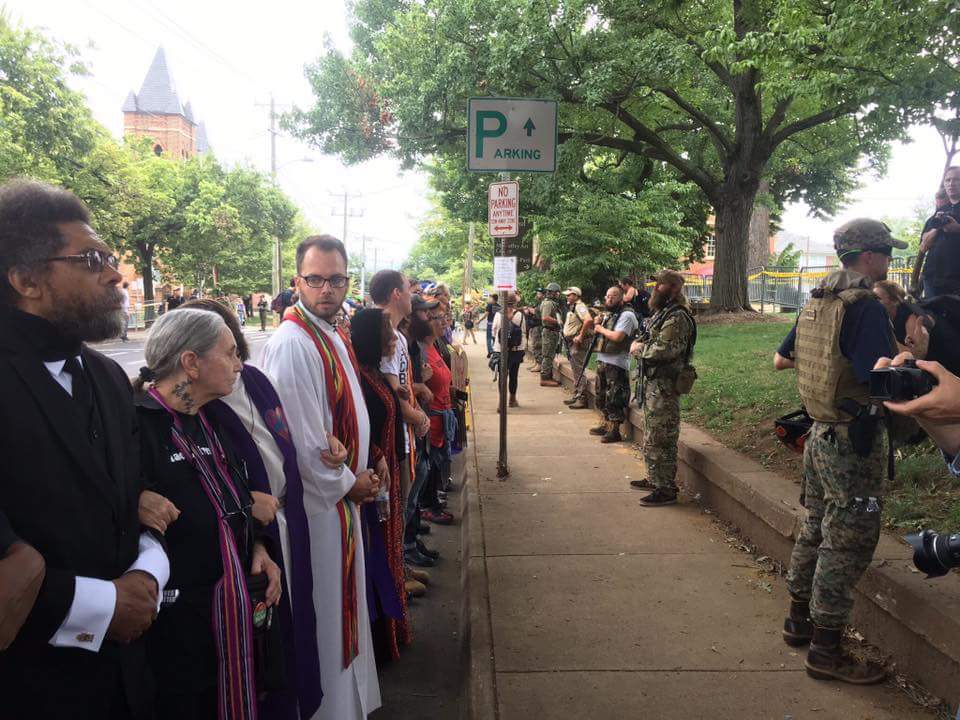
Yesterday in Charlottesville, Virginia, white supremacists gathered to spew their vile hatred of those who are not white, not Christian, and not what they would consider the right kind of American.

But others were there, living out their call to love as God loved. Ministers of the Gospel enacted God’s love by praying and ministering to the the injured and standing in witness to God’s inclusive love – God’s love without boundaries or limits.

I saw a photo on Facebook this morning. On one side are angry people with hateful signs and faces twisted by hatred. Some of them carried clubs and others firearms. On the other side of the photo there is a line of clergy, men and women from across denominations united in the love of Christ.

They stood in silent witness of that love in the face of all that hate.

Our Bishop, Bill Gohl, was there in Charlottesville yesterday.

He has shared that he was especially saddened to see white supremacists wearing and carrying symbols of Christian faith.

Sisters and brothers, the cross is desecrated when it is associated with symbols of white superiority, Nazi Germany, and American slavery.

Jesus died on the cross to defeat sin, including the sin of racism.

The so-called Christianity shouted and displayed by white supremacists in Charlottesville is the opposite of the Gospel.

White supremacy is anti-Christian.
It is anti-Christ.
It is anti-love.

I want you to know, if you are at all confused, that God loves everyone.
No exceptions.

Let’s make this clear.

They marched against people of color.
If you are a person of color, God loves you.

They marched against immigrants.
If you are an immigrant, God loves you.
It doesn’t matter where you are from, whether you are documented or not.
No person is “illegal” in God’s kingdom.
God does not love America or Americans more than God loves the rest of the world.

They marched against LGBT folks.
If your are LGBTQIA, God loves you.
God’s love is not determined or defined by the letter designating your sexual preference or gender.

They marched against Jews. A sign I saw on television read, “Jews are children of Satan.”
If you are a Jew, God loves you.
It is a testament to the ignorance of the racists that they somehow do not know that Jesus was Jewish, as were most of his disciples and earliest followers.

They marched against Muslims.
If you are Muslim, like the gentleman I met a couple evenings ago walking my dogs, God loves you.

And if you are like most of the people who marched – if you are like me – white, Christian, straight, American – God loves you.

And this is the hardest thing for me to say this morning.
If you marched, or agree with those who did, God loves you.

I believe that if those who marched really knew and experienced the unconditional and infinite love God has for each of them, and the wideness of God’s love for the kosmos, they would not need to hate.

God does not love every action or belief that we hold. Actions and beliefs that are contrary to God’s desire and commands are sin. We are called to look at our own sin – as Jesus put it in the Sermon on the Mount, to take care of the logs in our own eyes, not the specks in the eyes of others.

If our response to being confronted with, or realizing, our own sin is to say, “But what about him or her or them,” then we are missing the point. We are missing God’s point.

Our Bishop was interviewed on Fox News yesterday afternoon. He said the church is – we are – complicit because we have failed to stand up and call racism a sin. He said we are complicit because we want to be “nice” even in the face of such horrific things.

As a church that is predominantly white, we must confess and repudiate the sin of white supremacy.

If you don’t believe racism or sexism or any other “-isms” lurk somewhere inside you, you are a better person than I am. I believe you are deluding yourself. “If we say we have no sin we deceive ourselves and the truth is not in us.”

I believe that’s in the Bible somewhere. It’s in the words of our confession.

God calls us to confession not because God needs our permission or our action to forgive us. Forgiveness happened on the cross. Forgiveness became ours in baptism.

God calls us to confession because sin – especially the sin of hate – thrives in the darkness. When our sin is brought into the light of God’s love and forgiveness, it no longer has any power over us.

When I got to this point in writing my sermon Saturday evening, I felt the need to pray. I invite you to join me in prayer:

God, I confess my complicity in systems that divide and discriminate. I ask your forgiveness. Look into my heart and reveal to me anywhere I hold onto stereotypes and prideful attitudes. Bring them into your light and destroy them with your forgiveness. AMEN

Some say we should ignore the hatemongers in Charlottesville and others like them. But when the church is silent, the world assumes such evil is just fine with us.

Too much of the church has been too quiet for too long about the sin of racism.

The Fox News interviewer asked Bishop Bill what he would preach about on Sunday.
The Bishop said he would preach about how the church is called to turn the world upside down.

Yes! We are called to turn the world upside down with God’s love.

Each church is called to be an outpost of Gospel love in a world infused with fear and hatred.

We are not called to gather in our churches and stay there, safe and patting each other on the back for how holy we are.

Each of us is called to be an instrument of God’s love, an instrument of God’s peace.

That doesn’t mean everyone is called to stand witness at marches or preach sermons about the evil of racism.

Our actions can be simple, yet profoundly proclaim God’s love and peace.

We are instruments of God’s love and peace when someone makes a racist remark and we call them out.

When someone tells a supposed joke that perpetuates stereotypes, we are instruments of God’s love and peace when we say, “That’s not funny.”

At school or at work, we are an instrument of God’s love and peace in the lunchroom when we choose to sit with someone who is alone because of who they are.

We are called to act with love the face of hate, with peace in the face of violence.

The church is called to be an example to the world. Diversity is a gift of God to the church. Diversity is central to what church is meant to be.

Perhaps those who marched in Charlottesville haven’t read Galatians 3:28: “There is neither Jew nor Gentile, neither slave nor free, nor is there male and female, for you are all one in Christ Jesus.”

All of this starts with God’s love for us; with God’s love for the world.

“For God so loved the WORLD!”

God loves you.

It is God’s love that empowers us to love.

Karl Barth was a 20th century Swiss theologian. He wrote books with thousands of pages and millions of words. Once when he toured the United States a student asked him if he could sum up his theology in a single sentence.

Barth thought for a moment, then answered, “I can sum it up in the words of a song I learned from my mother.

“Jesus loves me, this I know, for the Bible tells me so.”

(I then began to sing, “Jesus Loves Me.” The congregation joined in.)

AMEN

Posted in Bible, Christian Living, Christianity, Church, Racism | Tagged , , , , | 1 Comment

Goodness and Love Will Follow Me

(This is the final post in my series this week on the six verses of the 23rd Psalm . . . you can start at the beginning with Verse One here.)

Psalm 23:6: Surely your goodness and love will follow me all the days of my life, and I will dwell in the house of the Lord forever.

Wait, I thought it was “goodness and mercy.”

It is . . . in many English translations of this verse.

But it is also, as in the NIV above, “goodness and love.”

Not just that!  Also, “goodness and grace, glory, hope, kindness, steadfast love, loyalty, favor, devotion, righteousness, rejoicing, compassion, etc.”

How can one word mean all those things?

When it is the  Hebrew word Chesed (or Hesed; the “H” sound is gutteral like the end of “Bach”), one word can mean all those wonderful things!

Chesed is one of the most awesome words in the Bible, right up there with the Greek Agape – sacrificial love in action – from the New Testament. Chesed is in fact similar to agape, but not exactly.

Both can be translated “love.” Both mean so much more.

I don’t want this post to become a Hebrew lesson, but look back at that list of English translations for chesed. So much is encompassed in the Psalmist’s declaration that God’s “goodness and chesed” will follow him. His life – our lives – is and are infused with chesed, filled to overflowing so the grace, glory, hope, loyalty, compassion, and so on that  God pours out in us transforms our relationships with others.

And yet, it gets better still. 

Bear with me for one more brief Hebrew digression. The word translated “follows” in most of our English Bibles more exactly means “pursues.” That small difference changes the entire nature of God’s relationship with us, and illuminates our picture of God’s chesed.

God doesn’t just follow me around attempting to shine a little love on my life (ELO shoutout).

No! God pursues me with goodness and chesed.

Most of you reading this blog know there was a significant chunk of my adult life when I actively resisted God’s pursuit. I denied not just God’s goodness but God’s very existence. But God never let go of me, never paused the pursuit.

Too often God is depicted as pursuing us in order to mete out punishment and to smite those who deserve it.

How much more wonderful is our God, who pursues us not with furious anger, but with “goodness and chesed.”

Even though what we really deserve is the smiting.

Becoming one of us was God’s ultimate pursuit of humanity.

He pursued us all the way to the cross.

The night before he died, Jesus gathered with his disciples one last time. He told them he was going to prepare a place for them – and for us. A dwelling place – an eternal home. Then he said he would come back and take them to be with him where he was.

He would take them home.

He will take us home.

Home to the house of the Lord where we will dwell . . .

Forever.

Posted in Bible, Christianity | Tagged , , , , | 2 Comments

A Table in the Presence of My Enemies

(I’m blogging on one of the six verses of the 23rd Psalm each day this week . . . you can start at the beginning with Verse One here.)

Psalm 23:5: You prepare a table before me in the presence of my enemies. You anoint my head with oil; my cup overflows.

Ridiculous!

Sitting down to the table for a meal with my enemies all around. My head may be anointed with oil, my cup may be overflowing, but what is to stop my enemies from blowing me away as I defenselessly dine?

Shouldn’t I take care of my enemies, either fight them or build a wall to keep them out – and to keep me safe – before I eat? How can I enjoy my meal in the presence of my enemies? It is at best simply not good for my digestion.

How are we to interpret this verse?

First, it is important to recognize the shift in the Psalmist’s metaphor. For the first four verses, the Psalmist was a sheep and God was his shepherd. Now, God is a gracious host and the Psalmist is God’s guest.

Hospitality was perhaps the most valued attribute in the time and place the Psalm was composed. That certainly makes sense when there might be some distance between arable land. A traveler depended upon the gracious generosity of the inhabitants encountered along the way.

As Abraham provided for his mysterious visitor in Genesis 18, the host in verse four waits upon – even serves – the guest with food on the table and beverages that overflow their cups.

What a picture!  God as host. God as servant.

“(J)ust as the Son of Man came to serve not to be served, and to give his life as a ransom for many.”

So what about these enemies?

Is this verse about the host’s – God’s – protection from our enemies? Is our enjoyment of God’s provision in the midst of our enemies meant to be both an act of faith and also a sort of taunting of those who would mean us harm?

Perhaps.

But there is a more radical picture that I believe to be more consistent with the Gospel’s depiction of God’s outrageously inclusive love.

What if “in the presence of my enemies” means that our enemies are also invited to the feast?

What if our very enjoyment of God’s feast is meant not to be a rebuke to our enemies, but rather an invitation?

Whether we are talking about food and drink as God’s daily provision, or as the Eucharist meal shared in worship, or as the great never-ending feast of eternity, God’s desire is the same. God – the Most Hospitable Host – yearns for all to gather and share the table.

So perhaps verse five of this great Psalm is not just an invitation to appreciate God’s abundant provision.

Perhaps this verse is also an invitation to . . . invite. For it is you and I who have the privilege of sharing the Good News that God’s sustaining food and overflowing drink are available to all.

Even our “enemies.”

Posted in Bible, Christianity | Tagged , , , , | 5 Comments

For You Are With Me . . .

(I’m blogging on one of the six verses of the 23rd Psalm each day this week . . . you can start at the beginning with Verse One here.)

Psalm 23:4: “Even though I walk through the darkest valley, I fear no evil; for you are with me; your rod and your staff— they comfort me.

I majored in English in college, so I wrote a lot of papers on poems and novels and short stories and so on. Vital to the analysis of a literary work was determining the “Central Idea,” the main theme or message the author was trying to convey. Sometimes that was difficult to determine and subject to debate.

Not in the 23rd Psalm. The Psalmist puts the Central Idea right in the . . . center.

In the original Hebrew, writes Luther Seminary Professor Kathryn Schifferdecker, there are 26 words before and 26 words after the Central Idea of Psalm 23:

FOR YOU ARE WITH ME

When my daughter was a little girl, she used to wake up in the middle of the night and cry out for someone to “Rub my back!” Her back may have been a little itchy, but her primary need was for someone to be with her. She did not want to endure the night shadows and sounds on her own. To have her back rubbed was to have someone with her. And not just any someone, but a parent who she knew loved and trusted her. Thus fortified, she could drift back to sleep (but woe to the parent who stopped rubbing and tried to sneak out before she was asleep!)

“Even though I lie in the darkest bedroom, I fear no monsters and ghosts, FOR YOU ARE WITH ME, your hands and your voice, they comfort me.”

Most of us have outgrown our fears of goblins jumping out of the closet or from under the bed. Our adult fears are more real . . . terrifyingly real. We fear financial failure and broken relationships. We fear incapacitating illness and especially the finality of death. We fear not just for ourselves, but for those we love. We fear our own helplessness, our impotence in the face of situations and circumstances beyond our control.

The world is a scary place. Dark valleys abound.

The Psalm’s picture of a dark valley springs from the shepherd and sheep metaphor. Picture a flock of sheep with their caretaking shepherd bedding down for the evening. They are in the same green pasture which before had been so inviting, perhaps surrounded by rocky hills. As the sun sets behind those ridges, light and vision fade. Predators may prowl in the gloom. Hungry animals as well as humans with nefarious designs strike under the cover of darkness. Death itself lurks there in the shadows.

But the flock is protected by the shepherd who is right there with them. He carries a rod, a weapon. It is not for clouting unruly sheep, but for fending off those who might do those sheep harm. And he carries a staff that guides the flock to safety and is a physical sign of his presence and his nurturing authority.

There is something else about that staff . . . It is shaped like the letter “J,” with a hook at the end. Sometimes despite the shepherd’s best efforts those silly sheep sometimes fall into holes. The hook allows the shepherd to pull them out, gently lifting them back onto the right path.

How much like those silly sheep are you and I? We fall into holes . . . sometimes through absolutely no fault of our own, sometimes into holes of our own making. But God keeps pulling us up and pulling us out. Over and over, we never really learn, at least not fully, to avoid the holes. But God never gives up on us and never stops lifting us up and out.

There is an honesty to the 23rd Psalm, an honesty that pervades the Bible. I told my congregation in a sermon a couple of weeks ago that this honesty is one of the reasons I keep believing that the Gospel is true.

This Psalm – and the Bible – describe the real world, the world as it really is.

Scripture does not paint a picture of a fairy-wonderland where everything works out and nothing bad ever happens to God’s people.  No.

We’re given a warts-and-all picture of the world and especially of humanity. There are dark valleys and plenty of evil. There is no promise or program for avoiding turmoil and strife. Trouble will come to us in this sin-scarred world filled with sin-stained people (people like us!).

God doesn’t promise perfection. Our promise is God’s presence.

FOR YOU ARE WITH ME

The greatest gift of God’s presence is of course Jesus Christ, God as one of us, God with us.

We have Jesus’ no-matter-what promise to be with us always. “Even until the end of the age.”

There is no valley we will ever walk through that will be too dark, no evil we will ever confront that will be too diabolical, that we will not be able to know and to proclaim . . .

FOR YOU ARE WITH ME

Posted in Bible, Christianity | Tagged , , , , , | 1 Comment

He Guides Me Along Right Paths . . .

(I’m blogging on one of the six verses of the 23rd Psalm each day this week . . . you can start at the beginning with Verse One here.)

Psalm 23:3:  “. . .he refreshes my soul. He guides me along the right paths for his name’s sake.”

A questionable translation of this verse provided perhaps my greatest epiphany when I prepared to preach this Psalm last week.

Usually I appreciate Eugene Peterson’s earthy, fresh rendering of Scripture in The Message.  But in the portion of verse three typically translated “He guides me along right paths,” Peterson chose, “You . . . send me in the right direction.”

The subtle difference between guiding and sending opens up the central message of the Psalm.

Years ago I worked as a retail manager. At the record store I managed, I trained employees to be guides, not senders. When a customer entered the store and asked where they could find the Cure’s latest album, Disintegration (like I said, it was years ago . . . but wasn’t the music great!), staff members were not supposed to point in the general direction of the New Wave section. They were not supposed to send them in the right direction.

Instead, employees escorted customers to the music they were looking for. They guided them along, uh, right paths. (The metaphor does break down a little, but stick with me.) Therefore the Cure-seeking customer would feel a glimmer of happiness before descending into the dreary abyss of Robert Smith’s compositions. (I maybe should have saved The Cure for “dark valleys” in tomorrows verse. But I digress . . .)

Of course in the record store we guided rather than sent folks because they bought more stuff when they felt welcome. A friendly escort is certainly more hospitable than impersonal pointing.

Which is why the more precise translation of verse three where God is a guide is superior to The Message’s sending shepherd.

It’s an amazing thing, really, that God is our guide, with us and in us.  God even became one of us.

For many Christians, the Bible is unfortunately misperceived as primarily a book of rules and regulations. God gives us the guidebook for living, and if we follow it God will love us and let us into heaven.

The Bible most certainly contains much about how to live as God’s people in the world. But more than that, and more central than that, is the Good News that we don’t experience life’s journey on our own. God doesn’t give us directions and send us on our way.

No, God walks with us, guiding us every step of the way.

When we get off the “right pathways,” God promises to always bring us back, over and over again.

Like the Lost Sheep in Jesus’ John 15 parable. (The link is to The Message version of the parable . . . I still love you Eugene Peterson!) The Good Shepherd brings back the one lost sheep even though he has 99 others.  When the Shepherd finds the sheep, he doesn’t gesture toward the flock and say, “That way, sheep!”

No! The Shepherd puts the sheep across his shoulders and carries that wayward woolly ungulate back to the right path.

In that way He “restores my soul.” (Did you think I was going to forget the first part of the verse?) The original Hebrew more exactly means “restores my life,” or “restores my being.”  Everything that I am is renewed and restored and even resurrected by my relationship with the Good Shepherd.

Or, perhaps more pointedly, I am restored to who I was created to be.

No matter how I have screwed things up, no matter how far I have strayed from the right path, no matter how messed up I have become, the Good Shepherd never gives up on me and continually guides me back on the “right path” toward living out my call as a child of God in the world.

I am restored even – perhaps especially – when I walk through the dark valleys of life . . . But that’s tomorrow’s verse . . .

Posted in Christianity, Faith | Tagged , , , , | 2 Comments

He Makes Me Lie Down in Green Pastures . . .

(I’m blogging on one of the six verses of the 23rd Psalm each day this week . . . you can read the post on Verse One here.)

Psalm 23:2: “He makes me lie down in green pastures, he leads me beside quiet waters,”

Little tiger did not like going to bed.
Every night when mommy tiger said,
“Bedtime!”
Little tiger would say,
“But I don’t want to go to bed!”

So begins one of my daughter’s favorite bedtime books, aptly named I Don’t Want To Go To Bed! by Julie Sykes and Tim Warnes.

Many of us are like little tiger. We don’t want to take a break. We may not resist going to bed exactly, but that is only because we are so exhausted from our breakneck schedules. Busyness fills our days and we struggle to cram one more thing into our already overloaded calendars.

Peer pressure prods us onward. “You won’t believe how busy I am!”

I didn’t even have time to eat!”

I haven’t taken a vacation in 5 years!”

We don’t want to stop.
We don’t know how to stop.

Thank goodness God sometimes makes us lie down.

I had missed the significance of that verb. But last week on Facebook I posted an invitation for folks to share what the 23rd Psalm means to them. Tim, a pastor colleague, replied, “I always appreciate that the Lord *makes* me lie down beside still waters. Because on my own I don’t make the time. So the Shepherd has to make us sometimes, because she knows we’re headed for a dark valley.”

Lest we get the wrong idea, a shepherd does not “make” his or her sheep rest by bonking them on the head with a stick or a rock. No, the shepherd leads the sheep to a place with green grass to eat and quiet water to drink. It is a sanctuary from hunger, thirst, and predators. There, the sheep can be refreshed and rest. The shepherd may even lie down with the sheep.

This verse is about God’s provision of sustenance, security, and serenity.

In the first verse, we acknowledged that the Shepherd gives us everything we need.

In this second verse, we are reminded that rest is one of those things we need.

The third (or fourth, depending on how you number them) of God’s Top Ten Commandments is “Remember the Sabbath.”  The Hebrew word for Sabbath is rooted in a word that means “stop” or “cease” . . . rest. “Remember the Sabbath and keep it holy” the commandment says.

Rest is holy.

Of course, if we keep going without resting, our bodies will eventually make us take a break. In that children’s book, I Don’t Want to Go To Bed!, mommy tiger allows little tiger to stay up until he finally ends up sleepy and where he needs to be, safe at home in bed.

The same thing happens to us. Without rest we will wear out physically, mentally, and spiritually. The question is, as IT folks ask, is that a bug or is it a feature? Is it a flaw in the way we are put together that we can’t keep going and going? Or is that the way God intended?

I think it might just be a feature.

To stop and rest allows us not only to recharge physically, but also to make space to experience God’s presence and provision. We need to rest – to stop – in order to be freed from the distractions of our busyness that interfere with our apprehension of God’s steadfast love.

We need a break.

We need a break, not just for our body’s sake but for the sake of our relationship with God.

Posted in Christianity, Faith | Tagged , , , , | 6 Comments

The Lord Is My Shepherd, I Lack Nothing

(On Sunday, June 18, I preached about the 23rd Psalm. As I lived with the Psalm in preparation for the sermon, I experienced depth and richness far beyond what I could share in a single sermon. So this week I’ll be blogging on one verse of the Psalm each day.

As I said in the sermon, sometimes we become so familiar with a recitation – the Lord’s Prayer, the Pledge of Allegiance, this Psalm – that we miss the meaning of what we are saying. I invite you to slow down this week as we dig into the verses of this well-known – in some ways perhaps too-well-known – psalm.

I’ll be using the NIV translation. You can find other translations here.)

Psalm 23:1: “The Lord is My Shepherd, I lack nothing.”

How about the audacity of the author[1] of the 23rd Psalm? He claims the Lord – the Great I Am, who is and was and will be, who spoke to Moses out of the burning bush and led the people of Israel out of slavery in Egypt – as his personal shepherd. The Psalmist is most likely an Israelite, one of the Lord’s people, but to say “The Lord is my shepherd” rather than “The Lord is our shepherd” seems at least presumptuous.

But the singular pronoun reflects the intensity of the Psalmist’s relationship with God. This psalm is a proclamation not just of God’s nature but also a confession of the Psalmist’s experience of – and with – God. His God is not a mighty but unknowable mystical being off in heaven somewhere perhaps feeling sorry for the Psalmist when things are tough, but rather a personal presence whose love and care abide through the hilltops and valleys of his life.

Like a . . . shepherd.

Shepherds were ubiquitous in the place and time this Psalm was composed. Perhaps the writer himself worked as a shepherd. He would have known from observation or experience the devotion of a shepherd to his flock. According to Wikipedia, sheep live 10-12 years with some breeds approaching 20 years of life. Because sheep were raised not for premature execution for the sake of mutton stew but rather for their wool, they would live out that life span in the care of their shepherds.  Those shepherds would undoubtedly come to intimately know and maybe even become attached to members of their flock.  Each of those sheep depended fully on the shepherd for food and water and protection.

Sheep are quite helpless on their own.

Our judgment of the Psalmist’s audacity will be tempered when we realize the logical extension of his metaphor.

If God is his shepherd, then he must be a sheep.

One of the most popular and enduring Christian summer camp songs is “I Just Wanna Be a Sheep.” The profound lyrics of the chorus proclaim:

I just wanna be a sheep
Baa, baa, baa, baa
I just wanna be a sheep
Baa, baa, baa, baa
I pray the Lord my soul to keep
I just wanna be a sheep
Baa, baa, baa, baa.

The verses declare things I don’t wanna be – a Pharisee (they’re not fair you see), a Sadducee (they’re so sad, you see) before returning to the enthusiastic affirmation of the desire to be a sheep.

Inspiring!

Except, who really wants to be a sheep?

Sheep are stupid.  A sheep will put its head down in pursuit of tasty green grass and get separated from the herd. On their own, they end up lost, injured, and finally eaten. Better to be predator than prey, right?

Who wants to be helpless and vulnerable and . . . worst of all, dependent! We live in a pull-yourselves-up-by-your-bootstraps culture. “I don’t need anybody” is a declaration to be admired like the so-called self-made man (or woman) on the pedestal who utters it.  “Needy” is a pejorative for both those who are impoverished and those who could use a shoulder to cry on.

Like Herbie the Elf and Rudolph the Red Nosed Reindeer  in the classic Christmas special, we want to be in-de-pen-dent.

The 23rd Psalm is a Declaration of Dependence. The Lord is my shepherd. I am a sheep.

I can’t make it on my own.

Not only does the Psalmist profess total reliance on the Lord, but there is also an implicit confession of community. The apparent singularity of “The Lord is my shepherd” is repudiated by the social character of the flock.

God gives me everything I need. “I lack nothing.” In the context of the shepherd/sheep metaphor, that includes community.

The Psalmist makes it clear that “I lack nothing” because the Lord is my shepherd. Everything I have, everything I am, is a result of God’s loving care.

“I lack nothing,” or in more the more traditional rendering, “I shall not want,” does not imply or promise that I have everything I want. God is a shepherd, not a genie in a lamp. We struggle to separate our wants from our needs. We stress and strive for the things we believe will make us happy. Just one more purchase or experience and we’ll be there.

Acquisitiveness only leaves us ensnared in a consumerist version of Zeno’s paradoxes, never reaching our desired destination of satisfaction.

“I lack nothing” is not an encouragement of the “gimme, gimme, gimme” nature we all possess, but rather an appeal for us to move from greed to gratitude. It is an invitation to shift from wanting more and more to being thankful for what we have. And, most importantly, “I lack nothing” challenges us to transform our perception of the things and opportunities we receive from what we deserve and earn to gifts of God to be used and shared for the sake of God’s name.

“I lack nothing” could be perverted by a prosperity preacher into promised plenteousness, but that is patently not the poet’s point.

As we shall see as we journey through the Psalm, the Psalmist lives and expresses the real world in which there are unfulfilled desires and disappointments and even death. Dark valleys and evil and enemies abound, but the shepherd is with us in the midst of these terrors. We have everything we need.

We have the shepherd. We have the other sheep.

We have God. We have each other.

——————-

[1] The 23rd Psalm is traditionally attributed to David, but like many Bible authorship issues, that is far from settled among scholars. I’ll primarily be using “the Psalmist” to refer to the poet who composed this psalm. And although we can’t say for sure whether the author was male or female, I will be using masculine pronouns consistently.

Posted in Christianity, Faith | Tagged , , , , | 5 Comments

Celebrating Grace – Excerpt from Ten Year Ordination Anniversary Sermon

18527145_294854970967702_7153779643429651786_o

Pastor Dave and Karen

I can identify with Paul’s anger.

In his letter to the Galatians, Paul was angry at anything – or anyone – that contradicted or got in the way of the message of Grace he was called to preach.

Paul had experienced bondage to the law and to sin and death, and he had experienced the joy of freedom that comes with faith in Christ.

He had experienced the walls built between insiders and outsiders, and he wanted the church to experience – and to demonstrate – the awesome inclusiveness of God’s grace.

Yes, I can identify with Paul’s anger.

That is because I can identify with Paul’s experience.

Although I didn’t throw Christians into jail like Paul before I became one myself at 33 years old, I did reject their attempts to tell me about their faith. I made fun of that faith and of them.

I believed, as I have said before, that I was Too Smart for God.

God was for weak, stupid people.

Most of you know the story of how I ended up in church. Karen told me that if I wanted to date her I would have to go to church with her.

She was certainly worth what I considered a wasted hour each week.

You know about how God’s Word worked on me and in me as I sat there with my arms crossed each week.

And you know how, months later, I realized . . .

I believe this stuff!

I did not choose to believe Jesus is for the world – and for me – exactly who he claims to be.

I couldn’t have chosen it.

I WOULDN’T have chosen it.

Why would I want to go back on everything I had said and believed I was? Why would I want to be one of THOSE Christians?

But I could no more choose not to believe in God than I could choose to disbelieve the Law of Gravity.

I experienced faith as a gift.

I experienced GRACE.

Like Paul, I encountered the resurrected Christ. I wasn’t blinded by a bright light. I didn’t hear the voice of Jesus . . .

Except I did . . .

I head the voice of Jesus in God’s Word as it was read and preached. I heard the voice of Jesus in the people of the congregation who welcomed me in spite of my doubts and even my downright disbelief.

And once God created this faith in me, I couldn’t help but (eventually) share it.

Today we celebrate ten years of ordained ministry.

When I first found out this was happening I didn’t like the idea at all.

To be honest, I’m not feeling that great about my ministry right now. I feel I have let the congregation down by being out two months for medical leave, two months when I was not available to you. Now that I am back, I am still only partly here. I know logically that the illness that caused my absence is not my fault, but I’m still working through some guilt that perhaps some of you understand who have been through a serious illness. I am working on that.

But there’s a deeper reason I was at least uncomfortable with today’s celebration.

In the same way being a Christian was not my idea or my doing, neither was being a pastor. No one is more surprised than me that I am here doing this.

Sometimes when people ask me why I wear a clerical collar when many pastors do not, I tell them it’s so when I look in the mirror I can remember that I’m a pastor. (I’m only half-kidding.)

It feels weird being celebrated for something that is not my doing. Neither is anything that’s been accomplished through me during these ten years of ordained ministry my doing.

Anything good I have done or preached is the Holy Spirit working through me.

But perhaps that is the point.

It is not me we are celebrating, but rather God’s grace that has been poured out in me and that I have been called to share with others.

That is something to celebrate. That is a celebration I can get behind.

We celebrate today God’s amazing Grace and the privilege I have of sharing it as an ordained minister in this church.

Like Paul, I get angry when folks try to water down God’s Grace or add requirements for our salvation to it. You know I haven’t been shy in sermons and Bible Studies and conversations about calling out those preachers and Christian leaders who would dilute God’s grace by telling folks what they need to do so God will love them or worse, the types of people God does not love and accept.

But it’s on our sign out front . . .

GOD LOVES EVERYONE
NO EXCEPTIONS

You see, like Paul, I have experienced the freedom of God’s Grace and have done my best to share and proclaim it for ten years. Today I get to celebrate with you what God has done in my life and through me in the lives of others.

I get to recommit to that message of love and freedom.

Sometimes folks have said this to me as kind of a complaint. But it is actually the best compliment I can get . . .

“Pastor Dave,
You always talk about Grace!”

Yep!
For ten years and counting.

AMEN

(You can hear the entire sermon on the church website.)


Posted in Christian Living, Christianity, Church, Pastors, Sermon | Tagged , , , , | Leave a comment

Last-Minute Conversions Are Definitely UNFAIR!

I agree.

It’s not fair.

It’s a question that comes up a lot. “Pastor Dave, how can somebody on their deathbed, who’d lived their life however they want, ask Jesus to forgive them and then get into heaven?  It’s not fair!

No it’s not.

It’s not fair . . . to the person on their deathbed.

It’s not fair that they have had to endure whatever illness or injury has brought them to the moment of death without God.
It’s not fair that they have walked through life without the assurance that God is with them every moment.
It’s not fair that they have carried the burden of guilt for the things they have done and the things they have failed to do without knowing they are absolutely forgiven.

It’s not fair that they have not known the joy of the unconditional love of God.

When we say, ‘It’s not fair” that folks can realize their salvation at the last minute, we are misunderstanding and mischaracterizing what it means to be a follower of Christ.

“Oh my, what a terrible slog it is to walk the Christian path. I’ve had to do all this stuff for years upon years, and Last Minute Louie (or Louise) gets in at the last minute.”

What is it that is so terrible that you’ve had to do?

Is it so terrible to be supported and encouraged by a church family?
Is it so terrible to know you are a baptized Child of God, or to receive tangible forgiveness in communion?
Is it so terrible to know you are saved totally by God’s grace – by God’s undeserved gift of love, forgiveness, and salvation?

I don’t look back at the 15 or so years I was an unChristian atheist/agnostic and say, “That was the most wonderful time in my life! I could do anything I wanted.”

No.

I look back at those years from my late teens to my early thirties and regret what I missed. I missed the presence of God, the assurance of forgiveness, the fellowship of believers, and on and on.

When my dad died when I was 25, I had no hope of ever seeing him again.

When we say it is unfair for someone to recognize who Jesus is for them a the last moment, we reduce Christianity to a cosmic insurance policy that does not pay off until this life is done.

We diminish and even dismiss the benefits of being a follower of Christ in this life.

When we express or inwardly brood about someone “doing whatever they want” before they finally experience God’s love for them, we reduce the Christian life to a prison constructed of rules.

To follow Jesus is to experience freedom, the freedom to be the people God created us to be.

This concern about late and last-minute conversions is not new. Jesus told a parable about it – the Parable of the Laborers in the Vineyard.  In the parable, workers who have labored all day complain when they are paid the same by a vineyard owner as those who only worked an hour.  “It’s my vineyard,” the owner responds, “I paid you a day’s wage just like I promised. I can pay them the same if I want.”

Sometimes this parable is simply interpreted as a lesson about God’s sovereignty – God too can do what God wants. The world and the people in it are God’s, after all.

But there is more.

The workers who complained  didn’t consider the benefits of working all day beyond the evening payoff.

They didn’t have to worry about whether they were going to find work that day.
They didn’t have to worry about whether they could feed their family that day.
They didn’t have to worry about shelter, clothes, and other needs that day.

The workers who were hired at the end of the day, although they received the same ultimate reward, had to endure this fundamental insecurity until they were hired at the last minute.

For whom were things that day the most “unfair?”

Folks sometimes ask, “If you can wait until the last minute to become a Christian, why not wait?”

Sure you can wait.

But why would you want to?

Posted in Christian Living, Christianity, Faith, Questions | Tagged , , , | 3 Comments

“Look! Here Is Water” – A Sermon about God’s Inclusivity with a Surprise Ending

18320546_1915395965153373_3150336191418249971_o.pngThe pivotal moment in today’s Scripture story is when the Ethiopian Official says to Philip, “Look! Here is water! What can stand in the way of my being baptized?”

That’s why Philip was there in the first place. But he didn’t know it.

What a surprise to him! He had been appointed to be a deacon in the earliest church, one of the men who oversaw the feeding of widows and the poor.  An angel told him to get out of town. to go out on that lonely, almost-deserted desert road.  “Get up and go,” the angel had said.

And Philip got up and went. 

On that road he had encountered that Ethiopian official, that Ethiopian guy. I don’t want to keep calling him “the Ethiopian guy” so I’ve decided to give him a name – Elias, which, according to an Ethiopian names website, means, “The Lord is God.”

The writer of Acts tells us that Elias was an official of the Ethiopian Queen, in charge of her entire treasury. He must have been pretty rich because he had a chariot and a driver. AND he had something probably even more expensive at that time when everything had to be written out by hand – a scroll with the book of Isaiah written on it.

He happened to be reading that scroll, and was confused by something Isaiah wrote 400 years before Jesus lived and died about a man who was like a sheep being led to slaughter, an innocent man put to death. So when the Holy Spirit told Philip to run over to the chariot, and Philip asked, “Do you understand what you’re reading?” Elias told him, “No I don’t.”

And Elias asked, “What does this mean? Who is this innocent man who was put to death?”

And that opened the door. Philip shared the good news about Jesus – the Gospel – with  Elias!

He told Elias about Jesus, about how Jesus had lived and died and rose again. About how Jesus had saved the world from sin and death.

And then right at the right time, they came to some water. Right there in the desert.

The Holy Spirit was definitely in charge.

“Look! Here is water! What is to stand in the way of my being baptized?”

I wonder how long Phillip thought about that.  I wonder how long Philip considered how he would reply.

Why not baptize Elias? Philip had lots of reasons not to do it . . .

Philip could have said, “Elias you don’t know enough. Five minutes ago you didn’t even know who Jesus was. Maybe if you could take some classes or do some reading, we could schedule the baptism at some point in the future.”

I mean, Elias hadn’t even professed his faith in Jesus as his Lord and Savior! He hadn’t recited the Creed (sure, the Creed hadn’t been written yet but that’s a technicality) or asked Jesus to come into his heart or whatever. “Sorry,” Philip could have said, “You haven’t said the right words. No baptism for you until you get that right.”

Incidentally, Elias hadn’t confessed his sins, either.

I wonder, did Philip think about Elias’ lack of knowledge or his failure to say the right words?

Do you and I let those things get in the way sometimes? Do we put too much stock in what we or somebody else knows or needs to know,  rather than realizing what happens in baptism – even our faith itself – is God’s work not ours?

I’ve heard it in discussions about communion – some of you remember it used to be that young people weren’t able to receive communion until they learned enough in Confirmation. Until they, quote, “understood the sacrament.” But I went to seminary and have a Master of Divinity Degree .

I don’t understand the sacrament. I don’t understand how we can receive the Body and Blood of Jesus along with the bread and the wine. It’s a mystery. If understanding was a requirement for Communion we would never commune developmentally disabled folks or folks with dementia. Thank God it’s not by our knowledge but by God’s grace and God’s action that we receive the benefits of Communion!  And faith itself.

And baptism – if you had to understand baptism we wouldn’t baptize babies. Or anybody else!  Baptism is something God does – God pours out grace, God’s undeserved, unconditional love and forgiveness.

Philip didn’t let Elias’ lack of knowledge or failure to say the right words get in the way of the Holy Spirit.

Here’s another thing Philip could said to Elias that prevented him from being baptized: “Elias! You’re an Ethiopian. You’re from Africa!”

I wonder if Philip hesitated because Elias was African. There probably weren’t any African Christians yet. Was the church for them? Maybe Philip could have said what folks of color sometimes have heard when they visited predominantly white churches. They were “lovingly” told, “Maybe you’d be more comfortable somewhere else.”  Or what white congregations have told clergy of color. “You’re just not right for our church.”

I wonder if Philip was worried about the church losing its identity.. People get nervous when churches get diverse.  Studies have shown that when predominantly white churches reach just ten percent people of color in membership, white folks start leaving. I don’t think that’s the Holy Sprit’s intention.

But Philip didn’t let Elias’ ethnicity get in the way of the Holy Spirit.

Philip could have also answered Elias’ question by saying, “Look at all you have. You’re rich! Jesus said it is easier for a camel to go through the eye of a needle then for a rich man to get into the kingdom of heaven. It’s right there in the Bible. Maybe if you sold some stuff . . .”

Sometimes we use economic status, either too much or too little, to separate us from fellow members of the Body of Christ.

But Philip didn’t let economics get in the way of the Holy Spirit.

Philip also could have answered Elias’ question by saying, “What’s to stand in the way of your being baptized? Just listen to you! There’s something not right about you.”  You see the Ethiopian was a eunuch – he is someone who had been castrated. His voice would have been a higher pitch than most men and he wouldn’t have had any facial hair. He wouldn’t have looked what would have been considered very “manly.”  According to Deuteronomy, if he was a Jew he couldn’t participate fully in Temple worship or offer sacrifices.

Philip could have said, “Look, it says in the Bible people like you don’t belong in the church.”

That would have been a pretty big reason Philip could have used to prevent him from being baptized.

“The Bible says it, and I believe it!”

Elias didn’t conform to the usual expectations of gender – he wasn’t the societally accepted picture of a “real man.” You might be able to understand Philip acting like some Christians even today, when they reject folks whose sexuality or gender are not their idea of  “normal.”

But Philip did not let Elias’ being different get in the way of the Holy Spirit.

Oh, and Philip could have said it was Philip himself that prevented Elias from being baptized. Philip wasn’t a pastor, after all, hadn’t been to seminary and didn’t wear one of these [point at clerical collar]. “Sorry. You’ll have to find someone else more qualified.” I can imagine what the Elias’ reaction would have been, [looking around] “Out here in the desert??”

Now of course in the Lutheran church it is Pastors who usually baptize. But that’s not because pastor’s have any special power (I wish I did). Baptism is a precious gift that has been entrusted to the church, and USUALLY pastors baptize so that gift is handled carefully and correctly. But even in our church, in an emergency, anyone can baptize and it will “work.”  I guess Philip could have told Elias to wait for someone more qualified.

But Philip didn’t let rules and policies stand in the way of the Holy Spirit.

The answer to Elias’ question, “What can stand in the way of my being baptized? “was . . .

Plenty. There were many reasons Philip could have cited to say, “Not now. Not here. Not you.”

But Philip baptized him . . . anyway.

I am actually more impressed with what Philip did before the baptism. You know, telling Elias the Good News about Jesus. Any of those reasons not to baptize Elias might have seemed like good reasons not even to share the Gospel with him. This dude was definitely different, and I’m sure Philip’s church buddies would have understood if he had just moved on.

But Phillip listened to the Holy Spirit. He shared that Good News and that Good News changed Elias.

The good news was for Elias!

[Walk to baptismal font].

You might be expecting me to end this sermon by saying, “Be like Philip. Go and share the Gospel with everyone.”

But I have something more important to tell you today.

Each of us is Elias.

There are reasons for God not to love us and to claim us as God’s own. There are things we’ve done and things we’ve failed to do. Ways that we are.

But God claimed us anyway. None of those reasons count. In the waters of baptism God poured out grace – unconditional, undeserved love and forgiveness.

No matter who you are, no matter what you have done . . . no matter what you may do . . . . God loves you.

What Paul writes in Romans 8 is the truth – NOTHING can separate us from the love of God.

But what if you’re not baptized?

I know it’s not the usual way we do things, but I can’t preach this sermon about Philip and Elias without saying,  “Here is water, what is to get in the way of you being baptized?” So if you have never been baptized, never experienced the outpouring of God’s love in that way, I want to invite you to come up, and we’ll do it right now.

There is nothing to stand in the way of your being baptized.

At the early service, no one came up to be baptized. But right after the service, one of our Confirmation students brought a friend to my office. The friend asked if we could schedule a baptism when her parents could be there.

And here’s the surprise ending – At the later service, someone did respond to the invitation to be baptized. In a highlight of my ten years of ministry, we baptized that gentleman right then and there . . . There was water. There was nothing to stand in the way of his being baptized.

 Later, he joined 21 other folks at the first session of our New Member class.

The Holy Spirit is awesome . . .

(Preached at Christ Evangelical Lutheran Church of Millersville, May 7, 2017. You can hear the early service version of this sermon here.)

Posted in Bible, Christian Living, Christianity, Christianity and Culture, Lutheran Theology, Sermon, The Holy Spirit | Tagged , , , , | 5 Comments