Quantum God

I am intrigued by quantum physics.  I don’t get all the math, but just trying to grasp the mysterious properties of matter in its infinitesimally smallest bits keeps me transfixed.

Right now, among the other books I’m reading is Absolutely Small: How Quantum Theory Explains the Everyday World, so far a wonderful introduction to the strange world of quantum phenomena.

Does learning about science – especially quantum science – challenge my faith?  Not at all.

Here are some big – and small – numbers I found researching a sermon a while back:

A German computer recently estimated that there are 500 BILLION galaxies in the universe.  And scientists estimate there are 1 SEPTILLION stars in the universe – that’s a one with 24 zeroes.  That’s a lot bigger than even the national debt!  Can you imagine a God that created every one?  A God that keeps track of every one?

I can’t either.

God is the God of the unimaginably big.

But God doesn’t just keep track of those stars as whole units – God keeps track of each atom from which they are made.  And God knows every time two hydrogen atoms join to become a helium atom to power those stars.  Every SECOND, just our sun converts over 500 TONS of hydrogen atoms to helium.  Multiply that by 1 septillion . . . that’s lots of helium atoms created per second in the universe.  And God is aware of every one.

God is the God of the infinitesimally small.

Did you know that there is gold in your body?  Lots of gold, actually, if you measure it in atoms.  There are 20 quintillion atoms of gold in a 180 pound human body.  (That’s 20 with 18 zeroes, by the way.)  Sound like a lot?

If you were to sell a gold dealer all the gold in your body at yesterday’s rate of 1728.80 an ounce, you’d get . . . about a penny (1.3 cents if my math is correct).  You see, 20 quintillion atoms of gold weigh only .000008 ounces.

And speaking of how God is the God of the infinitesimally small, your body is made up of more atoms than there are stars in the universe.  About 7 octillion (that’s a 7 with 27 zeroes if you’re keeping score at home).

And you are one of about 7 billion people on the earth, and the earth is a pretty nondescript planet in the outer corner of our galaxy, in the midst of billions of other galaxies in the universe.  You think about all those atoms and all those stars and all those people and you could feel pretty insignificant, couldn’t you?

With God creating and keeping track of all that unimaginably big stuff and all that infinitesimally small stuff, how important could we individual human beings be?

How important could you be?

Psalm 139 tells us that God knit you together in your mother’s womb.  God knit you together out of those 7 octillion atoms.

That’s why this science stuff doesn’t lessen my appreciation or awe of God.  I praise God all the more,  Seven octillion atoms! I am, in the words of that Psalm, “Fearfully and wonderfully made.”

And so are you.

Posted in Faith and Science, Psalm 139, Quantum Physics | Tagged , , , , , | 9 Comments

Keeping Score Church-Style

Today is the deadline for submitting my Congregational Report to the ELCA (Evangelical Lutheran Church in America).  I will dutifully count the number of baptisms, new members, confirmations, and so on that occurred in 2011.  I will report income, expenses, and mission support.  And I will guesstimate the totally ridiculous “Total number of people (including children) actively participating in the life of the congregation in 2011.”  This is supposed to include members and non-members, and then be broken out into “race/ethnic origin.”

Check out this instruction about the race/ethic breakout:   “This is not an exact count but an informed estimate.”  Informed by what?  Judgments based on the way people look?

I could go on about that part of the report, but I want to make a more general point today.  I guess I can understand why we have to send in all these statistics to the National Church. But then they get posted online.

Why?

Why should anyone trolling the web be able to see how many members my congregation lost to death last year, or how much money the members contributed?  Whose business is all of that besides the congregation itself?

Putting all those numbers “out there” only feeds our human, sinful need to compete.  “My church is growing more than your church!  We won the baptismal sweepstakes this year!”

And I say this acknowledging my status as the most competitive person I know.  But that desire to be “better than” (rather than just “better”) is a result of our human sinfulness.

Are these numbers supposed to be some “objective” way to measure churches or pastors?  That’s just silly.  It’s like when I’ve heard folks say that “Pastor so and so really grew that church.”

The bottom line is this – pastors don’t grow churches.  Churches don’t even grow churches.  That’s the work of the Holy Spirit, the Holy Spirit that “Calls, gathers, enlightens and sanctifies” the church according to the Small Catechism.

Yeah, my church grew last year.  We’re doing great financially.  I am blessed to be in a place where that is possible.

But it’s not because I’m working harder than a pastor in a church in an area where there’s high unemployment so contributions are down.  It’s not because I’m a better preacher than a pastor in a church where the community around the church has changed.

Pastors should be humbled by studies that show guests make up their mind about re-visiting a church within the first few minutes of being on the church property.  Much more important than a pastor’s brilliance is the work of the Property Committee (a disheveled facility implies “if they can’t take of their buildings they can’t take care of me”) and welcome given by the greeters/ushers and the congregation.

Numbers aren’t the only way – nor are they the best way – to judge the effectiveness of a church or a pastor.  There must be context for the numbers to even begin to mean anything – and throwing them up on the internet devoid of any context is at best meaningless, if not downright misleading.

We’re not given any idea in Scripture how big the churches were that Paul founded in Ephesus, or Corinth, or Thessalonica, or anywhere else.  We don’t know if they were growing, or whether the Corinth church had a greater offering than Ephesus, or whether the church at Thessalonica had more cash on hand a the end of the year.  What we do know is that they were actively ministering to the needs of the people in their communities, and that they were proclaiming the Gospel.

It is too easy for churches to get sucked into the worldly idea that success can be quantitatively measured.  When we do that as an organization, then we model for church members that their own success in life should be measured that way.

That’s a long way from the Gospel.

I’ve got to stop writing now, I have a report to do.  If nothing else, it’s given me a chance to meditate on what is really important in my life as a pastor and in the life of the church.  I’m interested in the opinions of others – comments are most welcome.

Posted in Church, ELCA, Pastors | Tagged , , , , , , | 7 Comments

42 Youths Mauled by Bears!

Elisha the prophet was walking to Bethel.  Some kids from the town started taunting him.  “What’s up, old baldhead!  Out of our way, skinhead.”*

As a fellow member of the No-hair Club for Men, I share Elisha’s offense at what those kids were saying.

So Elisha in his anger cursed them in God’s name, and God sent two bears who ripped 42 of those kids apart.

Justice!  Not only were those darn kids making fun of a bald guy, they were making fun of God’s prophet.

That’s my first, visceral reaction anyway.

I preached about Elisha yesterday as part of a series on Old Testament characters (actually I preached as Elisha in a first-person monologue).  I started with the bear-mauls-youths story.  It sure is an attention-getter.

But what’s it doing in the Bible (2 kings 2:23-25 if you’re keeping score at home)?  When you get past the initial rush of indignation satisfied, it really is quite a disturbing story.

Did those kids deserve to get ripped up and eaten by bears?

Lots of commentators have tried to explain away what is actually a horrific incident.  The Life Application Bible I use  most often has a note including this: “(The kids) were not merely teasing Elisha about his baldness, but showing severe disrespect for Elisha’s message and God’s power . . . when Elisha cursed them, he did not call out the bears himself.  God sent them as judgment for their callous unbelief.”

So it was not human impetuousness but rather God’s wrath that responded to the kids’ taunts with an all-you-can-eat  meal for the bears.  (It gives a new meaning to “Children’s Menu.”)  Somehow that does not make me feel better about this story.

There are things in the Bible that I just don’t like.  This story is one of them.  Abraham being asked to sacrifice his son (even though God called it off at the last minute) just seems cruel if you look at it from Abraham’s point of view.

And don’t even get me started about how much the whole idea of hell bothers me.  If it were up to me the Universalists would be right.

But it’s not up to me.  That was one of the hardest things for me to accept about being a Christian.  I wanted to pick and choose those characteristics of God that made me happy, that seemed fair to me, that comported with my ideas of “the way things should be.”

I wanted to make God in my image, rather than to accept that it’s the other way around.

I’m hoping that when we get to eternity there will be a question booth.  The line will undoubtedly be long, but I’m going to have, well, forever, so I’ll join it.  Unfortunately, I won’t be eligible for the 10-questions or less express lane.

But for now, faith means believing God knows what He’s doing, even when I don’t agree with it.  I may not know why that story about Elisha and the bears is in the Bible, but it’s there and I’ll deal with it.  But not by prettying it up and trying to make it palatable by explaining what God was up to even when the Bible has no such explanation.

God is big enough to handle our questions.  God is forgiving enough to handle our questioning.

Whether it’s Jeopardy or Who Wants to Be a Millionaire, or life in general, I like knowing all the answers.  But faith means accepting that I don’t get to know all the “why’s.”

You know, it’s probably better that way.  Because right now, in my limited imperfect mortal state, to paraphrase that great theologian Jack Nicholson  – I couldn’t handle the truth.  Not all of it, anyway.

*Bible quotation from The Message.  I love The Message’s earthiness in passages like this! 

Posted in Uncategorized | 3 Comments

Stump the Pastor in WaWa or Why I Wear a Clerical Collar

What a long line at WaWa this morning!  I was there on my daily visit to buy coffee, and although it was rush hour both on the road and inside the WaWa there was only one register open.  Thankfully, a guy appeared to open another one.  I made a move to get into the new line, and  a road crew member wearing a reflective vest got there at the same time.  Not just because he looked like a linebacker, I waved him in front of me.

“No, no.”  He said.  “I just want to ask you a question.”

“Okay,” I answered, not sure where this was going.

“Was Lot Abraham’s son?”

An easy one.  I’ll take Bible for $200, Alex.

“No, they were related.  But Lot was Abraham’s nephew.”

“Oh. ”

I started to walk away, my duty done.  But he wasn’t.  Done, I mean.  “Who were those people who came from Lot?  Descended from him?”

Suddenly I had another Jeopardy flashback – the first time I rang in my first game – I stood there the same as contestants I’d made fun of on TV with blank stares like they had no idea why their podium had lit up –  “Who did that?”   Now I was one of them.  I had nothin’.   Those few seconds as time ticked down to Alex’s “Ooooh, sorry” were both too short and forever.

I had nothin’ for the man in the reflective vest, either.  I racked my brain.  “I don’t know.  It’s in Genesis, though.” *

“Oh, okay.”  He said.  And he walked out of the store.

So, that was not the best example of why I wear a clerical collar.  But, does sort of illustrate why I wear the collar most of the time (on days I work, anyway).

Lots of Lutheran pastors choose to make wearing a clerical collar the exception rather than the rule.  And that’s fine.  I understand the reasons for not wearing one – it can be off-putting, especially to folks who haven’t been around churches much or at least in churches where pastors wear clerics.

But I do have my own reasons for my choice.  It’s not because it took me 9 years of part-time study to finish seminary and I earned it, by golly!  No, that’s not it.  Nor is it a desire to exhibit some kind of spiritual authority or to get leniency from State Troopers.  Nope, in fact I drive more carefully when I’m wearing the collar because I feel like I’m not just representing myself.

It’s also not that it makes hospital visits a lot easier because you don’t have explain to medical staff why you’re showing up.  Although that is a benefit.

And it’s even not because I’m so surprised to be a pastor that I need the reminder every time I look in the mirror (although that might have been part of it early on!).

The primary reason I choose to wear a clerical collar is something I heard a pastor say a long time before I was one:  “I don’t take off the collar when I go to the store; you never know when someone there might need a pastor.”

If I hadn’t been wearing the collar, I probably wouldn’t have had the discussion a while back with the Sandwich Artist (that’s really what they’re called) at Subway about how she drifted away from her faith and how she was feeling like she really needed a blessing right then.  I wouldn’t have had the encounter at another WaWa with the Assistant Manager who had a few things that were bothering him about the Bible.  And I wouldn’t have had the opportunity to pray with the Grocery Store checkout lady who was feeling overwhelmed with health and family issues.

That is why I wear a clerical collar.  Most of the time – not on my day off, not around the house, not to bed (the plastic tab wouldn’t be real comfortable).  But out and about on days I’m not off  . . . you never know who might need a pastor.

And while I’m on the collar, some folks have asked why I wore one  on Jeopardy, but only on the second of the five regular shows I was on.  Well, they want you to wear different clothes every “day” (although five games are taped in a day, you bring several sets of clothes in case you win so each game looks like a new day).  I didn’t wear it for the first game because I had no idea how I would do – I  wanted to embarrass only myself if disaster struck.  I wore it the second game because I had won . . . and who knows if there would be a third game.

And something about the collar before that second game as I described it in the blog I wrote about my Jeopardy experience:

After winning the first game, I returned to the Green Room (still not really green) to change clothes.  I got my clergy shirt on, then went to grab the plastic white tab (that fits into the collar) from my garment bag.  The problem was . . . it wasn’t there. I fished around in the pockets of the garment bag, but there was no tab. It was DIY time – I asked Contestant Coordinator Tony if there was any white cardboard around.  He and Contestant Coordinator Corinna went on a search, and located a sheet of cardboard.   And some scissors.  Then I spent my last moments in the Green Room cutting out a strip of the cardboard that fit into my collar.  They said it was the first time they’d ever dealt with that problem!  If you watched the show on HD, you might have noticed that the tab was a little frayed around the edges from my inexpert cutting.

As you can see in this picture, I did wear a clerical collar the first of my two games on the J! Tournament of Champions.

*  I looked up who descended from Lot – the Moabites and the Ammonites.  I hope I run into that guy again!
Posted in Church, Jeopardy, Pastors | Tagged , , , , | 5 Comments

My New Favorite Quotation

“What are you going to do now that you don’t have to do anything?”                       Gerhard Forde

I just came across this quotation last week.  What a wonderful summation of what it means to live as people of grace!

If you’ve heard me preach or teach, you’ve probably heard me talk about my biggest misconception of Christians during my time as an atheist/agnostic.  I thought that Christians were people who were trying to follow the Ten Commandments and do other stuff they believed God wanted them to do so that God would love them and forgive them and give them eternal life.

What I understand now is that Christians are people who are trying to follow the Ten Commandments and do other stuff they believe God wants them to do because God loves them and has already forgiven them and promised them eternal life.

The sad thing is that not only do people outside the church fall into my previous misconception, so also do many Christians believe that they have to toe God’s line in order to get or keep their salvation.

But Forde’s quote compactly reminds us that it is God’s grace that saves and sustains us.  Our sins were forgiven on the cross . . . totally and completely.  We are saved by grace alone, not by grace plus (anything else).

There is nothing that we have to do because it has all been done for us!

But there is much that we get to do.  We get to respond to the amazing things God has done for us, not in order to repay or earn those things (we can’t!), but in order to fully live out our relationship with God and with others.

Being humans, it’s hard to accept that we don’t have something to do with our salvation.  Pride is part of what it means to be human – we want at least some of the credit.  But being saved by God’s grace means that God gets all the credit.  And we are free to be the people God created us to be!

The good news about grace is that we never have to worry if we’re good enough – or have done enough – to be saved.

Does that mean it doesn’t matter what we do?  Certainly not!  It certainly matters to God – and to our neighbors – whether we love God and love our neighbors as Jesus directed, and whether we live out that love.  But when we are fully aware of God’s gracious salvation, we won’t be able to help but to live as faithfully as we can.

What are we going to do we  now that we don’t have to do anything?  We get to do those things for which Paul says we were created . . . and recreated: “Good works, which God prepared in advance for us to do.”

(NOTE: If you’d like to read something by Gerhard Forde, I recommend a book that had a profound effect on my theological development: On Being a Theologian of the Cross: Reflections on Luther’s Heidelberg Disputation.)

Posted in Church | Tagged , | Leave a comment

“The Tree of Life,” Lutheran Theology, The Meaning of Art, and Even Dinosaurs, All in One Blog Post

Where were you when I laid the foundation of the earth.  When the morning stars sang together and all the sons of God shouted for joy? — Job 38:47,  shown at the opening of “The Tree of Life

Mother, brother – it was they that led me to Your door. — Addressed to God, the first spoken words in “The Tree of Life.”

I’ll start by saying this post is in no way a recommendation to watch “The Tree of Life.”  If you watch it and don’t like it, don’t write me complaining you’ll never get those 2 hours back.  It’s not a film for everyone.  Just read the buyer reviews on Amazon to see how strong (and varied) the opinions are.

But I want to try to express why it moved me so much, and also to explore some of the theological themes that run through the film.

What stays with me are the images of this intensely spiritual movie.  It is simply the most beautiful film I’ve ever seen – Director Terrence Malick worked with Cinematographer Emmanuel Lubezki to paint a light-infused visual symphony. As one critic wrote, you can pause the movie at any point and blow up the frame and hang it on your wall.  (Lubezki was the cinematographer of the only other film I’ve seen that blew me away as powerfully as “The Tree of Life” with its camerawork – “Children of Men”).

“The Tree of Life” has engendered strong reactions from film critics – some love it, and some loath it.  When it was shown at the Cannes Film Festival, it was enthusiastically applauded and lustily booed (it ended up winning the Palme d’Or at Cannes, so I guess the applauders won out).

At the matinée I attended, as the end credits began the loudest sound in the theater was the exasperated sigh of a patron who apparently wanted to share her joy that the whole thing was over.  Several people had walked out earlier.

It is a film that requires a lot of its audience.  There is no linear “plot” and it jumps all over the place in time – all the way back to the Beginning (as in the Big Bang or “In the Beginning” as in Genesis 1:1 – or both, more about that later).  There is very little dialogue in the traditional sense – most of what is spoken is whispered in voiceover as inner thoughts and prayers.  It’s “only” 2 hours and eighteen minutes long (the first cut was reportedly 8 hours – how big a sigh would that have inspired from that woman?), but if you get into it there’s a sense of timelessness.  When I emerged from the theater, not only did I have the usual matinée bright-daylight shock, but I was also kind of surprised it was still the same day.

Lots of discussion I overheard on the way out centered on “But what did it mean?”

But that’s the wrong question.  Art is not about the meaning, or about one meaning.   That’s especially true of Impressionist art – what do Monet’s paintings of water lilies mean?  I’m not saying that Malick is Monet, but there is no question that this film is very impressionistic.  The way he and Lubezki use light (especially Malick’s favorite image – sunlight streaming down through tree limbs) is reminiscent of impressionist paintings.

The “right” question then is not about meaning – the proper query is “What does it evoke?”  No one answer – and no one’s answer – is going to be definitive.  What it evokes is going to depend in large part on what the viewer brings to it.

So I guess it’s no surprise that for me the core of the film is not what most critics say it is.  In the numerous reviews I’ve read online, those who praise and those who pan seem to agree that the “theme” of the film has to do with one of the first things we hear the mother character – “Mrs. O’Brien”-  say:

There are two ways through life: the way of nature, and the way of grace.  You have to choose which one to follow. . Grace doesn’t please itself. It accepts slights, insults, and injuries. Nature likes to have its own way, to lord it over.

Great stuff, and it is certainly one of the themes developed in the film.  The central part of the movie is about a family in Texas during the late 50’s.  “Mr. O’Brien,” played by Brad Pitt, is the “nature” part of the equation.  He wants to impart toughness to his three sons.  He believes the world is a battlefield where most folks get ahead by trickery.  He is balanced by the “grace” of his wife, who tells the boys, “Help each other. Love everyone. Every leaf. Every ray of light. Forgive.”

One of the wonderful things about this film is that it doesn’t simplistically laud the superiority of grace.  Although there is cruelty in some of what Mr. O’Brien does to toughen his sons, he is shown  loving them (and at one point in the movie apologizing to them).

In fact, the film seems to make an argument that both grace and nature are valuable.  Although the boys and their mother are relieved when Mr. O’Brien leaves for a lengthy business trip, all hell breaks loose when he is gone.  The oldest boy, Jack, gives in to (sinful) nature and begins a destructive run with a gang (in the 50’s suburban sense) of other boys.

I couldn’t help but see the nature vs. grace conflict through the Lutheran Lens of Law vs. Gospel.  Both are essential.  Without the Gospel, the law is only a burden, and you can’t comprehend the need for the Gospel without the law.  Although the O’Briens are very clearly Roman Catholic, I will make the bold statement that Terrence Malick has made a very Lutheran film (Luther did say to “Sin boldly!).

When his father returns from the business trip, Jack asserts, “I’m more like you then her.”  But we hear his unspoken struggle in another voiceover, “Mother, father, always you wrestle inside me. Always you will.”

Early in the film we meet the adult Jack (Sean Penn in a role in which he mostly gets to brood) who is still undergoing that internal wrestling.  But that struggle between nature and grace within Jack is only a battle, not the war.  The real war – the real center of the film – is the question we hear Jack ask God near the beginning of the film, “When did you first touch my heart?”

Jack’s existential crisis is the true heart of the film.  The crisis is the culmination of Jack’s disconnection with God.  At least that’s how I saw the film, and as I said above that may have resonated with me more deeply because of what I brought to it – my own history of spiritual disconnection and reconnection.  I was a self-identified atheist or agnostic (depending on how bold I was feeling) from the time I went away to college until I was about 33.  I saw my story of moving away from faith and then God drawing me back in spite of all my questions in Jack’s journey in the film.

Jack’s break with God was finalized when his brother died at 19 years of age. (One of the weaknesses of the film is that it’s never clear which of his two brothers died, at least to me.)  We never find out how he died – the news is brought by a telegram and it’s during the Vietnam Era, so I guess we are meant to assume he was a casualty of that war.  That’s what I assumed, anyway.

Not only is this death a crisis for Jack’s relationship with God, it also shakes the foundations of Mrs. O’Brien’s faith.  After she gets news of her son’s death, we hear her pray, “Lord, Why? Where were you? Did you know what happened? Do you care?”

You can see the parallel to Job in Mrs. O’Brien’s questions.  This occurs at the beginning of the film, and the death of the son and Mrs. O’Brien’s prayers are soon followed by a 15 or 20 minute depiction of the origins of the universe, harkening back to the “Where were you when I laid the foundation of the earth?” quotation from Job.

In this section of the film, we see the universe being born, planets forming, life emerging, dinosaurs ruling the earth and then the asteroid that wipes them out.  It is a grand and audacious sequence, but if one keeps the Job verses in mind it makes sense – “This is how it was when I laid the foundations of the earth” God seems to be saying in answer to Job/Mrs. O’Brien.  (I did feel sorry for the folks who wandered in late and sat down in front of me during the dinosaur scenes.  They seemed very confused – they must have thought they had mistakenly entered a showing of “Land of the Lost” or something.)

After the dinosaur detour comes that longest section of the movie about growing up in the late 50’s.  One more observation about that part:  Malick evokes the emotions and struggles of growing up – of figuring out who you are, of determining your own identity apart from your parents – as well as anyone has done in a film.

This includes a wonderful allusion to Romans 7:14-20, the passage in which Paul admits his sinfulness, admitting that he does the things he doesn’t want to do.  This is exactly what young Jack whispers in a voiceover, “What I want to do, I can’t do.  I do what I hate.”

Just in case you might see this movie and don’t want to know how it ends, stop now.  Actually, what comes next is not strictly a spoiler, though, because you may interpret it differently than I do.

There is a great deal more I could write about how this film touched me, but I’ll jump to the ending.  I said above that the heart of the film is Jack’s crisis of faith.  It is very clear to me that the film circles back to those first words Jack speaks in the film: Mother, brother – it was they that led me to Your door.  Those words are a prayer.  Jack walks through that metaphorical door at the end of the film and is reconciled with God.  But not just with God . . .

One of the most powerfully spiritual scenes in any film is the end of “Places in the Heart.”  The scene takes place during communion in a Texas church.  As the bread and grape juice (it’s a Baptist church) are passed, communion is shared by everyone we’ve met in the film – “good” people, “bad” people, even dead people.  It is a stirring reminder of the extent of God’s grace – and of what we mean in the Apostle’s Creed when we say we believe in the “Communion of Saints.”

The end of “The Tree of Life” is like that.  On a beach, Jack is united with his family – living and dead – and with a multitude of others.  Some critics have interpreted this as heaven, but I believe they are wrong.  This is the Communion of Saints (without the bread and wine/grape juice).  When Jack is reconciled with God, he is reconciled with his family and beyond.

The first and last image in “The Tree of Life” is a pattern of light flickering in darkness.  In the beginning, there was darkness.  The first thing God created was light.  In my interpretation, that flickering light is the faith God created in Jack.  At the end of the movie, the light in the darkness has been recreated.

Or something like that.

Posted in Arts and Culture, film, Movies | Tagged , , , | 6 Comments

The Who, A Metaphor for an Effective Church?

(NOTE: I hope this blog will be a place I can post half-baked ideas and grow them with input from others.  I’m interested in your feedback, and hope you’ll take time to post any opinions you have in the comments section below.)

I’ve been listening to the new remastered version of The Who’s Quadrophenia album.

It only re-enforces one of my longest-held beliefs: The Who is the greatest rock band of all time.

It’s all about the talent.  The Who had the best bass player (John Entwhistle), the most insane drummer (Keith Moon), one of the greatest songwriters who was also an excellent guitarist (Pete Townshend), and if he didn’t have the richest voice, Roger Daltrey was the most dramatically expressive singer in rock.

When all that talent combined as The Who, the result was not chaotic cacophony but what I’ll call sublime pandemonium.   It’s especially clear on live recordings, particularly Live At Leeds (the greatest live rock album of all time.)  I invite you to listen to any of the tracks on Live at Leeds five times.  (I’ve done it, but only in the car and only when driving by myself.  It tends to drive innocent bystanders crazy.)  Listen four times, each time focusing on a different member of the band, and then step back and listen to the whole.

In most bands the bass and drums are the rhythm section, laying down the beat, but what Moon and Entwhistle are up to is so much more than that.  They’re going off on their own flights of musical fancy, banging away at the bass strings and the drums, each one playing some other song that’s in his head somewhere.  You’ll hear Townshend’s guitar struggling to fill the rhythmic void and keep the beat, but he can’t help but veer off sporadically in his own crashing direction.  And Daltrey is all over the place with the vocals – he could be singing a capella in the shower for all he seems to care about what the other three are doing.

When you listen to the whole,  it all comes together.  On the best Who Albums (besides Live at Leeds . . .Quadrophenia, Who’s Next, Who Are You), each track is the powerful sum of what could easily be way-too-disparate parts.  But it works.  Each song is not so much the product or the result but rather a sort of unifying force under-girding the MUSIC that’s created.

Something like an effective church?  Or am I deluded by my admiration for The Who?

A church is a group of people gathered together by the Holy Spirit.  Each of those people brings not only unique experiences, but unique talents that are gifts of that same Holy Spirit.  Some folks are vocalists or guitarists, others are insane drummers.  Perhaps one thing that holds back the full unleashing of the Holy Spirit is when we try to get everyone to play the melody, to do things “the way we do them here.”  (Which reminds me of the seven last words of a dying church . . . “We’ve always done it that way before.”)

It can be scary when church members do things their own way – the way that works for them because of their background or personality or whatever.  There is sure to be some confusion and even occasional conflict.  BUT, isn’t this the way it’s supposed to work?  The early church as described in Acts was pretty confused and conflicted . . . but the Gospel spread like wildfire.

As long as there is that under-girding song, the music of the Holy Spirit, will God’s ministry happen more powerfully in a church when people are “unleashed?”

I’m not talking about complete anarchy, but that’s not the typical problem in churches.  It’s the other end of the spectrum, when the pendulum swings all the way to control, that dams the talents of  individuals from the ministry of the church.

One way to express this middle way would be coordination rather than the extremes of anarchy or control.

Of course, I’m not doing anything that Paul didn’t write about in I Corinthians 12.  I’m just modifying parts of the body in his analogy to members of the band.

Or maybe not.  What do you think – IS The Who a metaphor for an effective church?

Posted in Church, Rock bands, The Holy Spirit, The Who | 3 Comments

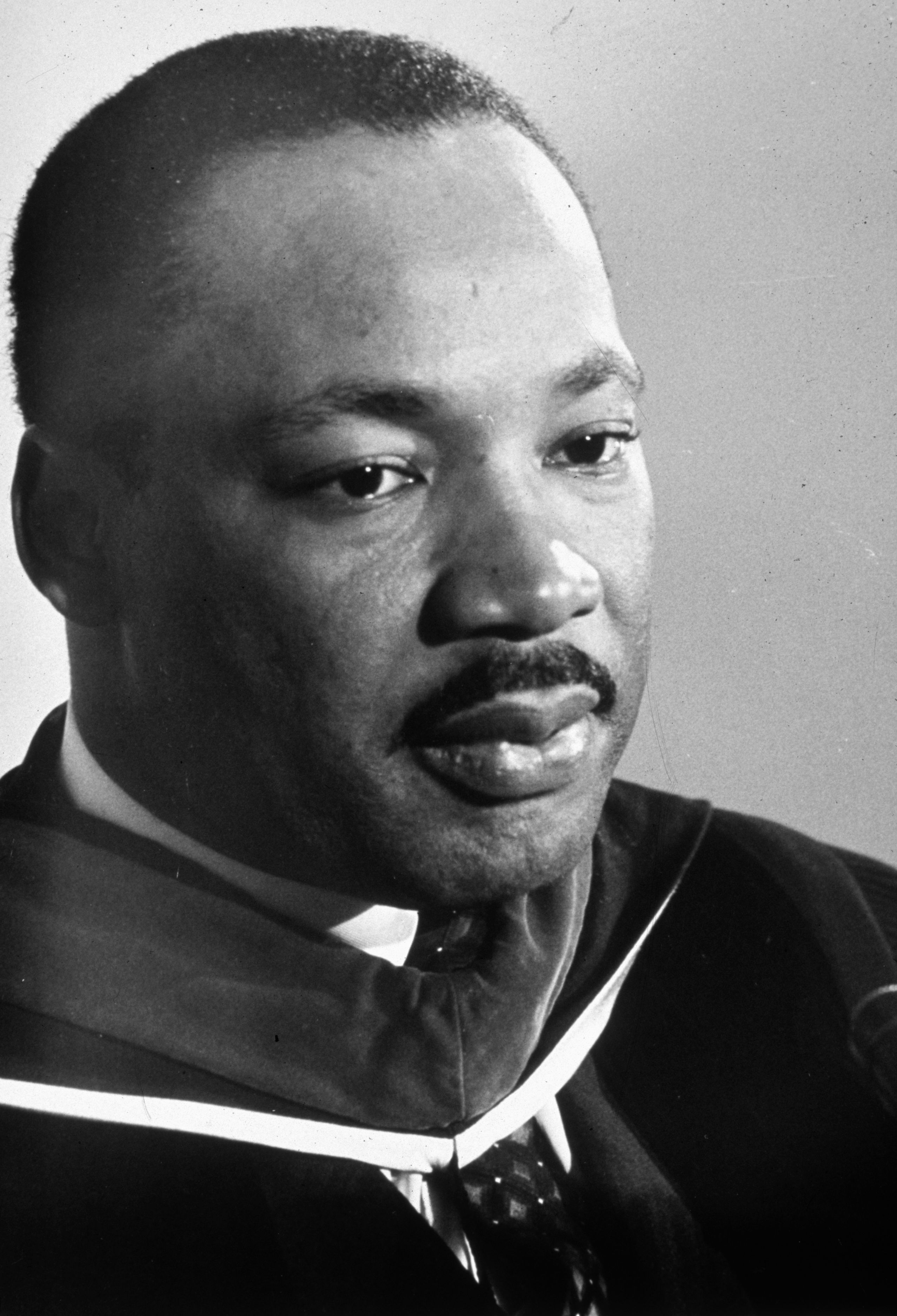
Still the Most Segregated Hour?

I was 15 years old in February, 1978 when the TV miniseries King was televised.  Race was not something that was ever really talked about in my family, but my desire to watch Paul Winfield’s portrayal of Dr. King over three evenings touched off a heated discussion.  I don’t remember my parents’ exact words, but they included “troublemaker” and “communist.”  No way was I going to take over the big color Magnavox TV in the living room for three nights; I ended up watching in my room on the snowy-pictured little black and white TV that traveled on a rickety cart around my house.

My parents were products of their time and place.  They both grew up in segregated Norfolk, Virginia, and they lived in the south all their lives.  I never heard them utter the N-word or make any overtly racist comments, but neither do I remember ever having a person of color as a guest in our home or in the pews of our church.  The only african-American I remember in my parents’ lives was the ringer on my dad’s office softball team; he definitely stood out from the other players on that “SCL Executive Department” squad.

I hope that it’s a sign of generational progress that Dr. King is among my heroes, and that attitudes such as my parents’ about his legacy are not so much heard – at least publicly.  And that is the way it should be – as Eugene Robinson reminded in his Sunday Washington Post column, Dr. King’s dream transcended division, especially politics:

This is not a partisan message; King was every bit as tough on Democrats as Republicans. His activism even transcended ideology. His call for social justice and his opposition to the Vietnam War were rightly seen as liberal, but his insistence on the primacy of faith and family was deeply conservative. His birthday is a national holiday because his words and deeds ennoble us all.

Yes, we have come a long way.

But . . .

We are still in many ways a nation divided.  Our schools and workplaces are for the most part integrated, but when we depart for our homes we still segregate ourselves, if not by law, then by habit.  Especially on Sundays.  When my children grow up, their memories of family attitudes toward race will be different  than the ones I grew up with, but like me they will remember the churches they grew up in as places where mostly white people worshiped.

Dr. King famously said, “eleven o’clock Sunday morning is the most segregated hour and Sunday school is still the most segregated school of the week.”  Has that really changed?  I know there are churches that are wonderfully integrated, but at least in my experience that is the exception rather than the rule.

According to a recent study by Baylor University, nine in ten churches have a single racial group that accounts for more than 80% of their membership.

Dr. King was first and foremost a pastor – he was the son and grandson of pastors.  It is ironic that his legacy is perhaps least reflected in the church.

As a pastor, I can preach about God’s love of all people regardless of race.  I can remind people that Jesus broke down race and all other earthly, sinful barriers (Galatians 3:28).  I am blessed to be in a church where everyone is welcomed .  . . once they are in the church . But how do you get folks of different ethnicity to enter the same church in the first place?

On this day we celebrate the life and work of Reverend Dr. Martin Luther King, Jr., I am troubled by this question.  I am troubled by the example that our churches present to the world – in fact when I was away from the church the segregation of the pews was one reason I would give to dismiss those who tried to share the Gospel with me.

I don’t have the answer, but I trust that the Holy Spirit who gathers God’s people into His Church is working to break down those barriers.

Perhaps my children’s children will remember growing up in churches that were just as integrated as the rest of their world.

That, at least, is my dream.

Posted in Martin Luther King Jr., Racism | 2 Comments