La-Z-Boys, Italian Greyhounds, and God

Tucker, the oldest of our two Italian Greyhounds (he’s the black and white one in the picture) is sitting in the red La-Z-Boy chair across the room from me.  Tucker and his cousin Blu often keep me company as I work at my desk.  They are more frequent visitors to my office since we retired the chair from the living room; the beaten La-Z-Boy had to be removed from public display not to hide the ripped upholstery (we covered that with a comforter), but because it now needs to be propped against a wall to prevent an uninitiated occupant from being dumped backward onto the floor.  (Perhaps an argument for keeping it in the living room for visitors in need of humility, but I digress.)

Tucker is curled up tight on the chair.  His companionship feels good, even after what I was helped to realize yesterday.  You see, yesterday I said to my daughter, “It’s really cool how much the dogs like to be with me lately when I’m in my office.  They really enjoy just being near me!”

“It’s not you, dad” she responded the 15-year old realist (bubble-burster) who is my daughter.  “It’s the chair.  They love that chair.”

She’s right, you know.  It’s the chair.  Not me.

Dogs.  A chair’s best friend.

I paused from my work and went over to Tucker in the Lazy Boy.  I sat on the floor and rubbed his back and his ears.  He loves his “rubbins.”  And I thought of this great analogy to “correct” people who go to church for the “wrong” reasons.

It went like this:  We’re supposed to be in church to be in God’s presence, but how many of us go because we like the “chair.”  We like seeing our friends, or the music, or the church itself.  We go to church because it’s comfortable (like the old La-Z-Boy is for the dogs).  If God happens to be there, then that’s fine too.

But as I rubbed Tucker, his joy in the attention I was paying him brought me back to God’s grace.  Tucker may have come to my office for the chair and not for me, but he still got the affection and the attention and the love that I have for that companion of 8-years and counting.

The key isn’t our motivation for going to church, it is that God meets us there no matter why we’ve come.

And how can I of all people get high and mighty about why people should be in church?  After all, when I was an unChristian I had only come back to church as a condition of dating my now-wife, Karen.   But God still met me there.  (That story’s here.)

God met me just as God meets everyone who gathers for worship, no matter why they are there.  God comes to us in God’s Word, and in the singing, and in the bread and wine of communion.  God comes to us in the community of God’s children, and in countless other more subtle ways.

Whether Tucker is here to be with me or to luxuriate on the La-Z-Boy, he’s going to get my love and attention.

We might be in church for “the chair” – whatever that means for us – but it is not our motivation that determines God’s presence.  It is God’s infinite, unfailing love for us.  God always comes to us.

Posted in Christianity, Church, Worship | Tagged , , , , | 3 Comments

More Bad Bumper Sticker Theology

Put “self-help” into Amazon’s search engine, and you get 259,852 books.

The Bible is not on that list.  If anything, the Bible is an “I can’t help myself” book.

God helps those who help themselves” isn’t in the Bible.  But I’m sure you’ve heard it.  If you saw the original “Poseidon Adventure,” you heard Gene Hackman preach it as the gung-ho reverend.  Hackman’s “Reverend Scott” got his small band of survivors to the surface, but “God helps those who help themselves” will not get you far as a Christian.

Being a Christian is really acknowledging that we CAN’T help our selves:

For while we were still helpless, at the right time Christ died for the ungodly. . . But God demonstrates His own love toward us, in that while we were yet sinners, Christ died for us. – Romans 5:6,8

There’s nothing we can do to save ourselves.  It’s only by realizing our powerlessness that we can fully grab hold of the cross.  God invites us to let go of everything that keeps us from fully embracing the cross; for most of us the last grip we release is the one on ourselves.

When I was trained as a lifeguard years ago, we were warned that often someone we would try to rescue would fight against us.  We were taught not to struggle with them, but back off and wait until they exhausted themselves and realized their helplessness.  Then we could grab them and pull them to safety.

In our attempt to rescue ourselves spiritually, we often flail around trying to do it ourselves, fighting against God, who desires nothing more than to free us from sin and death.  When we surrender, God rescues us completely, without any effort on our part.

That’s grace!

The problem with “God helps those who help themselves” is that it gets the basic order of things wrong.  God always moves first; God always comes to us.  Everything positive that we do is in response to what God has already done.

This was one of the hardest things for me to grasp when I was making the transition from UnChristian to Christian.  Even as I began to believe the truth of the Gospel message, I didn’t want to totally give up control.  I had always been taught to “be your man” and “pull yourself up by your bootstraps.”

I wanted to believe that I had found God, rather than the other way around.  But the reality is that God found me; in fact, God was always there.  It was me that was lost, not God.  (Which is why “I found Jesus” could be another entry in the Bad Bumper Sticker series.)

Could you imagine how much stress we could avoid if we stopped trusting in ourselves and started really putting our trust in God?  If we stopped trying so hard to help ourselves and surrender to the infinite love, power, and knowledge of the One who made us and who redeems us?

So let’s throw out the bumper sticker with “God helps those who help themselves.”  I’m not sure what we’d replace it with . . . maybe Proverbs 28:26?

He who trusts in himself is a fool.

Maybe not.  How about this?

God helps us when we can’t help ourselves.

Posted in Bible, Christian Living, Christianity, Uncategorized | Tagged , , , , | 2 Comments

Bad Bumper Sticker Theology

I heard it again.  At the youth retreat last weekend, no less.  It is a shame that kids get indoctrinated with the same soul-killing bumper sticker misreadings of the Bible that burden adults.

I am sad when I hear an adult say it; to hear it from a young person was downright disheartening. 

We were talking about how to deal with challenges, when one of the young people proudly parroted: “But God never gives you more than you can handle, right?”

Wrong.

And really just plain patronizing, if not downright mean.  Have you ever considered what “God never gives you more than you can handle” says to someone who is grieving or sick or dealing with some other challenging life situation?  “What’s wrong with you?  God wouldn’t give it to you unless God knew you could handle it.  Suck it up, don’t be a whiner  Just handle it already.”

Good thing the theology behind “God never gives you more than you can handle” is so rotten.

Leaving aside the question of whether “God gives us” situations that challenge us, the most insidious part of this supposed maxim is its focus on self-reliance rather than God-reliance.

In fact, the Bible consistently calls us away from “handling” challenges on our own and invites us to give them to God.  Scripture is replete with promises like this one:

Cast all your anxiety on him because he cares for you (I Peter 5:7).

Honestly, I often get more than I can handle in this life; at least, more than I want to deal with on my own.  There are times when I am overwhelmed with too many challenges, or with singular events of such a magnitude that I need help.

This week, we’re waiting for some medical test results for my daughter . . . and some of the (prayerfully remote) possibilities are beyond my capacity to handle them on my own.  Why would I want to even try?

I thank God that I don’t have to.  Jesus died so we don’t have to handle life on our own.  

What the Bible says throughout its pages is this:

There is nothing in your life that God can’t handle.

Let’s eliminate “God never gives you more than you can handle” from our repertoire of bumper-sticker proverbs.  Instead, let’s remind those who are suffering and sick and overwhelmed that we have a God who comes along side us in our troubles, who carries us when we can’t take another step on our own.

Throw away that bumper sticker!

And let’s hold on to actual words of Scripture, like these:

We do not want you to be uninformed, brothers and sisters, about the troubles we experienced in the province of Asia. We were under great pressure, far beyond our ability to endure, so that we despaired of life itself.  Indeed, we felt we had received the sentence of death. But this happened that we might not rely on ourselves but on God, who raises the dead.  He has delivered us from such a deadly peril, and he will deliver us again. On him we have set our hope that he will continue to deliver us  (I Corinthians 1:8-10).

Posted in Bible, Christian Living, Christianity | Tagged , , , | 4 Comments

Easter Promises for Mother’s Day

(Like many folks, I will not be celebrating this Mother’s Day with my mom.  Her life on this earth came to an end last year.  In her memory, and for others who miss their moms this Mother’s Day, here is an excerpt from last year’s Easter Sermon that I preached for the congregation – and for myself – not too long after her death.)

On February 11, just before lunchtime, I had a conversation with the doctor at the Northeast Florida Community Hospice.  She had just spent time examining my mom.  Two days before, on Wednesday, I had gotten a call from my sister that I needed to get down to Jacksonville as quickly as I could. I flew down and spent most of that night and the next day at my mom’s bedside.  Then came Friday, and that conversation with the doctor.  “It will be soon,” the doctor said.  I asked, “Soon as in days or soon as in hours?”  “Hours,” the doctor had replied.

It was my turn to call my sister and tell her to get to the hospice right away.  Thankfully, she lives just 20 minutes away from there.

So, I had 20 last minutes alone with my mom.  Although my mom was not at all responsive, everything I’ve heard and read about the end of life says that hearing is the last sense to be lost.  What could I possibly say that would encapsulate the 48 years we had known each other, especially the good chunk of that at the beginning when she had taken care of me, taught me, patched me up when I was cut or bruised, and most of all just let me know that I was loved?

I know many of you have experienced this time with a loved one – the last few hours that you’ll spend together.  Some of you have been through it quite recently.

For me, there were all kinds of emotions that day in the hospice room with my mom.  There was of course sadness, there was frustration that there was nothing I could do to change the outcome, there was even some anger that my mom was only 72 and that the last ten years of her life had been so seriously impaired by Alzheimer’s.

There was also fear.  Now, let me explain.  It wasn’t the same kind of fear I had experienced 24 years before when my dad died.  Then, as many of you know, I did not believe in God or salvation or an afterlife of any kind.  When you were dead you were dead.  And I remember not being so much afraid of death, but afraid that I would never see my dad again.  I was afraid of saying goodbye . . . forever.

The fear I felt with my mom was more for her comfort and for my doing and saying the right things.  I have to admit, I am always a little afraid the bedside of a dying person.  It’s part of my call, and I’m supposed to know what I’m doing – and that’s where the fear comes in. I do my best when I’m with a family in that situation to be led by the Holy Spirit, but the Spirit’s leading is being filtered through all of my imperfection and I wonder if I’m saying and doing the right things for the person who is dying and for the family.

And this was my MOM.

I held her hand.  I talked to her about all the things she had done for me – I told her again that I had been able to work with kids and families in trouble before I was a pastor because of the great job she and dad had done at parenting. And that I was sure the faith foundation they had laid growing up had a lot to do with my answering God’s unexpected call to ministry.  I thanked her for all the stuff she had done with me and my sister when we were little – all the crafts at the kitchen table, all the brownie batter bowls I had licked, all the stories she had read to us.  I told her again – for the last time – that the only reason I had been able to do well on Jeopardy! and WWTBAM was because of the curiosity and wonder about the world that she had instilled in me from the time I was very young.

Then we were just quiet for a while together.  The signs of death – the purpling of her hands and feet, the increasing shallowness of her breathing – were heavy in the room.

I was indeed afraid.  Afraid that I had not said enough.

And then . . . I grabbed my Kindle and opened up one of the Bibles I have stored in it.  I found the 28th Chapter of Matthew, and I read out loud the words of the Easter Gospel.

I read it for her.

I read it for me.

And then we got to verse five: “But the angel said to the woman, ‘Do not be afraid; I know that you are looking for Jesus who has been crucified.  He is not here, for He has been raised as He said.”

“Do not be afraid!  He is not here, for He has been raised!”

The resurrection of Jesus Christ isn’t just a nice story that we tell each year on Easter.  It’s not some myth or some symbol.  It’s not even just Jesus’ story.

The reality of the resurrection is OUR story – it’s the story that is at the core of our faith and of our hope.  It is at the core of our very identity.  We are EASTER PEOPLE.

When I had finished reading my mom that Easter story, I felt a mix of joy and of awesome wonder.  I felt the presence of God in that room.  I was sure of the reality that my mom was in God’s hands.  And I knew God would never let go of her – that the promises God made to her in her baptism were not just promises for this life, but forever.

I knew  my mom would not be cured – that she would die in a few hours.  But I also knew  she would be healed – perfectly healed in a resurrection that was prefigured by the resurrection of Jesus Christ.  And  in that resurrection there would be no Alzheimer’s or any kind of sickness or sadness or death.

Posted in Bible, Christianity, End of Life | Tagged , , , , | 4 Comments

How Do You Know God Is Good? (Youth Retreat Edition)

I spent most of the weekend at a church Youth Retreat.   In a semi-ironic convergence, I also  got my AARP Card in the mail last week (I’m turning 50 this month). Being with and leading a group of energetic young people for a couple of days I felt older and younger at the same time.  Younger because their energy and enthusiasm is contagious.  Older because my own energy and enthusiasm, while still quite strong in my head, is not as physically enduring as it used to be.

But it was an awesome weekend on a mountaintop in western Maryland.

One of the things we talked about was “How do you know that God is good?”  The young people came up with some great answers. . .

We know God is good because of God’s creation.  That was clear to see up on that mountaintop, looking out into the distance to see the farms and the woods and the mountains and the gap where the Potomac and Shenandoah Rivers converge at Harper’s Ferry.  We saw the glory of that creation in the “Supermoon” Saturday night, that big bright ball shining down through the trees, glittering as the branches blew in the breeze.

We know God is good because we have God’s word.  We have God’s word in three ways.  First, we have God’s word, God’s promise, that everything that is will ultimately be good for the people who love God (Romans 8:28).  Second, we have God’s Word, the Bible, God’s love letter to the Children of God.  The Bible has one primary purpose – so we can believe that God loves us and believe that we have life in the name of God’s Son, Jesus Christ (John 20:31).  Finally, Jesus Christ IS God’s Word who “became flesh and dwelt among us” (John 1:14).   I love how Eugene Peterson translates that verse in The Message:

The Word became flesh and blood,
and moved into the neighborhood.
We saw the glory with our own eyes,
the one-of-a-kind glory,
like Father, like Son,
Generous inside and out,
true from start to finish.

We know God is good because God is always with us.  We have God’s promise that God will never leave us or forsake us.

We know God is good because God keeps his promises.  I was glad to hear that response from a young person at the retreat.  So many “important” people have lied to them and let them down, I sure hope they know that God IS truth.

We know God is good because “I’m alive.”  I love this answer one young person offered.  It gets at such a basic truth – that we owe EVERYTHING to God, including our very existence.  Each of us is “knit together . . . fearfully and wonderfully” by the loving hands of our creator (Psalm 139).  Sure, we can understand the scientific processes of conception and fetal development, but does that make each life any more miraculous?  Again, here is how The Message renders those creation verses (13-16) of Psalm 139:

Oh yes, you shaped me first inside, then out;
you formed me in my mother’s womb.
I thank you, High God—you’re breathtaking!
Body and soul, I am marvelously made!
I worship in adoration—what a creation!
You know me inside and out,
you know every bone in my body;
You know exactly how I was made, bit by bit,
how I was sculpted from nothing into something.
Like an open book, you watched me grow from conception to birth;
all the stages of my life were spread out before you,
The days of my life all prepared
before I’d even lived one day.

But most of all, we know God is good when we look at THE CROSS.  It is on the Cross that the goodness of God is revealed most clearly.  In the moment when God looked defeated and powerless – the moment Jesus “gave up his spirit” – in that moment God’s love was poured out for all people in all times and at all places.  As Jesus himself said, there is no greater love than to lay down one’s life for someone else.  And he laid down his life for every someone else who ever lived or will ever live.

As someone said, the Cross is God’s “Yes!”  No matter who we are, no matter what we have done, no matter how long or how vehemently we have rejected God (speaking as a long and vehement rejector myself), we know that God accepts each of us, arms spread wide open both to be nailed to a Cross and to embrace God’s children.

If those young people didn’t get anything else “spiritual” out of the retreat or out of church or out of Sunday School, I hope they know and will always know how much they are loved by the good God who created not only the world but each of them, by the God who died for them, by the God who loves them unconditionally.

Posted in Bible, Christian Living, Christianity, Church | Tagged , , , , | 2 Comments

“Holey” Healing

For over a month now, it has hurt to eat or talk.  In the very back of my mouth where I had a molar pulled a few years ago, some bone pieces apparently broke off and worked their way to the surface.  After two painful trips to the dentist and one to the oral surgeon, all I could to do was to wait for healing.  I don’t remember what teething pain is like, but it must be something like what I’ve experienced as the bone breaks through my gum (and rubs up against my tongue).

I’ve lost 7 pounds because lots of the time all I feel like eating is oatmeal or soup.  So that’s a good thing at least (although I don’t recommend it as a diet plan).

Now I know this ache compared to the agony that other folks bear is insignificant.  I know I’ve been a whiner, and I  know that it has affected my relationships with others in my family.

This morning my daughter and I had a friction-filled ride to school.  I was frustrated that she was late which made me late, but she was exhausted because it’s Tech Week for the play she’s in and she hasn’t been getting home until after 10 each night.  Let me just say that I was not a model of the spiritual gift of patience.

But my mouth hurt, doggone it!

I’m also leaving today for a weekend Youth Retreat.  As the pastor in a church with no youth ministry worker, I’m planning and leading the retreat.  The 15 kids that are going are awesome, but still . . . the preparation and the execution (maybe not the best word) of the retreat are intensive.   Of course there are also 150 other pastoral things to do, as well as 200 family responsibilities.

Yeah, I’m whining again.

But my mouth hurt for more than a month.

So after I dropped off my daughter at school, her almost in tears and me too if I’m honest, I stopped at the WaWa convenience store.  I do that every day.  I get a coffee and say “hi” to the wonderful coffee-lady, Erica.  But today I added something to my coffee purchase . . . a chocolate covered yellow-cake doughnut.

It was a normal sized doughnut, but it was encased in a thick layer of unnaturally solid chocolate.  It was like a double-dip of the chocolate they put on the little chocolate doughnuts that John Belushi used to call “The Breakfast of Champions.”

Who knows how many calories or how much saturated fat that dark sweetened discus had in it, but I didn’t care.

My mouth hurt, you see.  And I was having a bad day.

Of course it hurt to chew that unnaturally solid chocolate.  But I’d been careful about what I ate for a month. I was tired of food choices based on a pyramid of pain.  I ate the whole thing, one painful bite at a time.

When I got home, something about my mouth felt different.  I had been sort of obsessively checking on the bone piece with my tongue – it’s funny how you (or at least I) can’t leave something like that alone.    Now I couldn’t find it.

The unnaturally solid chocolate had knocked that bone piece out of my gum.

I feel so much better.

After Joseph was reunited with his brothers who sold him into slavery (I know that’s quite a jump in topic but stick with me), he remarks on his situation.  He’s now a high official in Egypt, and he can save his family from the famine they are enduring.  This this is what he says, “You intended to harm me, but God intended it for good to accomplish what is now being done, the saving of many lives” (Genesis 50:20, NIV).

God can take our misguided, even evil, intentions and turn them into good.  I wasn’t up to any good with that doughnut this morning; you could say I was being evil to my body. But God used that poor food choice to deliver me from the pain I’ve been suffering.

Again, I know it’s no big miracle.  But I sure do appreciate it.

Thank God for “Holey” Healing.

Posted in Christian Living, Christianity | Tagged , , , , | 3 Comments

Ghosts? (Part Two – Conclusion)

GHOSTS? (Part Two)

(This discussion of ghosts and the Bible is a reply to some questions I received from members of my congregation.  In Part One, I discussed what Scripture says about the possibility of ghosts and also the incident in I Samuel where the Witch of Endor appears to summon the spirit of Samuel.  I know there are unChristians who read this blog and this discussion is sort of “inside baseball;” I’ll be back to posting more accessible stuff on Friday.  In the meantime, comments from everyone – whether you agree or disagree – are welcome.)

God is also at work in the other Biblical “ghostly” appearance.  At the Transfiguration, Moses and Elijah appear with Jesus.  Again, far from being an indication of what we think of when we talk about ghostly hauntings, the text makes it obvious that this is something exceptional.

Besides these two extraordinary, God-guided incidents, there is simply nothing else in the Bible that would support the existence of ghosts.  God’s Word is consistent in teaching that after a person dies, they are gone from the body and from this world, residing somewhere in some state (where and in what state are beyond the scope of this topic) until the Last Day.

So what about those who see or hear or otherwise experience “ghosts?”  If these phantasms are not the spirits of dead people, what are they?

There are several explanations that would be consistent with the witness of Scripture.  First, it could be that those who witness such an apparition are simply mistaken.  There might be natural phenomena that can explain what they see.   Or perhaps they are grieving and miss a loved one so much that they experience his/her presence in some way.

There are those who believe that when folks become aware of the presence of a deceased loved one, God is somehow giving them a sign that the person they miss is safe with God.  I would never say that God doesn’t do something or couldn’t do something, and that is certainly in line with something a loving, gracious God might do.  This is particularly true when that presence is experienced in a dream, as there are many examples in Scripture of God communicating with people in their dreams.

A more disturbing possibility is that at least some so-called ghosts are demonic deceptions.  We know from the witness of Scripture that Satan and his followers (demons or “fallen angels”) are liars.  Their goal is to confuse and scare and cause people to distrust that God loves them or that God even exists.  In 2 Corinthians 2:11, Paul encourages believers to forgive “in order that Satan might not outwit us.  For we are not unaware of his schemes.”

There are plenty of Scriptural warnings about these spiritual deceptions.  For example:

1 Timothy 4:1
The Spirit clearly says that in later times some will abandon the faith and follow deceiving spirits and things taught by demons. 

2 Corinthians 11:14-15
This does not surprise us. Even Satan changes himself to look like an angel of light,  So it does not surprise us if Satan’s servants also make themselves look like servants who work for what is right. But in the end they will be punished for what they do.

2 Thessalonians 2:9-10
The coming of the lawless one will be in accordance with the work of Satan displayed in all kinds of counterfeit miracles, signs and wonders, and in every sort of evil that deceives those who are perishing. They perish because they refused to love the truth and so be saved.

The reality is that there is a war going on between good and evil, between God and Satan.  As God’s people in this spiritual conflict, it is important for us to dismiss anything of a spiritual nature that does not have the support of Scripture.  I believe that Scripture teaches that “ghosts” are not of God (except for the two special occasions in the Bible).

We are clearly warned not to mess with the supernatural.  For us, there is only danger:

When you enter the land the Lord your God is giving you, do not learn to imitate the detestable ways of the nations there.  Let no one be found among you who sacrifices their son or daughter in the fire, who practices divination or sorcery,interprets omens, engages in witchcraft, or casts spells, or who is a medium or spiritist or who consults the dead.  Anyone who does these things is detestable to the Lord; because of these same detestable practices the Lord your God will drive out those nations before you.  You must be blameless before the Lord your God.  The nations you will dispossess listen to those who practice sorcery or divination. But as for you, the Lord your God has not permitted you to do so.  (Deuteronomy 18:9-14)

The real danger is to our relationship with the God who loves us and, because He wants only what is good for us, desires our complete trust.  Like all of God’s “rules,” this one is for our benefit.  When we run off after ghosts and fortune tellers and the like, that trust is eroded and we move farther away from God.  Although we might enjoy being scared by fictional “ghost stories” in books and movies, we must be careful that we do not fall into the deception that such things are real or that they are in any way of God.

(All Scripture quotations are from the NIV.)

Posted in Bible, Christian Living, Christianity | Tagged , , , | 3 Comments

Ghosts?

(Do you believe in ghosts?  A couple of weeks ago I preached about a post-resurrection appearance of Jesus.   I talked about how the disciples were afraid Jesus was a ghost.   I made an offhand comment that “We know of course from the Bible that there are no ghosts, so we don’t have to be afraid of them.”  Since then, a couple of folks have asked, “What does the Bible say about ghosts?”  Another e-mailed me a similar question.  As also often happens, I got carried away in my response.  Because it’s long, I’m going to share it here in two parts, today and Wednesday.  As always, I’m interested in your thoughts, whether you agree or not . . .)

GHOSTS?

There has been renewed interest in the existence of ghosts lately.  Here’s a partial list of the ghost-related shows currently running on cable television:

  • Celebrity Ghost Stories
  • Ghost Adventures
  • Ghost Hunters
  • Ghost Hunters International
  • Ghost Stories
  • Ghostly Encounters
  • Haunted Collector
  • The Haunted
  • Most Terrifying Places in America
  • Paranormal State
  • Paranormal Witness

People are fascinated with ghosts.  Certainly that has to do with our fear of being “haunted,” but it also reflects our confusion and apprehension about what happens after we die.  Christians are understandably confused about the reality of ghosts; after all, there seems to be so much “evidence” of their existence.

What does our authority on spiritual matters, the Bible, say about ghosts?  And what about the “ghosts” in the Bible?

First, we can be certain that there are no ghostly deceased Christians.  Scripture is clear that once someone dies in Christ, they immediately are in the Lord’s presence.  In I Corinthains 5:6-8, Paul makes it clear that “to be absent from the body is to be present with the Lord” (not a direct quote from the verses, but rather a summary of their meaning).  In Philippians 1:23, he writes, “I am torn between the two: I desire to depart and be with Christ, which is better by far.”  To depart – in other words to die – is to be with Christ.

We also have the words of Christ Himself.  On the cross, He speaks to the repentant thief: “I tell you the truth, today you will be with me in paradise” (italics added).  Whatever our state (conscious, “asleep,” etc.) in paradise until the Final Judgment, Christians are most assuredly not wandering the earth in a ghostly form.

What about those who die without Christ as their savior?  There are two places we can point to in the Bible that will disabuse us of the notion of ghosts.  First, there is Hebrews 9:27: “Just as people are destined to die once, and after that to face judgment . . .” There is just no indication of an intermediate conscious state between death and judgment.

We can also look at the Parable of the Rich Man and Lazarus in Luke 16:19-31.  Although this is a parable, it is the only time that Jesus used a specific name in the telling of a story.  Scholars believe this means He was teaching a lesson in reality beyond the moral(s) of the parable.  The reality here that is germane to the discussion of ghosts is that the rich man in Hades is totally separated from both heaven and earth; there is an unbridgeable chasm.  To return to earth (or to move to “Abraham’s bosom” i.e. heaven) after death is not allowed.

What about ghosts in the Bible, though?  Most of the time, “ghost” is a misinterpretation of what is really happening, particularly in the disciples’ fear that the post-resurrection Jesus is a ghost.

But there are two occasions in which dead folks at least appear to return from “beyond.”

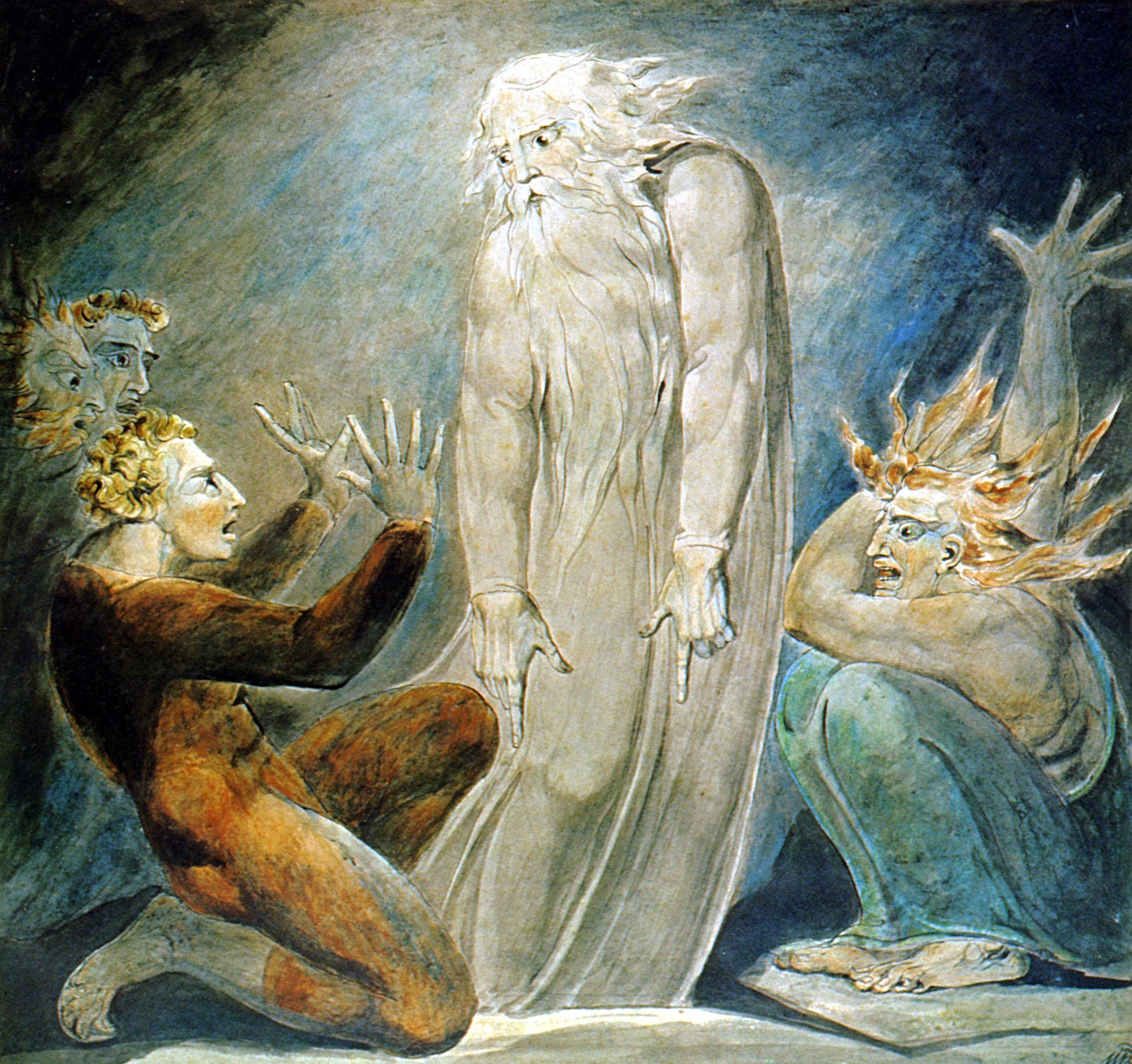
The first is when Samuel is “summoned” by the Witch of Endor.   I Samuel 28 is the story of a strange encounter between Saul and this necromancer.  Saul is desperate in the face of an invasion by the powerful Philistines and his previous loss of God’s Spirit because of his disobedience.  He turns for reassurance to the very thing that as king he had previously outlawed: the occult.  In disguise, he visits the Witch of Endor and convinces her to summon the spirit of the prophet Samuel.  When Samuel appears, the Witch is surprised.  Saul lays out his troubles.  Samuel condemns Saul and predicts his death.  Saul will indeed die the next day.

Scholars disagree about what actually happened at Endor.  Some say it was a demonic trick; Satan convinced Saul that Samuel had appeared to him.  Others believe it was a hallucination of either the Witch or Saul, but that seems unlikely because both of them seem to experience Samuel’s presence (the Witch sees him, Saul at least hears him – it’s not clear he sees Samuel because Saul’s face is on the ground).  The third possibility is that it was indeed an actual appearance by Samuel.

This is certainly something about which Christians in good faith can disagree.  If pressed, I would say that the third option is most likely for three reasons.  First, the reaction of the witch to Samuel’s appearance – she is used to dealing either with trickery or demonic appearances, and is shocked when a real spirit appears.  Second, the Bible refers to the apparition as “Samuel” and nothing else.  And finally, the “prophecy” spoken by Samuel comes to pass.

If it was actually Samuel there in Endor, does that support the “normal” existence of ghosts?  Certainly not!  Samuel has not been roaming around haunting people – he was somewhere.  The first thing he says to Saul is “Why have you disturbed me . . .?”

This is clearly a special – some scholars say “strange” – act of God for God’s purposes.  From the witch’s reaction, it is clear that she had no power over this situation.  Samuel appeared not because she summoned him, but because God made it happen.

(On Wednesday, the other “ghostly” incident in the Bible, as well as some possible explanations for spectral sightings.)

Posted in Bible, Christianity | Tagged , , , , | 2 Comments

The Absent-Minded Pastor

Being absent-minded means stepping into the bathroom and hoping you have to unzip your pants.

If you’re really absent-minded then you’re not worrying about whether the zipper is up, but whether there is one at all.  Did I remember to put on pants this morning?

I’m not that bad, but I am incredibly absent-minded.  As I told Alex Trebek during the contestant interview segment of my Jeopardy Tournament of  Champions Semifinal, my kids made a lot of money when they were younger when I would forget where I put my wallet, or my keys, or my glasses.  “I’ll give anybody a dollar who can find my keys,” I’d shout after I got tired of looking.

(Did you see what I did in that paragraph?  At the same time I was being all self-deprecating about being absent-minded, I casually mentioned that I was smart enough not only to get on Jeopardy and win but to make it to the Tournament of Champions . . .  and in the semi-finals no less.  I’ll have to write a post sometime about pride’s persistent pull.)

Being absent-minded means that sometimes . . . well, more than sometimes, I make mistakes in church.  The first time I ever assisted in worship, one of my jobs was to announce what hymns we were singing.  I stood up after the sermon and said, “The sermon hymn today is Amazing Grace (or whatever), number 548.”

The organist, on the other side of the church, got up, looked at me, and said, “Dave, I really liked it too the first time we sang it.  But let’s sing something else . . .”   I had re-announced the Opening Hymn we’d already sung.  Not too big a deal, but as it was my first time in any kind of “up front” role, it did cause me not just some embarrassment but a brief reconsideration of whether I was cut out for the pastoring stuff I was just getting into seminary to study.

I still make stupid mistakes.  Like last Wednesday evening at Bible Study.  I always start classes by asking for prayer requests.  It seemed like more than half the 30 people there offered something.  That’s great, but not realizing how long a list we’d have, I only wrote down the name of the person we were praying for figuring I’d remember the other stuff.  I should never figure like that . . . sure enough, during the prayers, I fervently prayed, “And we lift up ‘Mary’s’ nephew ‘Charles’ for healing.”

The problem was that “Charles” was “Janet’s” nephew,not “Mary’s.”   Again, not a huge deal but a pastor is supposed to be a good listener, especially about prayer requests.

When I apologized to “Janet” after the class, she said it wasn’t a problem.  Then she added, “I like it when you make mistakes.”

I think that’s a compliment.  I hope so, because she was the second person in the  last couple of weeks who told me one of the things they liked about me as a pastor was that I made mistakes.

Maybe what they mean is that they appreciate a pastor being open about imperfection.  My missteps leading worship are pretty obvious, but I also try to share my less conspicuous struggles and doubts in my sermons and teaching and counselling.  Pretending to be a paragon of perfection would be exhausting.

Maybe not just pastors but Christians in general have  put too much effort into hiding their flaws from the world.  Could it be that we have turned some unChristians off, scared them away, made them feel unworthy, or otherwise weakened our witness by presenting Christianity as some kind of cosmetic surgery for the soul?  Or worse, as only open to elite folks whose souls don’t need cosmetic surgery?

I’ll keep on doing my best as the absent-minded pastor.

Who won on Jeopardy.

And who (almost) always has to unzip his pants when he gets into the bathroom.

Posted in Christian Living, Christianity, Church, Jeopardy, Pastors | Tagged , , , , | 2 Comments