Review and Reflection: “Birdman”

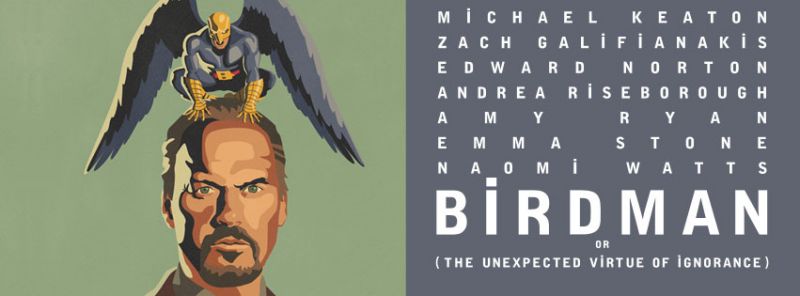
birdman poster

“Birdman,” and this post, are rated “R” for adult language and themes.

When we think of “breathtaking” films what usually come to mind are epic spectacles of sound and fury. But “Birdman” is a film that takes one’s breath away through the transcendence of the art form of film itself. “Birdman” is an amazing, synergistic achievement of artists at the height of their power. The result is both enthralling and exhausting; “Birdman” achieves a rare existential immediacy that is a thrilling reminder of what filmmakers, and indeed artists of all sorts, can attain.

in “Birdman,” Director Alejandro González Iñárritu (“Babel,” “21 Grams”) and Director of Photography Emmanuel Lubezki create the illusion of one uninterrupted take. There are no visible cuts in “Birdman;” the camera follows the characters through the labyrinthine corridors of the St. James Theater, onto the stage and out into the streets of New York.  Lubezki has achieved legendary results with long takes in films like “Children of Men” and “Gravity,” but in “Birdman” the seamless nature of the entire film contributes to the edge-of-your-seat experience. It is like watching an intricate dance where every precise movement contributes to the majesty of the whole.

All that, and it’s laugh-out-loud funny as well. A discussion of the serious themes of “Birdman” should not overshadow the fun of the film. There is plenty of snappy, clever dialogue as well as perfectly timed slapstick. You can amuse yourself counting the pop-culture name drops (from George Clooney to Justin Bieber) that are almost always biting references (Hugh Jackman’s not available for a serious role because he’s “shooting the prequel to the prequel of “Wolverine.”)

Sure, it’s a dark comedy.  There’s no happy ending (maybe . . . there is some ambiguity at the finish) where everything is neatly tied up. Like life. This is a film that earns its laughs by dissecting the faults and fears of its characters who are, if we are honest, a lot like us. We may not be actors and actresses like the people who populate “Birdman,” but we too struggle with the questions the film deconstructs.

What is it that gives us significance?  How do we know we really matter? What does it mean to be loved?

Those concerns are immediately raised by the Raymond Carver epigraph (that is carved on his tombstone) with which director Iñárritu begins the film:

And did you get what
you wanted from this life, even so?
I did.
And what did you want?
To call myself beloved, to feel myself
beloved on the earth.


riggan and birdman

What Riggan Thomson (Michael Keaton) wants is to be taken seriously.  Once he had everything that is supposed to make us happy. He was rich and famous. He was “Birdman,” a super-hero movie phenomenon. But he walked away from all that in the 90’s when he turned down $15 million to star in “Birdman IV.” His career spiraled downward, and now, he laments, “I’m a f—ing Trivial Pursuit question.”  Riggan’s final hope for significance – and love – is to write, direct, and star in a Broadway adaptation of the Raymond Carver short story, “What We Talk About When We Talk About Love.”

Riggan has poured everything into the play – all of his money, all of his credibility and connections, all of himself. But as the film begins, Riggan is experiencing nothing but obstacles in his Don Quixote-esque quest. Not the least of which is that he apparently is slipping into (or has already entered)  insanity. . . maybe; There is a magical realism element to the film that leaves the viewer questioning just what exactly is “real.”

Riggan is not only unable to shed his “Birdman” legacy with the public – A reporter asks, “Are you afraid people will say you’re doing this play to battle the impression that you’re a washed-up comic strip character?” – but that comic book character is a part of him, speaking to him, appearing to him, perhaps giving him telekinetic powers. Who is Riggan – is he Birdman, or vice versa?

Riggan wants to be known as a serious actor, not a superhero character. But in a way he wants what superheroes have – to be universally beloved. That is, of course, tragically unattainable. That Riggan is indeed a tragic, flawed character is vividly highlighted in a scene in which he walks the streets of New York and is confronted by a street-actor noisily emoting MacBeth’s “Tomorrow and tomorrow and tomorrow” speech that ends with the declaration that life is “is a tale told by an idiot, full of sound and fury, signifying nothing.”

BIRDMAN, (aka BIRDMAN OR (THE UNEXPECTED VIRTUE OF IGNORANCE), from left: Michael Keaton, Emma

Emma Stone brilliantly plays Riggan’s truth-telling daughter, Sam. She’s just out of rehab, her life a mess in no small part because her father’s quest to be universally beloved has neglected those closest to him. In an amazing speech both in content and delivery, she excoriates Riggan’s desire to find significance by mounting  “a play based on a book that was written 60 years ago, for a thousand rich old white people, whose only real concern is going to be where they can go to have their cake and coffee when it’s over.” (Watch her face as the camera lingers in closeup after she is done her diatribe . . . The way she wordlessly conveys her realization that she’s said too much too harshly is simply awesome acting.)

But . . . as much as Sam belittles her father’s quest for significance, she has her own concept of what makes one matter.  She constantly berates Riggan for his lack of presence on social media. When Riggan ends up walking through the crowded streets of New York in his underpants (a hilarious scene that actually makes sense in the context of the film), she is elated when raw video of the incident shows up on YouTube and instantly gets hundreds of thousands of views. Sam’s idea of what makes one significant is ultimately just as hollow as Riggan’s.

This is a film where people get what they thought they wanted and it only results in more longing when it turns out not to be what they thought it would be.  Naomi Watts plays an actress who is finally attains her dream of performing on Broadway, but finds she is still dealing with the same stuff – especially her same self – as she was before. Edward Norton‘s character is a Broadway star, but the magic of the theater has morphed for him into jaded cynicism. When Emma Stone’s Sam asks what he’d like to do to her, his answer signifies yearning  – he says he’d like to scoop out her eyeballs and put them in his head, so that he can see Broadway like he did when he was young.

Film Fall Preview

Yeah, that sounds weird . . . but Edward Norton’s character, Mike Shiner, is a weird dude. He is the embodiment of a narcissistic actor.  He says he can only be himself on stage; everywhere else he’s acting. Speaking of acting, they might as well close the nominations for Best Supporting Actor at next year’s Academy Awards. They don’t need to nominate anyone else based on  just his very first scene.  In it, he dominates a read-through with Michael Keaton while managing a tour-de-force of acting in just one scene.  It is an incredible performance, as is his later destruction of a preview performance in which he ends up declaring that he will act with a chicken leg because it is “the only real thing on this stage.”

Norton is also part of the meta fun in “Birdman.” In this film about a washed-up former comic book movie-star, we have a former “Incredible Hulk” (Norton), a man who walked away from the Tim Burton “Batman” franchise (Keaton, whose post-Batman life has been nothing like Riggan’s), and a star in the “Spiderman” franchise (Stone).

The acting in “Birdman” is so strong it would be worth seeing it even if all the other elements weren’t so extraordinary. I should also mention Zach Galifianakis as Riggan’s best friend/business manager/producer Jake.  I confess I have never liked Galifianakis in anything I have seen, but he does great work here as sort of the straight-man with the Sisyphean task of keeping everything backstage, including his unhinged star, together.

So, yeah,  I liked “Birdman.”  I rarely see movies more than once at the theater, but I’ll go back. I want to try to find the disguised cuts in Lubezki’s cinematography, to hear some of the fast-paced dialogue that I missed the first time. I want to revel in artists doing what artists do, using their talents to force us out of ourselves for a while.

But at the same time, they force us to look at ourselves in new and sometimes uncomfortable ways. Certainly, as a Christian I have very specific answers to the questions the film poses – I get my significance from being a child of God, I know that I am beloved by God.  In my worldview, looking for meaning elsewhere is inevitably deficient or even futile.

As a human, though, I know that I do look for significance in other places. I want to be “beloved” and taken seriously. I want my life to matter. I don’t always fulfill these quests in the most healthy or altruistic ways.  Even pastors try to accomplish significance through growing churches or perfect programs or excellent preaching. The issues in “Birdman” are universal.

I saw “Birdman” with my wife and my 23-year old son. We went out to dinner afterward and talked about the film throughout. We discussed it on the way home. This morning as we got ready for the day, my wife and I talked about it some more. And we didn’t just talk about the superb film-making or what actually happened in the ambiguous parts; we tried to get at what it all meant. That is testament to “Birdman’s”  power and relevance.

“Birdman” is only in limited release right now, but I hope it finds a wide audience. At one point in the film, the Birdman apparition (or whatever he is) says to Riggan, “People, they love blood. They love action. Not this talky, depressing, philosophical bullshit.”

I hope he’s wrong.

NOTE: The full title of the film is “Birdman, or the Unexpected Virtue of Ignorance.” To use the full title in this post would have made it even longer.

 

Posted in Arts and Culture, Christian Living, film, Movies | Tagged , , , , , | 2 Comments

Death With Dignity? (The question of Physician Assisted Suicide)

“Agnes” had lived long enough. The disease ravaging her lungs had downsized her once vigorous lifestyle. She couldn’t spend her days “out visiting.” Her children, grandchildren, and great-grandchildren had to come to her now.  Not too long ago, just getting out of bed was a victory.

Now, even turning over left her gasping for breath. She was confined to the bed. And not her own bed. She lay in a hospital bed sucking on an oxygen mask stuck to her face 24/7. She’d had enough.

One evening she made calls to the family and to her pastor. The pastor had been eating dinner with his family when his cell rang, but he came right away. There was finality in Agnes’s voice that couldn’t be put off.

When everyone had crammed into the small hospital room, Agnes asked the pastor to read her favorite Psalm. She inhaled the words of Psalm 139 about being knit together in her mother’s womb, about being fearfully and wonderfully made, about God’s promise to always be with her.

Then she asked the pastor to pray. He did his best.

It was after the prayer that Agnes started asking members of her family to remove the oxygen mask that was keeping her alive. No one would – or could – do it.

So she raised an unsteady hand to her face. She fumbled with the mask and the bands that held it in place. She shot an exasperated look at her clan. Then she yanked off the mask.

Agnes managed a prayer, a plea, perhaps a statement of defiance: “Thy . . . will . . . be . . . done.”

Then she closed her eyes.

Anyone in the room could have replaced the mask and prolonged her life.

No one did.

Twenty minutes or so later, Agnes breathed her last. She had died on her terms.

In my roles as pastor and blogger, I’ve been asked about what has been labeled “Death with Dignity” or “Physician Assisted Suicide.” Let me first admit that I have mixed feelings about this matter. I can’t help but think of Agnes’s last minutes, nor can I disregard the other folks I have been honored to accompany in their last moments or hours. Each time I have been present at the time of death has been a holy experience. Often that final encounter has been preceded with meetings and decisions about continuing treatment, signing DNR (Do Not Resuscitate) Orders and so on. Decisions around death are burdensome in no small part because of their finality . . . there is no changing one’s mind once life has ended.

Recent inquiries about the issue of assisted suicide were spurred by the publicity attending the death of Brittany Maynard. While I am willing to address the issue, I will be cautious as to the particular situation of Brittany Maynard. While much has been reported in the press and shared directly by Ms. Maynard and her family, it is impossible to know all the details of her situation. Although it is unlikely that her family would ever read this, it would be nothing but hurtful at this point to castigate decisions made out of love. (“Christians” have done enough of that already.)  I believe that in circumstances such as these most people truly do the best they can. It is not for me to judge Brittany Maynard or her loved ones, but rather to continue to pray for them as they grieve.

After all, is what Brittany Maynard ultimately decided really that different from what Agnes chose? Both had reached a point beyond which they felt they could not endure life any more. Both made a choice to end their lives sooner than they could have been extended.

Is what Brittany Maynard chose really that different from what we chose for my mother? Alzheimer’s and other ailments had completely incapacitated her. Treatment for anything but pain was ended, and extraordinary means of providing nourishment were withdrawn. My mother died of “natural causes,” but her life certainly could have been prolonged, such as it was.

In making pronouncements we must be careful to remember that these are weighty issues freighted with not just our fears and hopes about death but with what it means to be alive. We must be careful not to judge those who come to different conclusions as they watch a loved one suffer and lose their very identity . . . or who suffer themselves.

But I believe there is a distinction, however fine, between withholding treatment and actively causing death. There is a difference between Agnes removing the mask that was providing “extra” oxygen and suffocating someone. Ceasing extraordinary medical intervention for my mom is different than administering medications that cause death.

My conviction about that difference is rooted in my faith. I believe that we are, in the words of Psalm 139, “Fearfully and wonderfully made.” I believe that we are made “imago dei” – in the very image of God.

And I believe that every human being is therefore a sacred creation.  Deliberately ending a human life is contrary to God’s desire.

I want to live in a culture that values and celebrates life, and fear that allowing the taking of life always diminishes its value. I may be wrong, but I choose to err on the side of life whether the issue is assisted suicide or abortion or the death penalty or war.

I am not someone who blithely parrots the “party line,” but I believe my denomination’s (ELCA) “Social Message on End of Life Decisions” gets it just right. Here’s an excerpt:

The integrity of the physician-patient relationship is rooted in trust that physicians will act to preserve the life and health of the patient. Physicians and other health care professionals also have responsibility to relieve suffering. This responsibility includes the aggressive management of pain, even when it may result in an earlier death.

However, the deliberate action of a physician to take the life of a patient, even when this is the patient’s wish, is a different matter. As a church we affirm that deliberately destroying life created in the image of God is contrary to our Christian conscience. While this affirmation is clear, we also recognize that responsible health care professionals struggle to choose the lesser evil in ambiguous borderline situations—for example, when pain becomes so unmanageable that life is indistinguishable from torture.

We oppose the legalization of physician-assisted death, which would allow the private killing of one person by another. Public control and regulation of such actions would be extremely difficult, if not impossible. The potential for abuse, especially of people who are most vulnerable, would be substantially increased.

Beyond what might be called an “ethics of life” that resists physician assisted suicide, I worry most about that last sentence in the quoted material. As a Christian, I am called to care especially for the people Jesus seemed most concerned about, those who have been termed “the lost, the last, and the left out.” People who are disabled or diseased or otherwise disadvantaged would be most at risk of being adversely affected by society’s acceptance of physician assisted suicide. Medical care is expensive, especially end of life care; certainly there are those who would benefit from another’s premature exit from this life.. No matter how carefully statutes are constructed that legalized physician assisted suicide, vulnerable people will most certainly be pressured to make irrevocable decisions.

The irrevocability of the decision for suicide also gives me pause. I have met many folks who have desired to end their life, but who have received treatment and gone on to live fulfilling lives full of love given and received. Of course people will find a way to commit suicide whether it is assisted by a physician or not, but the last thing we need to do in a world where depression is an unfortunate reality for many is to make taking one’s own life easier or normalized.

Perhaps the best response for those of us concerned about “death with dignity” is to do what we can to make sure everyone has the opportunity for a “life with dignity.” It is also crucial that we support movements such as hospice that are attendant to suffering of both patients and loved ones, with a goal that every death is a “death with dignity” as much as is possible; but acknowledging that “dignity” does not mean total control (which is always an illusion anyway) but rather embraced by love and compassion.

Finally, as Christians it is important to meet those who disagree with us not with judgment but with grace. Let us remember that suicide is not the, or even an, unforgivable sin. It is crucial that we listen before we preach, if we are indeed called to preach at all. We must hear the agonized suffering of those who would desire physician assisted suicide, and pray them into the hands of the Great Physician who promises an eternity free from suffering and even death, where God will wipe every tear from our eyes.

NOTE: To protect privacy, not only was “Agnes’s” name changed but also some of the details of her story were altered.

Posted in Christian Living, Christianity, ELCA, End of Life, Lutheran Theology, Psalm 139 | Tagged , , , , | 2 Comments

Grace and Consequences

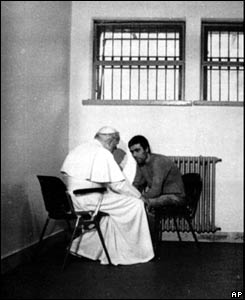
popewithmehmetOn May 13, 1981, Pope John Paul II entered St. Peter’s Square in the Vatican.   Mehmet Ali Ağca was waiting with a gun. Ağca pulled the trigger. Four bullets hit the pope, and he was rushed to the hospital where he eventually recovered from his wounds. Ağca was immediately taken into custody.

Just after Christmas in 1983, Pope John Paul II entered a cell in an Italian prison. He took Ağca’s hand in his own and looked his would-be assassin in the eye. Then the pope forgave the man that tried to kill him.  The pontiff later said, “What we talked about will have to remain a secret between him and me, I spoke to him as brother whom I have forgiven, and who has my complete trust.”

That’s an amazing story of grace. As I wrote in posts about grace last Thursday and Friday, grace is undeserved forgiveness. But I recount the story here not just because of the pope’s forgiveness, but because  Mehmet Ali Ağca remained in prison until 2010.

The pope forgave Mehmet Ali Ağca, but there are still consequences for Ağca’s actions.

We hesitate to extend grace, and even doubt that God might be graceful with “some people,” because we fear it is equivalent to letting someone off the hook for the consequences of their actions.

But that is not the case. Even though I know I am forgiven by God for everything I have done or will do, there will still be earthly consequences when I inevitably screw up. That is good for me – I need to learn from my missteps – and for those around me.

As a parent, when my children misbehaved I certainly forgave them. But there were consequences . . . how else would they learn?

When I share the grace I have received from God and forgive someone who does not deserve it and/or has not asked for it, that does not mean that I roll over and invite them to harm me again.

If another person betrays my trust by sharing a confidence, I will (hopefully) forgive them, but may not let them in on anything that I don’t want to be public knowledge.

Nowhere in the Bible does it say that we must “Forgive and forget.” To forgive is to extend grace; to forget may be just plain stupid.

Amazingly, it is only GOD who forgives and forgets! (Hebrews 8:12, Isaiah 43:25). How an omniscient God forgets all the times I have fallen short is certainly a mystery, but it is truly a wonderful promise.

This is Domestic Violence Awareness Month, so let me close this brief discussion of the distinction between grace and pardon from consequences with a confession on behalf of the church that I serve. I don’t mean the particular congregation, but rather the church of Jesus Christ historically. For many years it was the practice – and unfortunately still is in in some places – that women who were abused were instructed to “forgive and forget” in the name of grace and to preserve the “sanctity of marriage.”

The church has been just plain wrong in those instances. It has confused the meaning of grace. Certainly, at some point and with God’s help women will hopefully be able to release themselves by forgiving their abusers.  But that does not mean that they should have to return to be hurt again and again. The “sanctity of marriage” was already violated by their abusers.

And grace, whether extended by God or by others, does not mean there are no earthly consequences.

Posted in Christian Living, Christianity, Lutheran, Lutheran Theology | Tagged , , , , | 2 Comments

Grace? I Object!

i-objectI have heard all the objections to grace.

I have spoken them myself.

The primary objections are these: It’s too easy! It’s not fair!

I hear them every time I teach or preach about grace. I heard some of them yesterday in response to my post, “Grace Has No ‘If.'”  The funny thing is that almost all the folks who get offended by God’s extravagant grace are folks who are already in the church.

We’ve got to keep out the undesirables, you know. At least until they clean themselves up. (Until they’re really sorry.)

Yeah, that sounds like Jesus . . . Jesus who hung out with tax collectors and prostitutes. Jesus who pronounced forgiveness before it was asked for – before folks even knew he had the authority to forgive. (See the story of the paralyzed guy brought to Jesus by his friends in Mark 2. The dude never speaks, much less asks for forgiveness.)

We want to impose our broken human concept of forgiveness onto God. But God won’t have it. God proclaims and exclaims GRACE through the cross.

You know, the cross where Jesus died for us “while we were still sinners” (Romans 5:8).

Good Christian folks are scandalized by grace. So we add conditions to God’s gift . . . we add “if’s” to God’s grace.

As if we have that authority!

The biggest if  . . . “You’ve got to ask for forgiveness or God won’t give it to you.”

If that’s the case, then all of us are going to hell.

There is no way that we can ask God’s forgiveness for every way we fall short.

For one thing, we sin so often we’re bound to forget some when we get around to asking for forgiveness.

Also,  because we’re human we are masters of rationalization. We’ll never ask for forgiveness for some things because we’ll never realize we were wrong to do – or not to do – them.

And then there’s the fact that we are bound to get some things wrong about what’s a sin and what isn’t. Different denominations disagree about the rules . . . if our salvation depends on finding the church that gets everything right, then we’re all in trouble because none does (including mine . . . I’m sure I’ll have some “aha” – and “oh crap” – moments in eternity).

I’m preaching about the Ten Commandments this Sunday. There are wildly different interpretations of what just those ten basic rules mean. Just take a look at “Don’t Murder.” Do I violate that one if I kill in self-defense? In war? What if I’m on the “wrong” side of a war? What about abortion? What about abortion in cases of rape or incest or fetal abnormality? Jesus said if you’re angry at someone you’ve broken that commandment. What if I’m angry for a “good” reason?

And on and on.  That’s just one commandment.

If my salvation depends on my asking forgiveness every time I sin, then I darn well better get exactly right what is and isn’t a sin. I never will. Not in this life.

Even if we do our best to ask for forgiveness – and mean it! – for every time for fall short, death will eventually get in the way.

Suppose I’m driving too fast one night and my car slams into a tree. My last word will probably not be a good one. I may even take the Lord’s name in vain.

I don’t believe my salvation is so tenuous that it is threatened by my final, unconfessed exclamation!

My salvation doesn’t depend on me. Thank God.

My salvation depends not on my imperfect faith but on God’s perfect faithfulness.

My salvation depends on God’s grace.

No “If’s” about it.

(Monday I’ll deal with some other objections to grace, including the one that we “Let someone off the hook” when we forgive them unconditionally. But grace is NOT the same as pardon . . . more on that Monday.)

Posted in Christian Living, Christianity, Faith, Lutheran, Lutheran Theology, Uncategorized | Tagged , , , , | 4 Comments

If I Have Gay Children: Four Promises From A Christian Pastor/Parent (Reblogged from John Pavlovitz)

A friend who is the parent of a gay child sent me this link to a post on Pastor John Pavlovitz’s blog. It obviously resonated with them.  I think the post is quite awesome and well worth of sharing:

If I Have Gay Children: Four Promises From A Christian Pastor/Parent.

The comments on Pastor Pavlovitz’s post are disheartening; you may not want to read them.  Many excoriate him for basically saying, “I’ll love my children unconditionally.”  You know, sort of like God loves God’s children.

Posted in Christian Living, Christianity, Homosexuality, Parenting, Pastors | Tagged , , , | 3 Comments

“. . . in the best possible light”

HyperbolaeDrawnByHalogenLamp Just a quick thought . . .

We deepen division and obliterate even the possibility of relationship when we define those with whom we disagree according to the most extreme proponents and positions of their convictions. What if we stopped awfulizing religions (or lack thereof), political parties and perspectives, genders, ethnicities, sexual orientations, nationalities, etc. that are unlike our own, and instead gave those who are different than us, or who hold attitudes and opinions contrary to ours, the same empathetic hearing we desire for ourselves?

“We are to fear and love God, so that we do not tell lies about our neighbors, betray or slander them, or destroy their reputations. Instead we are to come to their defense, speak well of them, and interpret everything they do in the best possible light.” 
– Martin Luther’s explanation of the 8th Commandment in The Small Catechism.


Posted in Christian Living, Christianity, Faith, Martin Luther | Tagged , , | 2 Comments

A Pastoral Letter to an Abused Woman (Repost)

(I first posted this over two years ago. With the recent attention to Domestic Violence, I thought it was appropriate to repost.  The church should certainly be speaking to issues such as this.  As I say at the end, it was not written to any particular person or situation.)

Dear Child of God,

First, and most important, the abuse is not your fault.  It doesn’t matter what you have done or haven’t done, the abuse is not your fault.

Your abuser’s behavior is HIS responsibility.  HIS sin is between him and God.

No one “deserves” to be hit or used sexually or even verbally assaulted.  Nowhere in the Bible are husbands, boyfriends, or anyone else given a mandate or permission to abuse you.  You do not deserve to be hurt.

Which is why the first thing to do is . . .

GET SAFE.

If you are being abused by your boyfriend, terminate the relationship NOW.  Get out.  Get away.  Get safe.

Of course he promises that things will be different once you are married.  Of course he promises to change.  Of course he tells you that if YOU would just change then he could stop hitting/belittling/raping you.

Run the other way!  You CAN do better.  God loves you and wants better for you.  No matter what your experience may have been, not every man is an abuser.  Marriage is a sacred bond instituted by God.  Do you want to base that bond on an abusive relationship?  Do you want to bring children into the world with someone who is abusive?  Get out of that relationship and don’t look back!

But what if you are an abused wife?  What if you have already entered into that sacred bond?

My counsel is the same.  Get safe.  If that means going away, leave.  You know better than anyone if it is possible to be safe in your present situation.  If you’re not safe where you are – and a realistic evaluation will probably  tell you that you’re not – then go to a friend’s house, go to a relative’s home, go to a shelter.  Or better yet, get him to go live somewhere else for a while if you can.

Get safe.  Get out if you need to.  Not necessarily out of the marriage – not yet – but get out of the place or situation where your abuser can continue to hurt you.

Now, there are those who will throw bits and pieces of Scripture at you trying to convince you that God desires you to stay in the place where you are being abused.  “God has you there for a reason,” they will say.  Or, “There are only two Scriptural reasons for ending a marriage, and abuse is not one of them.”  These folks often have the best of intentions and are usually simply misguided.

“God hates divorce,” they will say.  Yes, that is a direct quote from Scripture . . . and I agree, that is indeed what it says in Malachi: “God hates divorce.”

But God loves YOU more than God hates divorce.  How can I say that with assurance?  Because I know that God loves you with a love that is INFINITE.  God loves you so much that God sent God’s only Son into the world to die for you.  Jesus died so that you could have new life RIGHT NOW.  He died so that you could look forward to eternal life with Him.

Jesus died because He loves YOU.

God loves you with a love that is without limits.  Certainly, if your marriage ends because of your husband’s abuse, God will grieve for that.  But God hasn’t, and God won’t, stop loving you.  God won’t stop renewing you. God won’t stop forgiving you.

A God who loves you that much does not want you to be abused.

Yes, marriage is sacred.  But that sacredness has already been violated – by your abuser.

Throughout history one of the sins of the human institution that is the church has been to use Biblical directives to excuse men who are abusers.  The church has told women who are being abused that they must stay with their husband no matter what because, after all, he’s the head of the household.

How sad.

The Bible directs husbands to love their wives as Christ loves His church.  Christ’s love is, above all, sacrificial.  An abusive husband is displaying the opposite of Christ’s love – rather than absorbing pain on your behalf (sacrificial love) he is inflicting that pain (abusive “love”).

And the truth is, the Bible calls on husbands and wives to submit to each other.

By his abuse, your husband has broken the promises he made to you on your wedding day.  He promised to love you, to cherish you, to take care of you.  It is he who has been unfaithful – unfaithful to the promises he made to you, and unfaithful to the promises he made TO GOD.

Some will say, “But what about forgiveness?”  Well, certainly we are all called to forgive those who hurt us.  Sometimes that takes a very long time.  But, God does not require you to be a doormat . . . or a punching bag.  Forgiveness is not the same as opening yourself up to be hurt again.

Forgiveness is also not the same as letting someone off the hook for the consequences of their behavior.

The primary consequence needs to be your getting yourself safe.

If you have kids, then it is exponentially more important to get to safety.  “He doesn’t abuse them,” you say, “It’s only me.”  But how long before the same ticking time bomb that showers you with shrapnel detonates with your children?  Even if your children are not being physically abused, it is at least emotionally abusive for them to live in a situation where mom is being hurt by dad.

What are your children learning?  What are they going to take into their own relationships and into their own marriages?  Is your little girl learning that “love” means being abused?  Is your little boy learning that men are supposed to hurt women?

Jesus taught and demonstrated how much He loves children, and He warned about harming them.  Get them to safety!

Let me be clear, I’m not telling you that you should necessarily jump directly to divorce.  No.  Get safe, then perhaps by the grace of God your husband will repent.  Perhaps he will make the complete change of heart and mind God desires him to make.  Certainly pray for him.

But do not even consider reuniting until he has taken concrete steps and made tangible changes.  One such step is a spiritual commitment demonstrated through action.  Another is counseling.  Why counseling?  Can’t God change him?  Certainly, but God works through human means all the time.  Someone who has a physical illness needs both prayer AND medical treatment.  An abuser needs both prayer AND counseling.

Make sure that YOU get spiritual support – and counseling – as well.  This is also vital for your children.

The unfortunate truth is that your husband may not choose to change. He may continue to push away the forgiveness and new life that God offers.  You cannot control that.  Ultimately, the best available option may be termination of the marriage.  That is sad, that is a tragedy, but because we live in a fallen, sinful world sometimes there is not a “good” option, only the best of unfortunate, imperfect options.

No, divorce is not God’s intention.  But it is not “the unforgivable sin.”  It is a tragic reality in our sinful world where two sinners (we’re all sinners!) come together in a sacred union.

Thank God we live by Grace, not by Law!

Never forget that God loves you.  God loves you not matter who you are, no matter what you have done.   You are forever God’s child, and, like any loving parent, God does not desire that God’s daughter be abused.

Christ’s peace,

Pastor Dave

(I did not write this letter to any particular person, but I hope it might be some comfort to those in an abusive situation.  I would appreciate feedback, including suggestions for improvement.)

Posted in Christian Living, Christianity | Tagged , , , , , | Leave a comment

Convert Them or Kill Them!

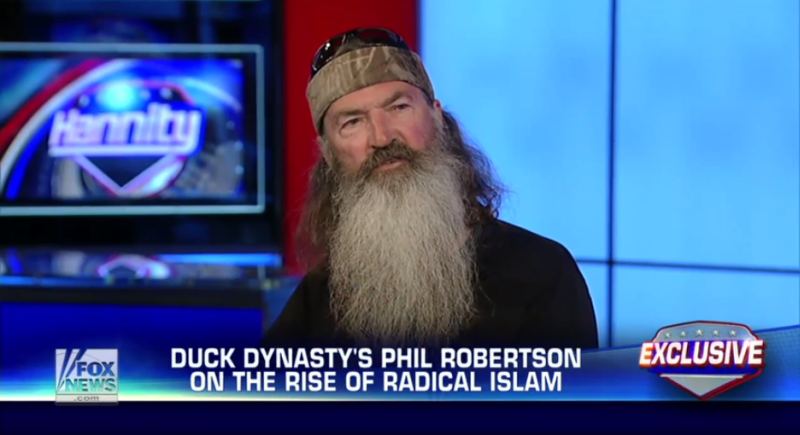
phil-robertson-hannityOn Sean Hannity’s Fox “News” show the other night, they were talking about ISIS. That’s certainly an important topic – ISIS is destabilizing the Middle East, killing and torturing people indiscriminately, and doing their best to drag the US back into combat in Iraq.

So the Hannity show needed someone to address the ISIS crisis. I can imagine the production meeting:

PRODUCER ONE: “Who can we get that’s an expert in Middle East policy? Someone who understands the political realities, and also has a grasp of Islam and its various sects?”

PRODUCER TWO: “How about a State Department official? Or a scholar?”

PRODUCER ONE: “Maybe . . .”

HANNITY: “How about a guy who makes duck calls?”

BOTH PRODUCERS TOGETHER (obsequiously): “Brilliant!”

So Phil Robertson was invited to hold forth on ISIS. He brought his Bible.  (“I never leave home without my Bible and my woman, Hannity.”)  He quoted Scripture, pingponging around the New Testament in a display of prooftexting that made my head spin.  Not that there’s necessarily anything wrong with that, it’s just not how my particular tradition uses the Bible (because we believe things like context are important).

He presented himself as a minister who was speaking for Christians and maybe even for God.

And then he said, “I’m just saying, either convert them or kill them. One or the other.”

Here’s my question . . . is that really much different than ISIS telling Christians in Iraq, “Convert to Islam or die”?

Some might say the difference is that ISIS has brutally carried out its ultimatum. But while the duck call-guy is not personally threatening anyone, he is advocating on a national “news” show that the most powerful armed forces in the world “convert them or kill them.”

There is no doubt that ISIS is an organization that does brutal, despicable, evil things.  I’m not smart enough to know the best way to deal with ISIS. I am thankful that we have people who are qualified to make those decisions.

But “Convert them or kill them” cannot be our mission. Not as a country, and not as Christians.

It’s not the job of the government, or the armed forces, to convert anybody.  Maybe “killing them” is the only effective way to deal with ISIS, but the goal is not to convert them, but to stop them. That may mean getting them to surrender or retreat or laying down their arms.  Duck-guy’s strategy would be to keep bombing and shooting until they say they love Jesus.

And sure, Christians are commanded by Jesus to spread the good news. But Jesus never even hinted that we should kill people who don’t convert.  Christians have done that kind of stuff in the past – in the Crusades, in the Inquisition, and so on – and I thought we all agreed that “convert or kill” was not an acceptable evangelism strategy.

Here’s the bottom line – lots of Christians are critical of Muslims who don’t repudiate Muslim extremists. We need to get our own house in order, and distance ourselves from Christian extremism like “convert them or kill them.”  If we don’t, then the extremist voices of hate will continue to shape how Christianity and Christians – and Jesus – are viewed by unChristians.

(You can watch the interview, or read a transcript, at the Fox “News” website here.)


Posted in Bible, Christian Living, Christianity, Faith | Tagged , , , , | Leave a comment

Eulogy for the Simpson Family Vacation

The Simpson Family at Gullfoss (Golden Falls), Iceland, 2004

The Simpson Family at Gullfoss (Golden Falls), Iceland, 2004

There was something . . . incomplete about our summer vacation this year. We spent a relaxing week at beautiful Deep Creek Lake, Maryland.  But there was something missing . . .

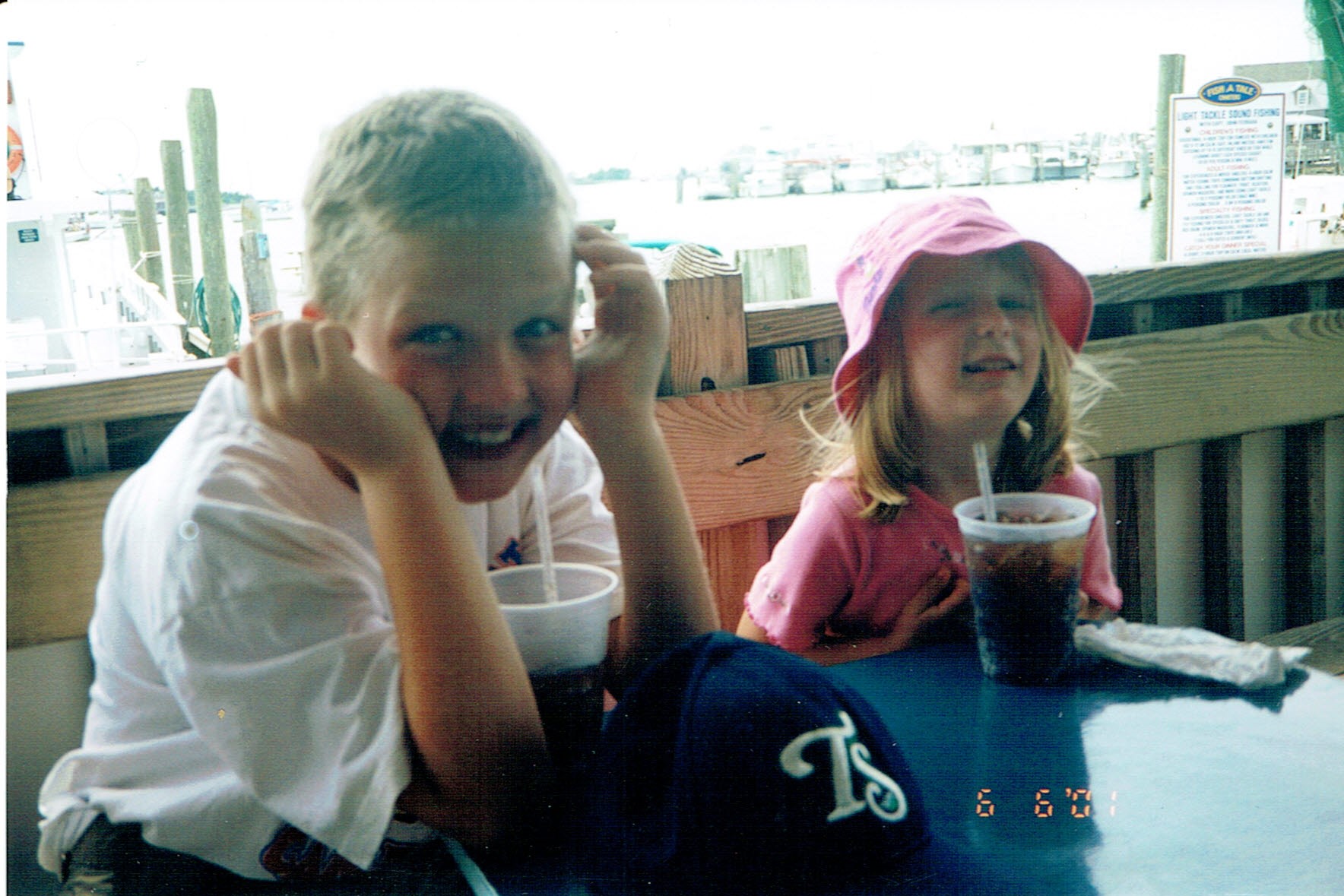
CCI09022014_0009My 23-year old son.  Philip had entered the working world and had no vacation time. He couldn’t come with us.

On one of our last nights at Deep Creek, as I lay in bed I realized that an era had come to an end. The Simpson Family Vacation was probably a thing of the past.

CCI09022014_0003You see, since my daughter Autumn (now 17) was very young we have taken two Family Trips each year. I know she was an infant when we started because I remember trying to cram her baby tub into the trunk of our compact car along with the suitcases when we went for a driving trip in Vermont. It was one of those trips where we stayed somewhere different every night, so I had lots of practice “fitting” (smashing, pushing, cursing) that bright blue plastic oval-from-hell into the trunk.

CCI09022014_0006One of the trips each year has been to Florida between Christmas and New Years, when we stay with my sister in her house that’s walking distance from the beach.

Every summer, we’ve headed out on a variety of adventures. We’ve been lots of places – from Utah to the big cities of the Northeast to Iceland and England – but the best thing about the trips was that we were TOGETHER. There is nothing like a family vacation to get on each other’s’ nerves in new places, to experience fresh disagreements instead of the same old disputes, and to find out that dad likes to get up and going on vacation when everyone likes to sleep in.

CCI09022014_0012I wouldn’t trade any of it.

Even though things often went wrong.

I’ve lost my wallet in at least two states and a foreign country. But it’s always come back. How else would we have gotten to visit the Stratford upon Avon Police Headquarters? That was the day before I flattened a “tyre” on the too-big, not the compact car we ordered when I rammed a curb in Bath.

Earlier in that trip next to a beautiful lake in Iceland, I was dive bombed by an angry arctic tern. She gave my head a good peck as I foolishly tried to snap her picture while the rest of the family wisely took cover in the car.

CCI09022014_0010Weather hasn’t always been perfect. According to the car thermometer, it was 116 degrees the day we hiked and rode horses in Zion National Park. We ended up in Disney World one year on the Fourth of July when it was well over a hundred with Florida humidity only made worse when the park got so crowded they stopped letting people in (“That almost never happens” said a Mouse employee in a cheery voice that implied, “Aren’t you lucky!) At the other extreme, we about froze in June the day we went to Mount Rushmore on my son’s “we’ll go anywhere in the US since you’ve graduated from high school” trip (he wanted to see “The Heads.”)

Simpsons at the RanchThen there was probably our best vacation – a week at a ranch in Wyoming where we learned to ride horses and herd cattle.  But early in the week Autumn was struck with altitude sickness at an 8000-feet-above-sea-level ranch in Wyoming where we spent a week. Thank goodness she had just gotten off the horse when she passed out; it was scary enough on the ground.

CCI09022014_0001Yes, Simpson Family Vacations have presented plenty of challenges. Maybe that’s part of what’s supposed to happen on Family Trips – you learn you can, together, get through whatever life throws at you.

It was usually the unplanned and unexpected that highlighted the trips. Often that involved animals. We didn’t expect the prairie dog town beside the road to Devil’s Tower in Wyoming to be more memorable than the tower itself. We didn’t plan to spend a day in CCI09022014_0011Custer State Park near “The Heads,” but we saw more buffalo and other animals that day than we had in any zoo visit – and they were in the wild. We didn’t even know the massive “Best Friends Forever” Animal shelter existed before our Grand Canyon trip, but our unplanned visit there to see so many abandoned dogs being cared for was inspiring fun. And feeding the turtles who lived in the pond next to our Outer Banks vacation rental was the prime memory of our week in a rented Hatteras house.

CCI09022014_0008

Even disappointments were memorable. Like the whales we didn’t see on the “guaranteed whale watching excursion” out of Reykjavik. The “Puffin Island” we sailed past was pretty cool, though. Also disappointing was  the several-days of driving and hiking through the Maine woods searching for a moose; the only one we found was Lenny the Chocolate Moose at a candy store.

CCI09022014_0015

CCI09022014_0016Perhaps Our Best Day Ever was the day we went to Legoland in England as part of a game show winnings financed trip. The weather was perfect and I hadn’t lost my wallet or flattened the tyre yet. Phil got to fulfill a lifelong (13 years) dream to visit the land of the Legos, and 7-year old Autumn got her “Driving License” in an electric car on the left side of the road at the Legoland Driving Academy. But the highlight CCI09022014_0013of the day was probably the farmhouse B&B we blundered into – not only were there a variety of farm animals available for petting and feeding, but there were two dogs that needed walking. Autumn still remembers walking those dogs probably more than anything else about England.

CCI09022014_0014

When you take a Family Trip, the whole exercise becomes about possibility. Memories of discoveries made become family keepsakes to be taken out and enjoyed as much – or perhaps moreso, because they are always available – than the souvenirs and pictures.

Maybe we couldn’t always really afford to take those trips, but they are some of the best money we ever spent. They’re a big reason all the WWTBAM and Jeopardy! money is gone. A financial planner would have probably told us to stay home a few summers.  But, yeah, like the commercials say . . . priceless.

CCI09022014_0005I’m writing this not just to share these memories, or to preserve them for myself, but to encourage other families, especially parents with young kids, to get out there. Not only have we gotten closer, but Philip and Autumn have experienced different places and people. They discovered they love the wide open spaces of the west. Hopefully the horizons of their dreams are similarly larger.

Make big plans, but allow time for the simple and the surprising. One year we rented a cabin on top of a mountain in the Smokey Mountains of Tennessee. The view was awesome, we took day trips to hike up mountains, play in streams, and explore towns. But our most vivid family memory of that week is the fun we had in a tire swing that hung from a big tree next to the cabin.

CCI09022014_0007

That’s an image I’ll keep with me always . . . I have a feeling that even when I’m older and not sure what I did yesterday, I’ll remember swinging in that tire with my family.

So, yes, I’m sort of grieving. The Simpson Family Vacation may indeed be a thing of the past. But I – no, WE – have the memories. They are ours. Together.

CCI09022014_0004

Posted in Family, Father | Tagged , , , , | 3 Comments

I Won’t Try to Convert You . . . Because I Can’t

Talk IconWhen I get a notification that someone has liked a post or has decided to follow The Unexpected Pastor (which you can do with the “Follow” button on the right, by the way), I usually check out their blog. The other day, someone known on WordPress as “hessianwithteeth” became a follower of this blog. Hessianwithteeth appears to be atheist or agnostic. (It is awesome that folks of many different beliefs – and unbeliefs – read The Unexpected Pastor!)  

Among the intriguing posts I read on hessianwithteeth’s blog was one called “Should We Attempt to Convert Others?”  I found it a balanced piece that was fair to both Christians and unChristians.

The post struck a nerve with folks; there were the seventy-some comments from all kinds of perspectives. Of course I had to add my own (slightly modified here) . . .


 I believe what happens when we try to “convert” other people is that they become commodities, simply objects of our perceived will and overestimated powers of persuasion. Whether Christian or Atheist, entering into communication with someone simply to convert them is the antithesis of relationship.

Rather than trying to convert people with other beliefs (or non-belief), how about if we try to get to know them? Try practicing empathy rather than beating them over the head with our right-thinking. Perhaps in the context of relationship they’ll come around to the way of thinking we believe is right, perhaps not. But in the context of relationship we might just learn something about how other people think and feel and believe (or not), and even about ourselves.

I don’t believe I can convert anyone, anyway. I don’t have that power over other folks. Once I remove that fallacy from my interactions with others, especially unChristians, then I can have actual relationships with them. I trust that the Holy Spirit will take care of the converting (or not).

One of the reasons I was an unChristian for so long before I embraced Christianity was the in-your-face “Christians” who seemed to be only interested in me as a trophy for their wall of conversion (metaphorically).  I didn’t want to be a part of all that . . . and I certainly didn’t want to encourage it by letting it succeed. Since I’ve been a Christian, I have met atheists with the same unproductive zeal.


Let me be clear here on my own blog – I am not saying that Christians should not practice evangelism. Evangelism means sharing the Good News, specifically the Good News about Jesus. Sharing the Gospel – hopefully not just, or even primarily, in what we say but especially in how we treat (love) others, especially those who are “other” (different in any way than ourselves) – is not the same as interacting with someone with the sole agenda of somehow converting them.

We Christians believe that conversion is the Holy Spirit’s work, not ours. So let’s relax and do our job – treating everyone (yes, everyone) with the grace and love we believe we have received from God.

So, Christians, atheists, agnostics, Buddhists, whoever  – I know you’re out there – what do you think about hessianwithteeth’s question? Should we attempt to convert others?

Posted in Atheism, Christian Living, Christianity, Faith | Tagged , , , | 9 Comments