Some Thoughts about Depression and Suicide

In Memorium

In Memoriam

(Yesterday after the “normal” sermon about the book of Ruth, I spent a few minutes discussing a couple of things I felt called to share.)

While I was away on vacation, Robin Williams died. It was amazing how much his death by suicide touched a nerve in people – Facebook blew up, Twitter blew up, and the news was full of reports about what happened. I was saddened by his death – he was a tremendous actor and a very funny comedian.

There were lots of good things that were said in the wake of Robin Williams death, but there were a some misconceptions that were shared, particularly by Christians, that I believe are important to address as a pastor.

First – some said or wrote that if Robin Williams had been a Christian he never would have had depression in the first place. I honestly don’t know what Robin Williams’ faith was, but that is a silly statement regardless.

Christian people – committed Christians, believing Christians, Christians who live out their faith – do deal with depression. Depression is no more a sign or a result of a lack of faith than are cancer or a broken leg. Depression is a disease, an imbalance of chemicals in the brain. Being a Christian does not inoculate a person from depression.

Certainly, as is the case with other illnesses, prayer helps.

But in the same way God has given us doctors and nurses with skills to treat heart disease and arthritis and so on, and has given us medications that also help, God has given us resources to treat depression.

For a Christian to receive therapy or take anti-depressant medication is NOT a sign of a lack of faith any more than it is for a diabetic to take insulin.

Implying as we sometimes do that “if you just had more faith you wouldn’t be depressed” or “if you prayed/went to church/ read the Bible more,” only adds to the guilt and hopelessness experienced by a person with an illness who needs treatment.

Another things folks said and wrote after Robin Williams died is this: “If he only knew how much he was loved then he wouldn’t have been depressed. He wouldn’t have killed himself.”

Now, I’m never going to preach that love isn’t important, or that God’s love – both directly from God and shared by Gods’ people – is not the greatest thing in the world. But depression makes it tough for folks to experience that love. The way I think about it is the same way a diabetic can’t process sugar without help, someone who is depressed can’t process positive things in life – including love – without help. Another analogy might be color-blindness – someone who is depressed is like someone who can only see gray, and it’s not their fault or anybody else’s fault.

Not anybody else’s fault . . . Depression is not the fault of family or friends – it’s an illness. We only make folks feel guilty when we imply “They should have been shown more love” or whatever. And that’s especially the case when suicide results from depression.

As humans, we try to figure out why a person does something harmful, and it’s only natural that we speculate when someone commits suicide as to why they did it. But that’s not what the survivors need – they are already beating themselves up enough. What the survivors need isn’t speculation and judgment – they need support and love and perhaps mental health treatment, for a time, themselves.

I’ll preach about this more sometime, but I just need to say this about suicide – Suicide is not “the unforgiveable sin.” Some churches have taught that, but it says that nowhere in the Bible. It’s a tragedy and it is certainly not what God wants his children to do. So yes, it is a sin. But we are forgiven by grace, not by what we do or don’t do – the blood of Jesus is enough to cover even a tragic thing like suicide.

Finally, if you might be depressed – there is help! It’s a sign of strength, not weakness, to ask for help when you need it. Not only is it a blessing to serve, it is a blessing to be served. One of the things that made Ruth a Woman of Valor is that she boldly got help for herself – and Naomi – when she needed it.

As your pastor, I can always listen but I am not a professional counselor. Just like if you came to me with symptoms of another illness, I can refer you to someone who God has given the skills, talents, and training to help you heal. I will certainly support you through your treatment.  I am blessed to have a wife with a counseling background – I think we are blessed as a congregation – and she is always happy to listen as well if you’d rather talk to a woman, and she can also refer you to professionals who can help.

And if you feel like hurting yourself, tell someone. Tell me, tell a friend that you know will get you help. God loves you and has given you a gift of life. God has stuff for you to do even if you can’t see it right at the moment.

Finally, I say this to our Confirmation students every year when we talk about suicide, but it goes for adults as well as middle schoolers: If someone ever says anything to you about hurting themselves, take it seriously. Don’t keep a promise not to tell someone. They may get mad at you, you may even lose a friendship, but that’s always better than losing a friend.

(Preached at Christ Evangelical Lutheran Church of Millersville, August 24, 2014)

Posted in Christian Living, Christianity, Pastors | Tagged , , , | 3 Comments

Hail To The Redskins – and Farewell

redskins jerseyPicture a buck-toothed 5th-grader with a crew cut and Husky-sized pants. It’s winter 1973 and he’s on his way to school in Richmond, VA. That’s a burgundy and gold jacket he’s wearing. If you look close, you’ll see that those pants are held up by a belt with a shiny Washington Redskins helmet-shaped buckle. The white notebook he’s carrying has a rendering of that same helmet on the front. If you look inside, on page after page Redskins helmets are painstakingly (and crudely) sketched in #2 pencil at the top and around the edges.  If you’d asked him the time, he’d have looked at the Redskins watch on his wrist.  At home was his most prized possession – an autographed black-and-white 8×10  of Redskins quarterback Billy Kilmer.

And if it was Sunday and he was on the way to church, he’d have on his burgundy Redskins clip-on tie pinned to his chest with his Redskins tie tack.

That kid, of course, is me. I’ve been a Redskins fan longer than I’ve been about anything but a Simpson. January of 1973 was magical. The ‘Skins finished off their 11-3 season with a trip to the Super Bowl where they suffered a heartbreaking loss to the Miami Dolphins.

The next summer my family would move to Jacksonville, Florida. I was sort of concerned about leaving my friends behind – but devastated to think I wouldn’t be able to watch my team on fall Sundays. To my joy and exaltation we found that the CBS station in Jacksonville showed Redskins games.

You see, long-time Redskins owner George Preston Marshall had worked diligently to make his franchise the South’s team. So the Redskins television network extended down through the Carolinas and Georgia into Jacksonville.

One of Marshall’s strategies for southern domination was to keep the team colors, as Washington Post columnist Shirley Povich famously wrote, “Burgundy, Gold, and Caucasian.” The Redskins were the last NFL team to integrate (in 1961), and only because of pressure by Attorney General Robert Kennedy. (Another famous Povich line – “Jim Brown, born ineligible to play for the Redskins, integrated their end zone three times yesterday.”)

By the time I became a fan this was just painful history. The Redskins I knew were an integrated team that would become the to win the Super Bowl with an African-American quarterback. (It is not true that a reporter asked Doug Williams before that Super Bowl, “How long have you been a black quarterback?)

As I grew up and moved from place to place, rooting for the Redskins was a constant in my life. Honestly, one of the reasons I ended up in Maryland is because I wanted to read the Washington Post each day not just for its excellent coverage of world events, but because it extensively covered the Redskins year-round.

I have traveled to five different NFL cities to cheer on the ‘Skins, and I was on the Season Ticket Waiting list for years before I finally got the letter saying I could buy home tickets. (Unfortunately, in the meantime I had taken up a vocation that required me to be busy on Sundays, so I had to decline the invitation.)

On recent fall Sunday afternoons, I have donned my Chris Cooley and then RGIII official jerseys to watch every game on television, sometimes on TIVO if I can’t see them live. I know every word to “Hail to the Redskins,” and have sung it after touchdowns even if I was  by myself.

As I sit writing this in my church office, I can see the vintage Redskins cap on the shelf above my desk and the Redskins Santa that permanently sits on my window sill. In my home office is more burgundy and gold paraphernalia.

But I won’t be buying any more. There will be no more Redskins gear for me.

“And why worry about a speck in your friend’s eye when you have a log in your own?” (Matthew 7:3, NLT)

I am so good at pointing out insensitivity and barriers to inclusiveness in others. I’ve written blog posts that called out racism, sexism, and gay-bashing. It is easy – and oh so satisfying – to point out where others fall short.

“Do to others whatever you would like them to do to you. This is the essence of all that is taught in the law and the prophets.” (Matthew 7:12, NLT)

The Golden Rule does not require sympathy. Jesus commands us to practice empathy, to walk in the shoes of another; to exalt with our neighbor in their joys, and to weep with them in their sorrow. That is difficult, and it is much easier to rationalize doing what we want to do even when it causes someone else sorrow.

The Washington football team name is causing some of my neighbors sorrow. For too long I have excused my insensitivity – “It really honors Native Americans,” or, “Not all Native Americans are offended,” or, worst of all, “I have a right to root for who I want to and the the team has a right to use whatever name they want.”

But Jesus calls us to give more consideration to our neighbor’s plight than to our rights.

If my neighbor is offended, then I need to take a look at what I am doing. I am called to compare my conduct and decisions to that of Jesus Christ . . . Do I really think Jesus would be singing “Hail to the Redskins” if he were around today knowing that it hurts some of his children?

If we hold on to traditions and attitudes that offend, then it ultimately damages our witness to the only truly offensive thing that we are supposed to hold on to – the Cross. (In his epistles, Paul writes about how the cross is offensive to the world because of the whole idea of an innocent man being put to death for the sins of the world.)

So, I have decided not to support the Washington football team with any more of my money – through team merchandise or tickets – until the name is changed. I will publicly, beginning with this blog, let folks know how I feel about the team name. I will try not to use that name in writing or in speech. It is very unlikely to change anything the Washington team does, but it is what I need to do to live congruently with what I believe and teach.

Some will appeal to “tradition” as a reason for keeping the name; when that “tradition” includes a legacy of segregation and a clearly racist former owner – who named the team! – those appeals ring hollow.

While I was driving yesterday, I was listening to a sports talk program out of DC. Former Washington football players Brian Mitchell and Doc Walker were talking about the name. Even though they were speaking about the team they loved on the radio station owned by Daniel Snyder, the current team owner, they both spoke in favor changing the name. “I know what it feels like to be discounted and dismissed,” Doc Walker said (both Mitchell and Walker are African Americans). He said his change of heart came when he met a Native American on an airplane and asked him what he thought of the name. Hearing that man’s offense changed Doc Walker’s mind.

For me, it hasn’t been one event or one conversation, but rather a gradual feeling of conviction that I needed to be consistent in my walk of faith. Some will blow this off as “Political Correctness” – I’m not even sure what that means, but screaming “political correctness” seems to be a convenient means of dismissing the consideration of others’ feelings when it would impinge on our “rights.”

This is simply one way for me to live that Golden Rule I am so good at preaching to others; one way to deal with that log in my eye rather than the specks in the eyes of others.

 If you missed the powerful commercial funded by Native Americans that aired during the NBA Playoffs, you should watch it here.

Posted in Christian Living, Christianity, Football | Tagged , , , | 3 Comments

Better Than an Arc Reactor – A Superhero Pentecost Sermon

Iron Man

(You can hear this sermon here. It’s based on Acts 2:1-21.)

Late this week I read an excellent blog post by Pastor Ed Strietelmeier about Superheroes and Pentecost.

I was going to preach about something else on this Pentecost Sunday, but it seemed like it was a lot more fun to preach about Superheroes.  That’s how the title of this sermon became, “Better than an Arc Reactor.”

Who knows what superhero has an Arc Reactor implanted in his chest? [Iron Man].  We’ll come back to Iron Man and his Arc Reactor a little later.

Spider-ManEvery superhero has an origin story, right? Peter Parker was just a normal teenager until  what happened?  [Spider Bite]  That’s right, he got bitten by a radioactive spider and then he got his spidey powers. He became . . . Spiderman.

Captain AmericaSteve Rogers was rejected from the army when he tried to go defeat the biggest bully of all in World War Two. But he was selected for a secret program and injected with Super Soldier Serum (say that three times fast!) and he became . . . Captain America.

SupermanKal el was just a regular baby on Krypton until his father rocketed him to earth and he became . . . Superman.

the incredible hulkAnd David Banner became the Hulk after he was exposed to gamma rays.

What does all this superhero background have to do with Pentecost? Remember, Peter Parker, Steve Rogers, Kal El, and David Banner were just normal folks.  In fact, they were far from being anything like a superhero, they were pretty much nerds.  (I have the authority to speak about nerds when my favorite thing to do is to play on a trivia team and here I am preaching about superheroes.  But SOMETHING HAPPENED in the life of each of them, and they were TRANSFORMED. They became superheroes.

And that is the story of Pentecost!

Stay with me . . .

last supperLet’s look at the disciples. Remember them – a long way from superheroes.  They were the unlikely men that Jesus chose to be his closest followers and students. If you’re like me you read the Gospels and see what the disciples say and do and wonder if maybe Jesus had made a terrible mistake.  Those guys misunderstood Jesus over and over, they fought about who was the greatest among them right when Jesus told them he’s going to die, one of them betrayed him and another denied him three times. And then, even though Jesus told them over and over he was going to die, they were shocked and surprised when Jesus was arrested and killed.

They were just as surprised when he rose again on Easter!

The resurrected Jesus was with them for 40 days. Then he took them up on top of Mt. Olives and told them he was leaving them but the Holy Spirit would come on them, just wait for it.

They still didn’t get it. One of them asked him, “NOW are you going to establish your kingdom in Israel?”

They didn’t understand that Jesus had commissioned THEM to take the kingdom of God into the world.

Then he ascended. We talked a little bit about that last week. He took the cosmic elevator away from them and they stood there watching until an angel told them to stop looking up – someday he’s coming back.  The implied message is . . . ‘You’ve got work to do.”

So they waited as Jesus told them to do. They don’t know – they can’t know – what this “Holy Spirit coming on them” business is about. Ten days pass. During that time they hung out and prayed together. There were others with them as well including Jesus’ brothers, his mother, and other women.

And they wait.

Ten days after Jesus’ ascension, 50 days after Easter, it’s Pentecost Time – one of the three big festivals of the Jewish Year.  Jerusalem is filled with Jewish pilgrims from all over the Roman Empire, wearing different clothes, practicing different customs, speaking different languages.

PentecostThe disciples were gathered in one place. You know the rest of the story because I just shared it with the young people – wind, tongues of fire, instant Berlitz language courses for the disciples.

They are TRANSFORMED.

Peter – the same Peter who out of fear denied even knowing Jesus – Peter stands up and begins to preach perhaps the most powerful sermon ever! Preaching to all those folks gathered in Jerusalem.

Peter was TRANSFORMED.

Now, there are some who see and hear all this and reject the whole thing – “Listen to them babbling on. Those guys must be drunk!” (I’ve never been convinced by Peter’s response that “We can’t be drunk it’s only 9:00” – I’ve known some folks . . .).

But THREE THOUSAND repented and were baptized that day!  Christianity goes from 12 disciples plus Jesus’  brothers and a few women to 3000+ IN ONE DAY!

Those who heard and were baptized were TRANSFORMED!

What was it that caused the sound of the wind and the tongues of fire? What transformed the disciples? What transformed Peter? What transformed those who were baptized?

Wrong questions!  It’s not a matter of WHAT did all that transforming – it’s WHO transformed all those folks?

You already know the answer because it’s Pentecost – The Holy Spirit.

Peter and the others gathered there became superheroes that day – no longer were they ordinary people, but now they had Holy Spirit Power – they had the Holy Spirit living in them.

Think about it – God moved into each of those who were gathered on that first Pentecost. Their bodies became Temples of God. The first evidence of that power was their polyglottic speech.  (That’s your superhero word for the day – polyglottic.) They began to speak in different languages that they had never known before.

That was a GIFT of the Holy Spirit. That was their first Superhero power!

They had the power of God living inside of them. The greatest power of all!

But, as Peter Parker’s Uncle Ben told him after Peter had become Spiderman – “With great power comes great responsibility.”

No longer could the followers of Jesus huddle together behind closed doors. No longer could they keep the Good News about Jesus to themselves. They had the responsibility to share it. More than that, they HAD to share it.  They couldn’t help it.

David Lose, a pastor and seminary professor, says that the Holy Spirit wasn’t given to the church on Pentecost  to solve problems, but rather to create a new one. . . how do we get the Good News about Jesus out into the world?

So, what do you think? Have you ever thought about the first followers of Jesus as superheroes? I mean, superheroes have great power and what greater power is there than GOD – God living inside of them! But it wasn’t just those first followers in the upper room – no, as soon as those 3000 believed and were baptized, they got Holy Spirit Power as well!  3000 more superheroes that day!

And I bet some of you already see where I’m going with this – there’s about 200 of us gathered here this morning, almost  all of us baptized, which means that God has poured out God’s Holy Spirit into us . . . so here we are, gathered together a bunch of superheroes . . .

The AvengersYES, WE ARE THE AVENGERS!  Superheroes called together for a common mission – for the Avengers it was to defeat Loki (in the first movie, anyway). For us, it is to share the Good News about Jesus.

Wait a minute, Pastor Dave, I can hear some of you protesting. I get that I have the power of the Holy Spirit within me, but I don’t have any super powers. I can’t fly or shoot webs out of my hands or throw a magical hammer or any of that stuff. I can’t even speak another language.

But you do have Holy Spirit Powers – Super Powers if you’ll give me the grace to call them that this morning. They are called Gifts of the Spirit, and we all have them. They are listed in the New Testament in several different places – they aren’t just things like preaching and teaching, but include hospitality and service and encouraging. Generosity is a gift of the spirit, and so is mercy.

Like the Avengers, superheroes who had different super powers and learned to use them together, we gather as God’s church with different gifts of the spirit, all of them necessary for our God – given mission.

Perhaps the greatest gift of the Spirit, though, is one that we all share. That is FAITH. Remember, as Martin Luther wrote,” I believe that I cannot by my own reason or strength believe in Jesus Christ, my Lord, or come to Him; but the Holy Spirit has called me by the Gospel, enlightened me with His gifts, sanctified and kept me in the true faith.”

He goes on to write that it is the Holy Spirit that calls, gathers, enlightens, and sanctifies the church. We can’t be the church without the Holy Spirit.  That’s why Pentecost is sometimes called the birthday of the church.

Our Mission Statement at this particular church is to “Gather, Grow and Go.” I still remember the meeting of the Mission Statement Team where we came up with that – or more exactly when the Holy Spirit inspired us to come up with that. It was written up on a white board, and we thought it was great, but somebody, I don’t remember who, said, “It needs more.” And that person reminded us of the POWER that enables us to serve in mission together.

And that’s how the four most important words were added to our Mission Statement, how it became “EMPOWERED BY THE HOLY SPIRIT, we Gather, Grow, and Go!”

We’re a Holy Spirit church because there is no other kind of church.

I’m going to close with another superhero example. Now we’re going to get to the Arc Reactor.

Ironman is Tony Stark, who was a wealthy arms manufacturer.  He went to Afghanistan to sell missiles and he was captured by terrorists. In captivity he constructed the first Iron Man suit. It was powered by an Arc Reactor.

The Arc Reactor was also the thing that kept Tony Stark alive. He had been wounded by the terrorists and the Arc Reactor eventually implanted in his chest was the power that kept shrapnel from entering his heart and killing him.

tony stark arc reactorSo picture Iron Man, picture Tony Stark, with that Arc Reactor glowing in his chest. Keeping him alive.

That is the Holy Spirit for us. God in our hearts, giving us life.

We were dead in sin, and we are now alive in Christ. It is the Holy Spirit in us that is our life source, as the people of God and as the church.

Holy Spirit power – it’s even better than an Arc Reactor.

Happy Pentecost!

(Preached at Christ Evangelical Lutheran Church of Millersville on Pentecost Sunday, June 8, 2014.)

Posted in Bible, Christianity, Sermon | Tagged , , , | 4 Comments

What Must I Do To Be Saved? (Plus a story about a free hot dog)

I’ve had more requests for this sermon based on Acts 16:16-34 than any in a while. I think it’ s because it’s a clear explication of grace. At least I hope it’s not just because of the hot dog story at the end. You can also listen to it (or a version of it – I preached it without a manuscript or notes) here.

free disney vacationA friend of mine told me about a call she received.  When she picked up the phone a voice said, “You have WON! You have won a FREE trip to Disney World!” The prize included airfare, hotel, food, and tickets to Disney.

My friend was understandably very excited.  She said, “That’s great! How can I get this free trip?”

The person on the phone responded, “Well, what you have to do to start is to give me your credit card number. There’s a $250 processing fee . . . for your free trip.”

My friend hung up.

Was that really a free trip?

I received a mailing a few years ago. It said you and your family can come to Williamsburg for three days and two nights. All expenses paid! It was a gift from the company who mailed it.  They would put us up in a nice place, feed us, even give us tickets to Colonial Williamsburg and Busch Gardens.  So I called the number on the mailing.

When I called they said, “Yes, the trip really is free. It’s our gift. All you have to do is agree to go to a brief presentation about buying timeshares. You just have to experience this presentation to the end to get your free trip.”

I didn’t go.

Was that a free trip?

I want you to keep those “free trips – those “gifts” – in mind today as we talk about the answer to one of the most important questions in Scripture. It’s also one of the most important questions in our lives. It is the question the jailer asked Paul.

“What must I do to be saved?”

What does GRACE – God’s underserved, free gift of love and salvation, really mean?

Let’s briefly look at the context of the jailer’s question before we really get into that.

Paul and Silas are taking the Gospel to the Gentiles – to the non-Jews, to people like most of us. Last week we heard about Paul’s conversion and that God had chosen Paul to take the good news about Jesus to the Gentiles. Today’s reading takes place a few years later when Paul, along with Silas, is doing just that.  They have gone into Europe for the first time, specifically in a Greek city called Philippi.  We know it from Paul’s letter to the Philippians.

Now in Philippi there was a woman who followed Paul and Silas wherever they went. She was a slave who had a spirit or a demon inside of her that allowed her to tell the future – or to appear to be able to tell the future. As she trailed Paul and Silas, she kept shouting something that was true but must have gotten annoying after a while – “These men are slaves of the most high God who are telling you the way to saved.”  Eventually Paul got annoyed enough that he turned around and, in the name of Jesus, cast that spirit or demon out of the woman.

This made her owners very angry. She was making them lots of money from her purported fortune-telling, and now that was over.  So the owners accused Paul and Silas of saying things against the Roman Empire and dragged them before the town council. The council had Paul and Silas stripped, beaten, and thrown into jail.

They are put into the deepest part of the jail – the darkest, most isolated place. And they are put into stocks so they cannot move. What do Paul and Silas do?

All night they sing praises to God.

Later that night the earth trembled and rumbled. The earthquake was some kind of miracle because it causes the prison doors to swing open and the prisoners to be unbound.

The earthquake shook the jailer awake. He saw the open doors of the prison and figured that all the prisoners under his watch had escaped. The jailer feared he was in so much trouble that he might as well end it all.  Just as he was about to kill himself a voice came from deep inside the prison . . .

“Stop! We’re still here!  We didn’t leave!”

The jailer was so impressed by this that he asked Paul and Silas The Question: “Sirs, what must I do to be saved?”

“How can I get what you have? How can I get the kind of FREEDOM where you don’ thave to walk out of the prison when the doors swing open? How do I get the kind of FREEDOM that when I’m inside a prison, I can sing praises to God? How can that happen in my life?”

What do we need to do to be saved?

Last fall, a local church put this on their church sign:

What do I have to do to be saved? Nothing.

As you might imagine that sign caused lots of conversation. People called and left messages on the church voicemail. People in the congregation were talking about it. (Isn’t that a good thing, to have people discussing salvation?)

I thought that was a good thing so I posted that sign on my Facebook page where it caused more conversation. People talked to me, they messaged me.  “How can that be right? How can that be? How can we need to do NOTHING to be saved?”

One conversation went back and forth and I made a blog post out of it (with their permission).

You see, we are OFFENDED by that, by the idea that we don’t have to do anything to be saved. It’s too easy! It’s too wide open!

If that’s true, then just ANYBODY could get in!

But what was Paul’s answer to the jailer? When the jailer asked, “What must I do to be saved,” Paul responded, “Believe in Jesus Christ.”

That’s something, isn’t it?  Believing is certainly not nothing.

But is it something I do?  Is believing something I have to do to be saved?

Can I decide to believe that Jesus Christ died for my sins? Can I decide to believe that Jesus  Christ is the King of the Universe, that Jesus Christ is the Son of God?

I don’t think so.

Neither did Martin Luther.

Luther wrote this at the beginning of his explanation of the third article of the Apostle’s Creed in the Small Catechism: “I believe that I cannot by my own reason or strength believe in Jesus Christ.”

In other words, believing in Christ is something we are not capable of doing. Belief is something the Holy Spirit creates in us. It’s not something we can take credit for.

So if all we have to do in order to be saved is to believe in Jesus Christ, then there is nothing we have to do because that is something the Holy Spirit does in us.

The most beautiful picture we have of that in the church is baptism. Parents bring a little baby to the font. That baby hasn’t made a decision for Jesus Christ. That baby hasn’t been asked if she wants to be baptized. But at the baptismal font water we pour water over that child believing that God will create faith in that child. Believing that through the water and the Word God will claim that child as God’s own. Believing that through the water and the Word that child is forgiven of their sin and sinfulness.  That child does nothing, and yet that child is saved.

Our human nature is to want to take some credit for our salvation. 

What about repentance? Doesn’t the Bible say you have to repent?  Sure it does. But we have a mistaken idea about repentance. Sometimes we think of repentance as making a to-do list of our sins and then checking them off as we solve each one.  That’s not what repentance is at all. We are never going to get to the end of that list! We’ll be working on it until we die. And if we have to finish that list before we’re saved then we are all in deep, deep trouble.

Repentance, Biblical repentance, means a change – a transformation – of our hearts and minds. We can’t do that. Repentance is something the Holy Spirit does inside of us.

Salvation is God’s work, not ours. It is Christ’s work on the cross where he said, “It is FINISHED.”

Ephesians Chapter 2, verse 8 . . . “For it is by grace” – God’s GIFT of undeserved love and  salvation – “by grace that you have been saved, through faith – and this is not from yourselves, it is the gift of God.”

The GIFT of God.

But some of us want to make god into a telemarketer telling us that salvation is a gift but there is a processing fee.

Some of us want to make God into a timeshare salesman saying that salvation is a gift but you have to do this stuff in order to earn it.

God is neither of those things. God loves us and if God says that our salvation is a gift then it is a gift. No strings attached.

My dad, like all dads, could be embarrassing sometimes. He had his hangups, those things that really bothered him. One of them was, “Buy one get one free.” It was not beyond him to find a “Buy one get one free” special in a store and ask for the free one. Of course he’d be reminded that you had to “buy one” to “get one free.”

“Then it’s not really free, is it,” was my dad’s response.

I think some of the confusion comes from conflating two questions into one.  “What must I do to be saved” is one question.  God is the answer to that one – the Cross is the answer to that one.

The other question is “What must I do,” or the way I like to think about it, “What do I GET to do once I’m saved.”  Because then there is stuff we are called to do, that we need to do, that we are commanded to do, that we even have to do.

But not to earn our salvation or even to keep it.

On this Mother’s Day I talked during Children’s Time about my mom. Growing up, there was stuff I had to do in my house. If anyone asked me what I had to do, I would have told them that for one thing, my mom says I have to make my bed every day. But the truth was – and parents you may want to cover your children’s ears – the truth was that maybe one day out of each week I actually made my bed. Which honestly is better than I do now.

But you know what, I “had” to make my bed. But when I didn’t do it, when I didn’t  do other things mom said I “had” to do, mom didn’t disown me, she didn’t stop loving me, I didn’t get kicked out of the family. I was still loved.

There were consequences, sure. And certainly there are consequences when we don’t do the things we have to do as followers of Christ. The biggest consequence is that our relationship with God and our relationships with other people are damaged. But God still loves us, God doesn’t kick us out of the family – we are still God’s children.

Do you know why this is such good news?  If salvation is all up to God, we never have to worry, we never have to fret, we never have to wonder if we’ve done enough.  Because when Jesus Christ said, “It is finished” on the cross he meant it.

That’s very good news.

Our job – our main job – is to do what Paul and Silas did in that prison. We are to go out into the world and to live out our freedom. We are free from sin, we are free from having to earn our salvation. That is what enabled Paul and Silas to sing praises to God even confined in the stocks, it is what empowered Paul and Silas to remain in the jail even when the doors were opened. Paul and Silas lived their freedom and the jailer asked, “How can I get what you have.”

We are called to live out our freedom so that those who don’t know the good news about Jesus will say to us, “How can I get what you have?”  Our freedom is not to do whatever we want, our freedom is to proclaim Christ through what we say and what we do.

I’m going to close with a small example.  I’m reluctant to share this story because it’s one of the times I think got things right, but I’ve shared with you enough of the times I messed up . . .

Last Monday evening, Philip and I went down to DC for a Nationals game. I know some of you are thinking that’s not what I got right; I should have gone to an Orioles game. But anyway, it was raining. It was a miserable night. I wasn’t in the best of mood because of the rain it looked like the game was going to stop and we’d gone all the way down there . . .

But 15 minutes before the game began I told Philip I was going out to the concession stand and get us a couple of hot dogs. I figured I had plenty of time before the game started. So I got to the concession stand and, you know what – this is an amazing thing! – at this major league baseball game before it even started they were out of hot dogs. There were three kinds of hot dogs – Nats Dogs, Kosher Dogs, and Beef Dogs – and they had none of any of them.

And they were taking people’s money and then telling them they were out of hot dogs so you had to wait.

I’m one of those people who wants to see every pitch of the baseball game. I keep score in my little scorebook. And I missed the beginning of the game waiting for two Nats Dogs. One for me and one for Philip.

Then when the Nats Dogs finally came and I took out my credit card and tried to pay the lady at the register said, “I don’t know how to take credit cards” and pointed me over to another register where I had to wait again to pay for my two Nats Dogs. The lady there finally swiped my card and I was free.

So I was walking back to my seat and thinking about what she had charged me and I realized she had only charged me for one Nats Dog. So I’m sitting there watching the top of the first inning – at least as much as I got to see – thinking “What should I do about this free Nats Dog?”

“Well I deserve this free Nats Dog because they made me stand in line and miss the beginning of the game!”

But when the top of the first was over I said to Phil, “I’ve got to go back.”

So I went back to the concession stand, got back in line, and when I got to the front I said, “You only charged me for one Nats Dog, here’s my receipt . . . and here’s some cash to pay for the other one.”  So I gave the cashier my $4 and she said, “Wow! At least your honest.” And I managed to say something about how my faith required me to be that way.

Now she didn’t fall down right there and shout out, “Sir, what must I do to be saved!”

But maybe, just maybe, a seed was planted.  That Christians are different. In a good way.  And who knows what God might do with that seed.

And Phil is 23, but maybe, just maybe, I can still give him some good examples of what it means to be a follower of Jesus Christ.  Because there have been plenty of other kinds of examples.

We are saved by the grace of God. Salvation is a gift. It is all God’s action. Because we are so grateful, because we want other people to know about and experience that joy and that grace, we go out into the world and live lives that invite other people to ask, “Tell me, what do I need to do to be saved.”

AMEN

(Originally preached at Christ Evangelical Lutheran Church of Millersville May 11, 2014.)

Posted in Christianity, Faith, Lutheran Theology, Martin Luther, Salvation by Grace | Tagged , , , , | 2 Comments

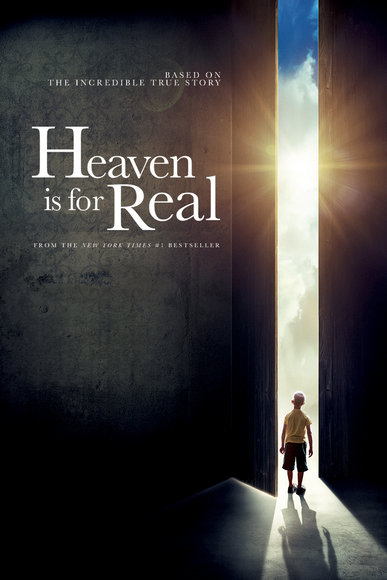
Heaven Is For Realz #feelgoodism

heaven is for real onesheet

How did I end up going to see “Heaven Is For Real” last Saturday afternoon? I’m teaching a Bible Study on the afterlife, and the movie (and book) about four-year old Colton Burpo’s visit to “heaven” is inevitably a topic of conversation.

(Before we go on, an advisory: Like many of my posts, this one is somewhat lengthy and meandering. I hope you’ll stick with it. But if you’re looking for a more succinct but similarly theologically sound reaction to the film, my friend and colleague Pastor Earl Janssen has written just such a post.)

As a film, “Heaven Is For Real” surprised me by being a higher-quality production than the usual Christian polemic like “Facing the Giants” or “Fireproof.” Sure, clichés abound – a sudden wind sweeps through the house as Colton is making one of his big reveals about heaven, and I about threw my popcorn box at the screen when the little circle of sooty firemen took their helmets off and bowed their heads to pray (isn’t that scene in every Christian movie of the past 25 years?).

 There are also continuity issues, such as one sequence of scenes where the world brightens as it gets later into the evening – Greg Kinnear puts his kids to bed in the evening gloom, then shares a moment with his wife on the porch as the sun is just setting, then he gets a fire call and by the time he’s on the fire truck racing down the road it’s a bright, sunny day.

Maybe it was a MIRACLE, like when God made the sun stand still for Joshua or when God made a rainbow on a clear day in answer to Colton’s prayer (in the book not in the movie).

Sorry, was that snarky?  My point is that continuity errors  do not enhance a film’s credibility.

The thing that did give “Heaven Is for Real” what credibility and heft it had was Greg Kinnear’s performance. He plays Pastor Todd Burpo (“Call me Todd”), the father of the boy who allegedly visited heaven. The movie is framed as Todd’s story. And Kinnear captures the struggle of a man who doubts not just his son’s trip to heaven, but his call to ministry and even God’s goodness in the face of the Job-like trials he endures.

Kinnear in Heaven is For RealThis movie works – and there are times when it is quite good – when Kinnear wrestles with belief and doubt. He’s the modern embodiment of the man who asks Jesus to heal his son, to whom Jesus replies that anything is possible for someone who believes.  The man answers, “I believe. Help me get over my unbelief.”

According to the movie, and to the book upon which it is based, the way God helps Todd get over his unbelief is by sending his son to heaven.

Really?

Now, I’m not denying that Colton must have experienced SOMETHING while he was under anesthesia. But he didn’t die, so it wasn’t death. According to the doctors, he didn’t even come close to dying so it wasn’t a Near Death Experience (NDE). It was just an E – an experience.

Credibility has been given to the experience because Colton supposedly came back knowing things he didn’t know before – especially that his mother had a miscarriage.

colton burpo heaven is for realAs Ann Hornaday points out in her review of “Heaven Is for Real,” there is a subversive strand in the movie that isn’t in the book that provides an alternative explanation for Colton’s knowledge. In several scenes Colton is shown overhearing adult conversations where they don’t notice him there.  Could this have been how he knew he had a miscarried sister?

When I was about Colton’s age, I can remember overhearing my mom talking – and crying – about a neighbor’s miscarriage. We never talked about it, but I’m pretty sure she’d be surprised to find I knew about that.

Depending on the testimony of a four-year old for eternal knowledge is pretty tenuous, anyway. I remember watching football with my dad when I was four (maybe a bit younger) and seeing a player go off the field and get replaced by someone else after a play. I asked my dad what had happened, “Oh, he got hurt.”  The next play was a change of possession and everybody ran off and was replaced. This sport is too dangerous for me, I thought.

Four-year olds have an innocence, sure, but they process things at a pre-school level.

But for Christians, “How could Colton have known those things” or “How credible is a four-year old” are not our ultimate measuring sticks for something like “Heaven Is For Real.”

When someone makes a claim about God or the things of God (like heaven), our tool for determining its truth is God’s Word.

What concerns me about “Heaven Is For Real,” both book and movie, is that it suggests that God’s Word is not enough.

There is a scene late in the movie where Todd is sitting in a cemetery with a woman (the always excellent Margo Martindale) whose son died years before. Pastor Todd says to her, “I let you down, I had nothing to give you.”

What?! How about Jesus? How about the resurrection? How about hope? You had nothing to give her until Colton took his jaunt in heaven? It’s good that happened because there is nothing sufficient in God’s Word – in the life, death, and resurrection of Jesus Christ – to comfort the bereaved?!

How did we ever conduct all those Christian funerals before Colton?

Our ultimate hope isn’t “heaven” anyway. The Bible doesn’t teach that we are going to spend an eternity as spirits in heaven, but rather in perfect new bodies (mine’s going to have hair!) on a perfect new earth. Stories like “Heaven Is For Real” distort, and distract us from, the real hope we have of, as the Apostle’s Creed states, “The resurrection of the body.”

There are a plethora of books purporting to describe journeys to heaven. Although they are similar in some ways, they vary in detail. For example, according to Colton people in heaven have wings. Don Piper, author of “90 Minutes in Heaven,” says they don’t. A small detail to be sure, but both can’t be right.

So how do we choose? As Christians, our authority is God’s Word.

“But Pastor Dave,” folks reply, “These stories give people comfort. Why do you want to take that away?”

Because I pray that folks will be comforted based on the firm foundation of God’s Word, not on the equivocal experience of a four-year old. Once we start accepting things as true because they make us feel good, then we have left Christianity and entered “Feelgoodism.”

Feelgoodism is rampant among Christians these days. It is embodied in the biggest church in America, Joel Osteen’s Lakewood Church. “God wants you to be rich, successful, beautiful,” and so on makes people feel good but it’s not Biblical. “If you just ask and believe you’ll get it, God will give you what you want” sounds good until you consider the millions of Christians who live in the third world. Or Christians who are imprisoned and even killed for their beliefs – according to Osteen and other purveyors of Feelgoodism, their faith must really suck.

“Heaven Is For Real” is finally problematic because its popularity is a product of wanton Feelgoodism. Feelgoodism disregards the tough passages of Scripture and focuses on “what’s in it for me.” Feelgoodism makes Christianity all about ME, and not about loving God and loving neighbor.

Feelgoodism embraces “Heaven Is For Real.”

But for followers of Jesus Christ, the Bible is Enough.

Jesus is enough.

Posted in Christian Living, Christianity, Movies | Tagged , , , , | 11 Comments

Easter, The Last Two Minutes

Painting by Karen, my wife, who got me back into church(After I was done with the prepared part of my Easter Sermon, I spoke from my heart for a bit. Here’s sort of what I said – it wasn’t written down until now and it was a little different at each service.)

So that’s the “big finish” for the Easter Sermon.

But  I’m going to keep going for another couple of minutes.  Because every Easter and Christmas Eve I realize there are folks here who are like I was. You’re here because someone said, “Hey, you’ve gotta come” or because it’s a family tradition. Or because it’s the thing to do on Easter Sunday.

Maybe you consider yourself an atheist or an agnostic like I did. Maybe you consider yourself a seeker or a searcher. Maybe you’re not sure where you are spiritually.  Maybe you’re a Christian who’s doubting and struggling with faith right now.

Whyever you’re here, I’m glad you’re here. You are welcome here. I’m the last person to judge anybody about why they’re in church – I came back when I was 33 because it was the only way my girlfriend would date me!

What I want to say to you is this . . .

What we’re talking about this morning – the suffering, death, and resurrection of Jesus – that’s the essence of our faith.  

I want to apologize to you.  We Christians have given you a mistaken impression of what our faith is all about. Some of our most vocal Christians have made it seem that the most important thing about our faith is the rules, the rules, the rules.  And that this (the Bible) is a rule book.  I had that impression myself.  People used to hit me over the head with this book all the time when I wasn’t a Christian.

But this is not a rule book. Not primarily. Sure, there are things in here that God wants us to do, even commands us to do because it’s good for us and good for our relationships with God and with other people. But the essence of this book is that it is a love story. And it is a love story like no other. Most love stories are about two other people.  This one is about God and you.

God invites all of us – God invites you – into that love story. That’s what the suffering, death, and resurrection of Jesus is really about.

You don’t have to be a “good person.” That’s another lie we’ve told the world – that the church is made up of good people. It’s actually the opposite; the church is people who realize how much forgiveness we need. There’s a reason we start each service with Confession!

I’m sure you have questions about Christianity.  That’s awesome!  I had hundreds when I wasn’t a Christian.  Now I have thousands!  God can handle our questions.  Ask somebody – you can always ask me; text me, e-mail me, Facebook message me.  My answer may be “I don’t know” but I’ll always respond.  I’ll always listen.  Or find someone else you can talk to.

I want to invite you this morning into that love story. Because that is what Easter is all about.  That is what following Jesus is all about.

To begin that journey, you don’t have to do anything but realize that it’s all been done . . . for you.

On the Cross, Jesus said, “It is finished.”  Everything was completed to save the world. Everything was done to save . . . you.

Yes, on the Cross Jesus said, “It is finished.”

On Easter Sunday, he walked out of the tomb to prove that it was . . . Finished.

—————

(Painting by Karen, my wife, who got me back into church before she was my wife.)


Posted in Christianity, Church | Tagged , , , , | 5 Comments

Jesus’ Wife Gets a Date

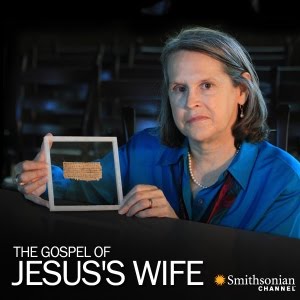
Gospel of Jesus WifeAs surely as political attack ads proliferate prior to polling, stories with supposed challenges to Christianity pop up in newspapers and magazines right before Christmas and Easter. One year it’s “The Gospel of Judas,” the next it’s “The Jesus Tomb.” Often there are articles months later that basically say, “We were wrong.” This year, the media’s Easter Basket is filled to overflowing with headlines that imply Jesus was . . .  married!

I just got 72,000 hits by typing “Jesus wife” into Google’s news search. Like children hunting Easter eggs that might contain chocolaty treats, the news folks apparently can’t resist this kind of story. Maybe you’ve seen the headlines:

  •  Scientific Tests Show “Gospel of Jesus’ Wife Wasn’t Faked”
  • “The Gospel of Jesus’s Wife” Is Real, What Now?
  • Controversial “Gospel of Jesus’ Wife” Is the Real Thing, Say Researchers

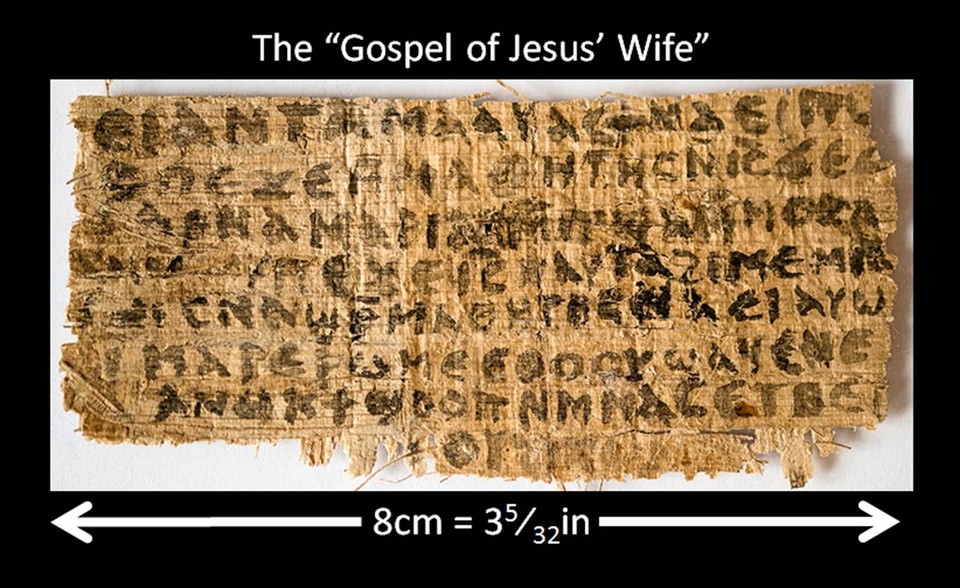
Just reading these pithy headings gives the impression that it has somehow been confirmed that Jesus was married.  But if you read the articles, you find they are as empty as a hollow chocolate Easter bunny.  The new “proof” is not that Jesus had a wife, but rather the date the “Gospel of Jesus Wife”was written. They’ve determined it’s not a modern forgery.

The testing shows conclusively that it was written as early as . . . several hundred years after Jesus’ death.  Wow. (Please read that “wow” with appropriate sarcasm, as if I was reacting to finding a peanut butter and chocolate candy made by anyone other than Reese’s in my Easter Basket.)

So, several hundred years after Jesus lived, someone wrote that he said something about his wife. But we don’t really know what.

The Gospel of Jesus WifeYou see, the “Gospel of Jesus Wife,” as impressive as it sounds, is actually a credit-card sized scrap of writing that is totally devoid of any context whatsoever.  At one edge, it says this, “Jesus said to them, ‘My wife . . .” The rest of the sentence is missing because the paper is ripped. Not only do we have no idea if Jesus actually said those words, but we don’t know what he said about “my wife.”

Maybe Jesus was talking about the church, described as “The Bride of Christ” in Scripture. Maybe he was making some other analogy.

Henny YoungmanI kind of hope he was making a joke – perhaps he was taking a moment to be a 1st century Henny Youngman; the complete sentence could have been, “My wife, take her please.” Of course Jesus had a sense of humor, and if he did make jokes, would it be so surprising that they would have been repeated centuries later on the Borscht Belt circuit? Jesus was Jewish, after all.

But seriously, folks . . .

No, I’m not taking this very seriously. It’s really kind of silly, but par for the pre-Christian holiday course in American media.

Don’t get me wrong, I’m not accusing the media of any vast conspiracy to undermine Christianity.  If that’s what they were doing, surely they could come up with something much better than this lame stuff.  They’re just trying to lure readers and web-surfers.

And besides, so what if Jesus was married?

I don’t think Jesus was married because one of the Gospel writers or Paul surely would have mentioned it; but it is possible they didn’t include that information because they just assumed everyone would know that rabbis got married and so Jesus, a rabbi, was married. Also, we don’t know everything about Jesus (John says all the books in the world couldn’t hold everything he did) so maybe that’s one of the things we don’t know.

What we do know is that Jesus never sinned. But getting married is not a sin.  And neither is – hold on to your pantaloons – sex.

Like anything else God created, sex when practiced as God intended (we can disagree about the particulars of that) is good. I think some of our resistance to Jesus being married stems from our puritanical and not necessarily Biblical attitudes about sex, even in marriage.  Paul writes that married people shouldn’t withhold intimacy from each other; we really should give that message equal prominence to the “purity until marriage” preaching.

If we found out Jesus were married, maybe we could let go of some of the paternalism that still pervades parts of the church.  (We need to do that whether or not Jesus was married.) The Roman Catholic Church would certainly have to reconsider that whole celibacy for priests thing, wouldn’t they?

If definitive evidence of Jesus being married was found tomorrow (this Jesus Wife Gospel thing ain’t it), it would not affect my faith one iota.

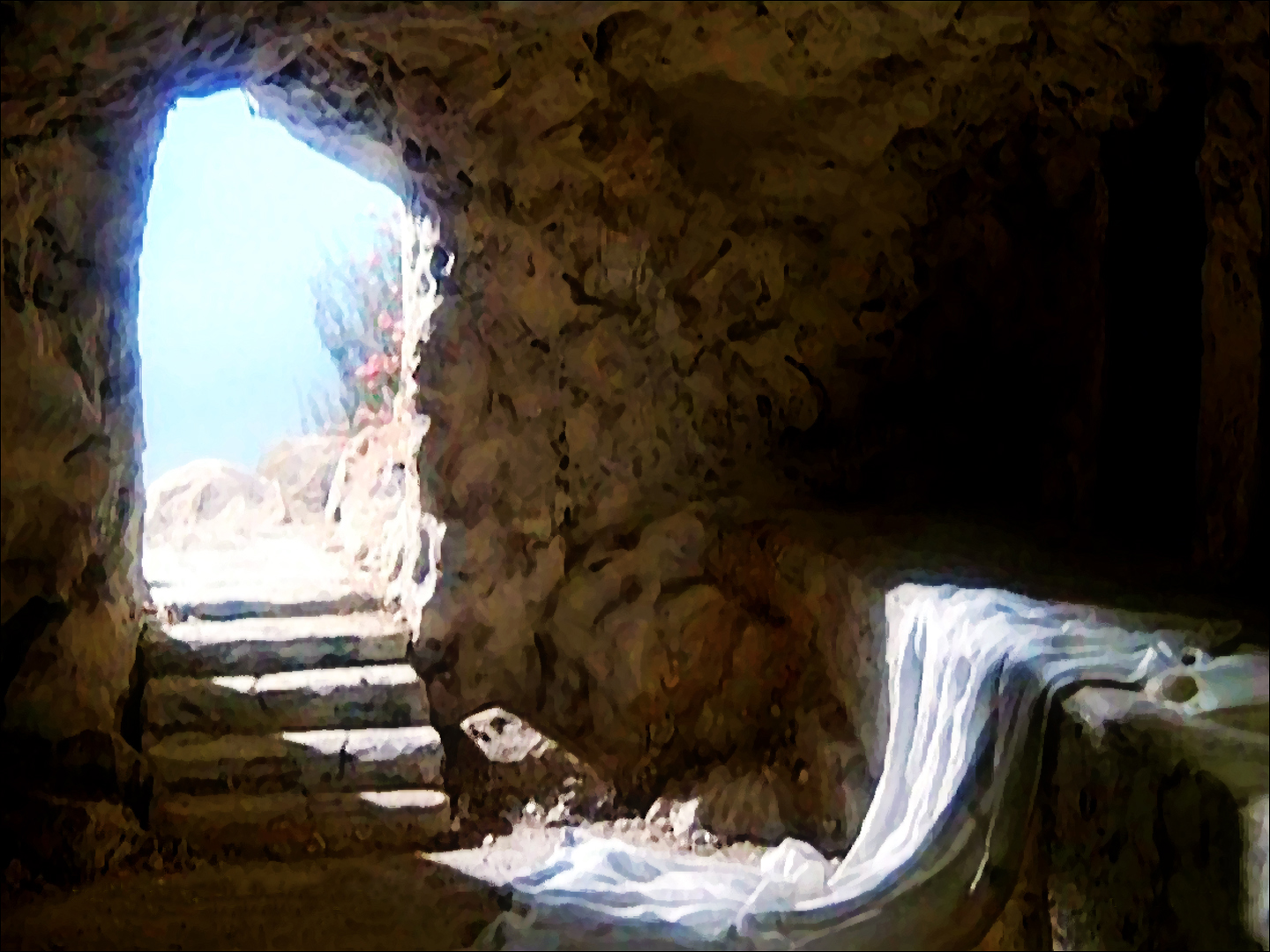
There’s only one thing that could be found that would challenge my faith – a tomb with Jesus’ body in it. But that’s not going to happen, because Jesus’ tomb was and is empty. Easter happened, and Jesus, whether married or not married, walked out of the tomb and proclaimed victory over death. That victory is my victory.  That victory is your victory.

And that is the Good News I’m holding on to and proclaiming this Holy Week.  The rest is hollow bunnies.

The-Empty-Tomb


Posted in Bible, Christianity, Uncategorized | Tagged , , , , | 3 Comments

“The Jesus Parade” – a Sermon for Palm Sunday

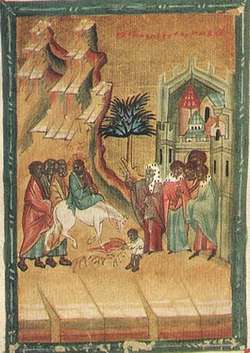
Palm_Sunday_Tver_15th_cJohn 12:12-27

Have you ever been to a Christmas parade? I remember going when my sister and I were little kids. We would get there early to get a spot where we could sit on the curb with mom and dad in lawn chairs behind us. We would take snacks and sometimes toys for the long wait, but time seemed to slow down as the hour for the parade got closer. We asked, “How much longer” over and over until my dad got tire of looking at his watch and told us, “It’ll get here when it gets here.”

Then, as time for the start of the parade finally arrived, I remember wondering how long it would take for it to get to where WE were sitting. I can still feel my eyes straining to see as far back up the street as I could, standing on tip-toe as I looked for the flashing red police car lights that were always at the head of the parade.

At the first sight of those flashing lights, the crowd lining the street would press a little closer and move around to get the best view of what was about to begin. Then, before you’d know it, that police car would be creeping by and the parade would have started! There were bands and floats and Shriners in little cars and clowns and horses and local celebrities in convertibles throwing candy to the crowd. It was great – especially when the bands would play a song instead of just marching along keeping the beat with their percussion.

As good as the whole Christmas parade was, it was all just a prelude for the Guest of Honor. I don’t mean the Grand Marshal, usually a local TV news anchor or some actor who’d moved out to California and gotten a few bit parts in movies or on television. Although one time I remember the Grand Marshall was one of the kids on “The Waltons” TV show; not John Boy, though, but rather one of the lesser Waltons. I don’t even remember if it was a boy or a girl.

But even John Boy wouldn’t have been bigger than the Man at the end of the parade – the one that everything had been building up for.

As the last of the floats crawled by and the final pooper scoopers cleaned up after the horses, you’d see that big ol’ sleigh heading toward you. And there he was, bundled in his bright red suit and waving a white-gloved hand, soaking up the adulation of the kids in the crowd – and even the adults.

Santa in the Disney ParadeSanta!

And along with every one of those kids I’d be imagining what Santa was going to bring me that year. What was he going to leave under my Christmas tree? Maybe a bike, or an electric football game, or something I hadn’t even imagined yet. And I’d make a mental note to try to be good extra good that year, and I sure hoped Santa would look down from that sleigh and see I was certainly a Good Boy, worthy of anything his elves could whip up . . .

And that’s what it must have been like for a lot of the crowd that turned out for the parade in Jerusalem on that first Palm Sunday.

They’d heard this rabbi from Nazareth did amazing things. What could he do for them? Could he heal them or their family members, feed them if they were hungry, make them rich?

Word had surely reached Jerusalem from Bethany, less than two miles away, that Jesus had brought a man back to life. That man had been in the tomb for four days – don’t you think that detail about how the corpse stunk had been part of the story that had been shared – and Jesus had called him out of that tomb and he had been alive!

It was Passover in Jerusalem. Jewish pilgrims had gathered for the festival from all over the Roman Empire and the city was bursting at the seams with people and excitement. What would Jesus do now? Certainly many who lined the streets waiting for the Jesus parade must have wondered what the next big show would be.

Some were hoping to see Jesus free the Jews from their Roman occupiers. After all, wasn’t much of what Jesus did and said in outright defiance of Rome – and if he could perform spectacular miracles, surely he could kick out the Romans.

Others were there because they had heard about those miracles – Jesus feeding thousands with a few loaves of bread and a few fish, walking on water, and casting demons out of people. And don’t you think word had spread ahead of the procession that Jesus had just, on the way into town, healed two blind men who could now SEE!

now you see me posterDid you see the movie, “Now You See Me” that came out last year? It was about four magicians – called “The Four Horsemen,” who did amazing magic. They had a big show in Las Vegas, and then one in New Orleans, and they announced a final show was going to happen on a rooftop in New York City. The people of New York had heard about their awesome magic, so thousands of people crowded around the building, abuzz with excitement about what The Four Horsemen might do next. They were hoping to be amazed.

Many in the crowd in Jerusalem that day were hoping to be amazed.

Those crowds waited for the Jesus parade in Jerusalem on that first Palm Sunday, standing on tip-toes and straining their eyes up the road toward the city gate to catch their first glimpse of Jesus and his followers on the way.

When Jesus finally arrived, they shouted “Hosanna” – which you heard in Children’s Time means “Save Us!” “Save us from sickness” or “Save us from money problems.” “Save us from Rome!” “Save us from boredom by showing us something amazing.”

“Just give us what we want. Just change our situation. Just show us a miracle. And then we’ll believe.”

It is easy to judge the crowds on that first Palm Sunday. But are they really so much different than you and me?

When we’re honest, we all want something from Jesus. Healing for us or a family member or a friend. Solutions to our financial issues. Restoration of our relationships. A bigger TV (okay, maybe not that one). Power, success, and so on.

And we may disagree about what’s wrong with our society and our government, but we all have ideas about how Jesus should fix it.

And we certainly would love to see a miracle – wouldn’t that be cool?

Now, don’t get me wrong – praying for healing, praying for a miracle, praying for societal change – there is nothing wrong with any of that. It’s what we’re supposed to do, really.

And sometimes we do get what we ask for. People get healed that doctors say shouldn’t have gotten well, or money miraculously shows up when we need it, or relationships get mended that seemed to have been over.

But miracles – at least the kind that fix our earthly problems – are the exception. That’s why they’re called miracles.

If you’re looking for me to explain this morning why miracles happen sometimes and they don’t other times, I can’t. I have no idea why one person is healed and another dies. I have no idea why one person’s job is saved and why another person loses their job and their home.

I don’t know why Jesus raised Lazarus from the dead but there were still thousands of others who died in Israel during his earthly ministry. I don’t know why he healed those two blind men on the way to Jerusalem while so many others were left not seeing.

What I do know is that Jesus did not enter Jerusalem that day to be Santa Claus – to give everyone what they wanted or even what they thought they needed. He didn’t march into Jerusalem to kick out the Romans and he didn’t show up simply to amaze everyone.

He came to Jerusalem for one thing . . . to die.

Actually, Jesus gave the people in Jerusalem that day exactly what they asked for. They shouted, “Hosanna” – “Save us!” And that is just what he did.

He saved them, and he saved us. He saved the world the only way he could. By dying.

So really, those who wanted something for themselves got it. They got forgiveness, and new life, and salvation.

Those who wanted a new kingdom got that, too. By dying, Jesus established a new kind of kingdom, a kingdom based on love rather than hate, on inclusion rather than boundaries, on giving rather than taking.

And those who wanted to be amazed – those who were looking for a miracle. They certainly got that!

If a miracle is a demonstration of great power, if it is something totally unexpected, if it is something that awes and amazes, what else can you call . . . Good Friday. (You thought I was going to say Easter, didn’t you . . . but that’s next week. As a professor of mine at seminary used to say, “Let’s not Easter over Good Friday. Let’s not lose what is remarkable and life-changing and world-altering about the crucifixion by rushing ahead to Easter.)

Sure, Jesus could have come into Jerusalem granted everyone’s wishes, or he could have an army of angels obliterate the Romans. He could have put on a really big show.

But none of that would not have been nearly as surprising – nor would it have had nearly as much impact – as his death of the cross.

The crucifixion was no temporary fix, it was no fleeting show. No matter how big the magic trick, no matter how big the miracle, eventually the crowds – and we are going to ask, “Okay, what’s next.”

On the Cross, Jesus said, “It is FINISHED.” Death, sin and satan were defeated once and for all. God was revealed more clearly on earth than God ever had been . . . or ever would be . . . revealed. On the Cross Jesus provided the ultimate picture of God’s self-sacrificing love for us, a love that even entered death.

So maybe lots of folks in Jerusalem turned out for the Jesus Parade for what we would say would be the wrong reasons. So maybe WE go to Jesus with selfish and self-centered requests.

But Jesus didn’t die for perfect people. Jesus died for those people shouting “Hosanna,” whatever their motivation.

Jesus died for us, not just in spite of but because of our flaws and our failures.

The crucifixion is God’s answer to our cries of “Hosanna!” “Save us!”

On the cross, Jesus did.

AMEN

Posted in Christianity, Sermon | Tagged , , , , | 2 Comments

Noah, the Film: A Rant, a Review, and a Recommendation

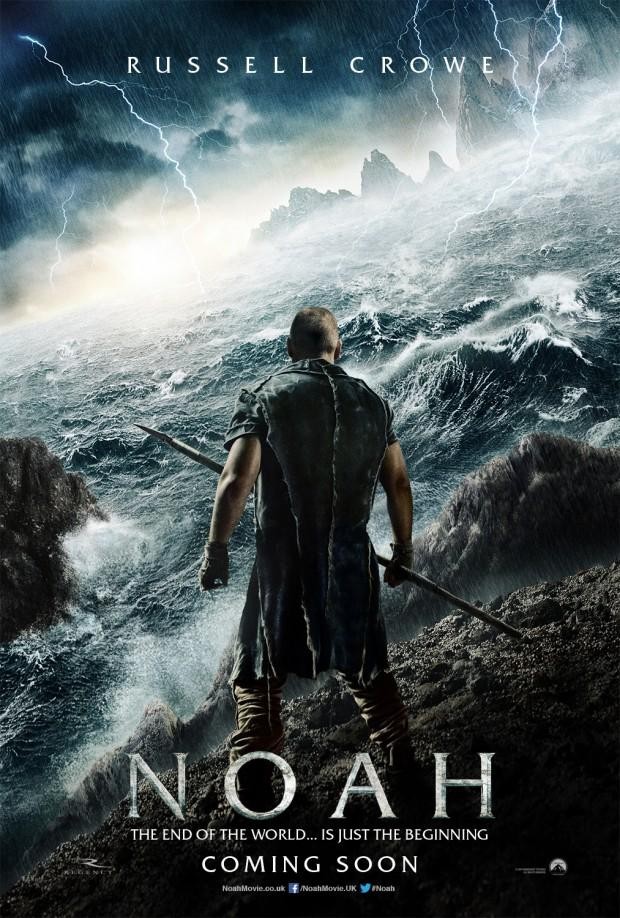
noah-movie-posterJustice and mercy. Those are the big themes of the new Darren Aronofsky version of Noah that opened to huge ticket sales and significant controversy this weekend. In the midst of big-budget CGI effects – supposedly the most complex ever produced by George Lucas’s Industrial Light and Magic – justice and mercy are explored in the character of Noah . . . and in the nature of God.

The Rant

You might be surprised to read anything about God in reference to this film. The usual Christian purveyors of pique (Wal Mart won’t say “Merry Christmas” to meeeee!) have been spreading the word to their faithful followers (donors) that God is not present in Noah. That is poppycock (this is mostly a family blog, so I didn’t use the first word that came to mind). True, the word “God” is never uttered. But there are countless references to “The Creator” that obviously refer to You Know Who.

Saying that Noah is not a movie about God is like saying the Bible Book of Esther is not about God because God’s name is never mentioned. (Trivia Extra – the only other book of the Bible without any reference to God is Song of Songs.) I didn’t count, but I would estimate “The Creator” is referred to, prayed to, cried out to, or otherwise invoked a couple dozen times or more.

The Review

As surely as Jacob by the Jabbok River, Noah wrestles with God.  Not physically like Jacob, but certainly his spiritual grappling with God is just as real.  And it’s not just the character of Noah doing the wrestling, but Noah the movie is a barbed-wire-steel-cage match. The contention is not over the existence of God, but about God’s goodness . . . or not. I agree with something my wife Karen said after we saw the film, “I think whoever directed this movie needs to reconsider whether they’re really an atheist.” It is true that Darren Aronofsky has identified himself as an atheist, but he certainly is contending with Something in this film.

The Creator in Noah is not the candy-coated God of Sunday School flannel-board arks. There is nothing wrong with telling stories to children on their level; my daughter’s room was decorated in a Noah’s Ark theme from infancy through Elementary School. But this is a grown-up version of the story, and of God. Sure, the animals are cool and many are cute, but Aronofsky does not shield us from the reality that two of every kind of animal being saved meant that countless other furry critters were drowned. And he makes us especially aware that one family safely on the ark left the rest of humanity clinging to whatever would float – or, in one memorable tableau, the last exposed shards of rocky peaks – in a desperate but fruitless effort to survive.

noah's arkPerhaps the most effective scene in the film occurs soon after the rain has begun and the ark has set sail. Noah and his family eat silently as the screams of the drowning masses reach them from outside the safety of the ark. I sat there in the theater wishing right along with the family in the ark that those shrieking pleas would cease, but knowing silence would mean they had all died.

In the unflinching portrayal of the deadly and destructive consequences of what has come to be called “Noah’s flood,” the film raises this question: What kind of God would unleash such horror on the world, and the creatures, that God has created? Is this “Creator” only about justice, or is there mercy to be found in his character?

Noah (the man) lives out this question. At first, he believes that he and his family have been saved because they are the only good people in a world where everyone else is depraved. It is only just that they be saved while everyone else perishes. But on the ark he realizes that those who have been spared are just as sinful (my word, not Aronofsky’s) as everyone else. At first, Noah takes this to mean that God intends for humanity – including Noah’s potential descendants – to cease after those on the ark finish the job of making sure “innocent” animals survive. Only able to see God’s justice, he is willing to go to extraordinary lengths to make sure that happens. But eventually (I’m trying to write this without spoiling some important plot points) Noah does give in to mercy, and in doing so begins to be aware of the Creator’s mercy.

This business about Noah being less-than-perfect may surprise some folks who have gotten the idea that God spared Noah because he was righteous. But that’s not exactly what the Bible says – it says that Noah found favor with (or received grace from) God and then after that he was blameless or righteous. Like Abraham and other Bible heroes, Noah was an imperfect man called out of God’s graciousness, not because he deserved it. In Christian terms, Noah was a sinner like everyone else, and was only righteous because of God’s action, not his. So I believe Noah gets Noah’s imperfection right, and also hints at God’s graciousness.

Noah is an intensely spiritual film. That being said, it is not a “Christian movie,” something that seems to have upset many earnest Christians (not just the Christian Industrial Complex referenced in the rant). But the story of Noah does not belong only to Christians – it was first, and still is, part of the Hebrew Scriptures. Aronofsky grew up inculcated in Judaism, so it is no surprise that his version of Noah is at its heart a type of Jewish Midrash, with its gap-filling storytelling and earnest grappling with the text.

charlton heston - 10 commandmentsSo Noah does not follow the Biblical texts exactly. That’s a good thing, because if it did we’d only have a fifteen minute or so movie, unless there was lots of time filled with shots of the ark drifting on the waves. The story only takes up three chapters in Genesis. The Bible was not written screen-ready; every Bible movie from The Ten Commandments to Son of God has had to add things that are not specified in Scripture to constitute any kind of a watchable film.

Certainly this Noah is much more faithful to the text than the 1990’s television movie, with its pirate battles and conflation with the Sodom and Gomorrah story which according to the Bible took place at least a thousand years later.

Some of the criticism of Noah has claimed the film has an environmental agenda.  That may be, but the environmental themes do not drown out the depiction of mankind before the flood pretty much as the Bible depicts – doing wanton evil.  In visits to the cities of man, Noah and members of his family find all manners of abuse going on, particularly of women and those who are weak. The film’s embodiment of evil, Tubal Cain, says that he is equal to the Creator because he can give life and take life. The environmental degradation depicted in Noah is more a symptom of man’s depravity than the primary evil.

The Recommendation

I’ve written about a thousand words and I haven’t answered the two most basic questions: Did I like it? Should you see it?

noah castThere were parts of Noah I liked very much. For the most part, the effects reflected the millions spent on them. Spiritually, I appreciated the depth of the questions raised.  The acting in general was quite good for what in many ways is an action-adventure genre film. Russell Crowe was excellent capturing Noah’s existential struggle. As Charlton Heston is to Moses, Russell Crowe is now to Noah. Jennifer Connelly was a serviceable Mrs. Noah (not named Joan of Ark, unfortunately), and Emma Watson gave a well-rounded performance as Noah’s daughter-in-law.

One unusual addition to the story by Aronofsky I didn’t appreciate at first are the Watchers.  These are stone giants that look, move and sound like cousins of the Ents in the Lord of the Rings series. Apparently they are Aronofsky’s vision of the giants and or Nephilim in Genesis; no one knows exactly what they were like so one can grant him artistic license. They seemed kind of ridiculous, but Aronofsky does use them skillfully in the story and I came to appreciate them when they become a recipient of the Creator’s (God’s) grace in a very surprising and beautiful way.

There were many derivative elements that detracted from my enjoyment of the film. I’m a big fan of Anthony Hopkins, but his Methuselah was so reminiscent of Gandalf that I couldn’t get Ian McKellen’s wizard out of my head when he was onscreen. Ham’s character arc reminded me too much of Edmund in The Lion, the Witch and the Wardrobe.

And then there was Tubal Cain. I’m not sure if it was Ray Winstone’s portrayal or the way the character was written, but I never really bought into his evil. The representation of everything about humanity that deserves destruction should have been more charismatic, more interesting. But all I could think of when Tubal Cain stowed away on the ark was Dr. Smith on the old Lost in Space television show (he stowed away aboard their flying saucer).  Hardly a menacing image.

So the answer to “Did I like it” is . . . mostly. I’m glad I saw it but it is certainly not one of my favorite films ever or even of the past year or so. I am not a big fan of big budget action-adventure movies and there were many elements of those kind of films in Noah.

So, should you see it?

We saw Noah on an Imax-size screen. If you can see it under those conditions, it is certainly worth the time and money. It is an epic film that should be seen in the theater and will definitely lose something on smaller screens.

I also think it is valuable for Christians to go see Noah so they can talk about it with non-Christians.  Unlike movies like Son of God and God’s Not Dead that mostly “preach to the choir,” Noah will be seen by many unChristians. It provides an opportunity not only or even primarily for evangelism, but for just plain conversation with folks who believe something different.

A place to start a discussion might be in the beginning. When Noah and his family are on the ark, Noah says that he will tell them the first story he heard.  It is the story of creation and the fall told, except for a blurring of some of the six days, with great reverence for the Genesis text. The accompanying, ultra-real visuals depict the progress of creation and of life, in a way that leaves ambiguous whether this is happening over a few days or over millions of years. It is a beautiful, and thought-provoking few minutes, well worth viewing and discussing, like a great deal of Noah.


You can read Karen’s review of Noah here.

Posted in Christian Living, Christianity, Movies | Tagged , , , , | 9 Comments

Forbidden Brownies (Our Story)

In our bickering about whether Genesis 3 is literally true or allegory, we miss the real Truth: either way, Genesis 3 is Our Story . . .

brownies piece missingOnce upon a time, my mom made the most amazing brownies.  When they were cooking the whole house would smell like a big ol’ Hershey bar.  My mouth would water in anticipation of the timer’s “Ding” that would signal the wait was almost over.  Just a few minutes to cool, and then . . . chocolate nirvana!

One afternoon when I was in middle school mom pulled a pan of deliciousness out of the oven and put it on a dish towel laid out on the counter.  I hovered nearby and waited to hear Just How Long I would have to wait.  Mom picked up her purse, “I’ve got to run to the store.”  Then she uttered the saddest words I knew, “Don’t touch these.  I’m taking them to work tomorrow.”  Then she added, “There’s plenty of other good stuff for you to snack on.”

♦♦♦

Once upon a time, God placed Adam and Eve in the Garden of Eden.  They had everything they would ever need, and, more than that, all that they could ever want.  Almost.  God only gave them one rule – “Don’t eat fruit from the Tree of Knowledge of Good and Evil.  You’ll die if you do.”

At some point after that, the Tempter came to Eve in the form of a snake.  The writer of Genesis doesn’t tell us how long Adam and Eve were in the garden before this happened, but my guess is that if God made the rule in the morning, they were tempted to break it by that afternoon.  That’s how we humans are. 

Tempter-snake asked, “Did God really say you couldn’t eat any fruit?”  Eve answered, “We can eat anything but the fruit from that one tree.  God will kill us if we eat it.”

♦♦♦

Soon after my mom left, my friend Dustin (name changed to protect the not-so-innocent) stopped by.  The aroma hit him as soon as he walked in the door, “Brownies!”  With their siren-song aroma and promise of cocoa ecstasy, the brownies drew him over to where they were cooling.  “Let’s have some.”

“We can’t.”

“Your mom never lets you have anything!”

“There are some Pop Tarts in the pantry.  And some Chips Ahoy.  Anything else.   Mom will kill me if we get into those brownies.”

“Your mom’s not going to kill you!  She just wants to keep all the good stuff for her and her friends.”

♦♦♦

You’re not going to die if you eat that fruit,” Tempter-snake said. “God just doesn’t want you to be like, well, God.  God wants to keep that good and evil knowledge to himself.”

Eve took another peek at the fruit on the taboo tree.  It looked so tasty!  And good and evil . . . she had no idea what that meant but why shouldn’t she and Adam know everything God knows?

So she picked one, and she took a bite.

♦♦♦

Dustin spoke truth.  I had a right to those brownies. Mom was just being selfish.  They looked and smelled so yummy. 

So I cut two out two brownie squares.  I gave one to Dustin.  And we ate.  Gosh they were good!

♦♦♦

Eve passed the fruit to Adam, who was right there with her.  Yes, Adam was there all the time. He was just as culpable as Eve.  (Sorry guys, it wasn’t all the woman’s fault!)  Maybe more guilty, as he stood back and waited to see what would happen to Eve before he ate.  (Just like a man, some of you women may be saying.)

Tempter-snake got out of there quick.  Adam and Eve knew right away they’d messed up.  For the first time ever, they knew what it meant to be embarrassed.  They tried to hide themselves by sewing leaves together and wearing them. 

Then they heard God coming.  What had always before been a sweet anticipation had become another new sensation.  It couldn’t be just the bit of fruit in their bellies that made their stomachs turn just then.  As ridiculous as it was, they tried to hide from God in the lushness of the garden.

“Where are you?” God called out. Of course God knew the answer to that.

♦♦♦

Dustin was out the back door as soon as we heard mom’s car pull into the driveway.  I fled to my room, shut the door, and put on a Pink Floyd record.  I covered my ears with headphones and tried to look nonchalant, lost in “Wish You Were Here.”

My mom knocked.  “Are you in there?”  Of course she knew the answer to that.

♦♦♦

Adam peeked out of the underbrush.  “Here I am.  I heard you coming.  But I was naked so I hid.”

“WHO TOLD YOU THAT YOU WERE NAKED?”  It had never been an issue before.  There had been no guilt to cover.  “Did you eat from that tree I told you not to touch?”

“It was the woman . . . the woman you made to be with me.  She gave it to me and I ate it.”  You may think Adam was blaming Eve, but hear what he said again.  “The woman you made . . .” Adam indicted God!

♦♦♦

Oh.  Hi mom.  I came in here because I didn’t want to get blamed for the brownies getting eaten.”

“And who ate them, gremlins?”

“Look, mom.  You did such a great job making those brownies.  They smelled soooo good.  They were perfect.  I couldn’t help it.  You never should have left them there.  You know I couldn’t resist.”

“So it’s my fault?”

“Dustin.  It was Dustin’s idea. Dustin made me.”

♦♦♦

God asked Eve what had happened.

“The devil made me do it,” Eve answered.

 ♦♦♦

Neither God nor my mom bought the excuses or the fingers of blame.  Adam, Eve, and I were all punished.

But we were also forgiven, and neither God nor mom stopped loving their children.

♦♦♦

The worst punishment of all was for Tempter-snake.  A Descendant of Adam and Eve’s would crush him and his sin-and-death power once and for all as He died on a cross.  God would do this for us even though this is our story, the Truth of who we are.

THE END

Posted in Bible, Christianity | Tagged , , , , | 6 Comments